World
Did Iran ask Donald Trump to be next supreme leader? Here’s a fact check

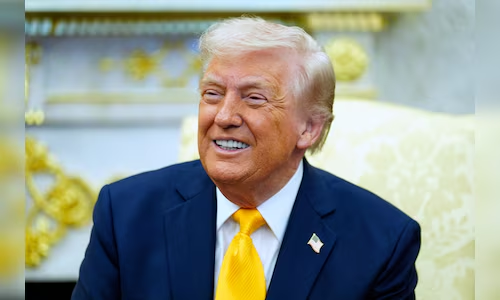
No one wants to be the supreme leader of Iran for fear of being killed by the United States, President Donald Trump has said. But that’s not true.
The US-Israeli war on Iran that began on February 28, assassinated Supreme Leader Ali Khamenei. His son, Mojtaba, has been appointed successor by the state.
“There’s never been a head of a country that wanted that job less than being the head of Iran,” Trump said at the National Republican Congressional Committee (NRCC) fundraising dinner in Washington.
“We’ll listen to some of the things they say we hear very clearly.”
“They say, ‘I don’t want it’,” he said, mimicking Iranians. “‘We’d like to make you the next Supreme Leader.’ ‘No, thank you. I don’t want it’,” the US President mocked.
???? BREAKING: President Trump just confirmed Iran is on its KNEES, crying for a deal, but they can’t say anything PUBLICLY out of fear they’ll be killed
“We’d like to make you the next Supreme Leader! NO THANK YOU, I don’t want it!” ????“They are negotiating, by the way, and they… pic.twitter.com/zbNvGyjspy
— Eric Daugherty (@EricLDaugh) March 25, 2026
“They are negotiating, by the way, and they want to make a deal so badly, but they’re afraid to say it because they figure they’ll be killed by their own people. They’re also afraid they’ll be killed by us,” Trump said.
Earlier, in a Truth Social post, Trump described Iranian negotiators as “very different” and “strange” and accused them of “begging” the US to make a deal to end the war that has raged for nearly four weeks.
“They better get serious soon, before it is too late, because once that happens, there is NO TURNING BACK, and it won’t be pretty!” Trump said.
ALSO READ | Trump to hit Iran harder if Tehran does not accept defeat, White House says
While the US claims talks have been underway, Iran denies any direct discussions with Washington.
Iranian Foreign Minister Abbas Araghchi told state media officials were reviewing an American proposal but said that exchanging messages “does not mean negotiations with the US.”
The US reportedly submitted a 15-point proposal, aimed at ending hostilities. According to the plan, Iran would be asked to renounce nuclear weapons, limit its missile programme, stop funding regional proxies like Hezbollah, Hamas, and the Houthis, and reopen the Strait of Hormuz to international shipping. In return, sanctions would be lifted.
ALSO READ | Trump says Iran made a major energy-related gift to the US
Following that, Araghchi laid Iran’s five-point counter-proposal of their own:
- A complete halt to attacks and assassinations by US and Israeli forces.
- Guarantees that the war would not be resumed.
- Payment of war damages and reparations.
- Sole Iranian control over the Strait of Hormuz.
- An end to Israeli attacks on Iranian allies in the region.
The unprovoked war following US and Israeli air strikes has since expanded as Iran, in retaliation, targeted American allies in the Gulf.
Click here for LIVE Updates on the West Asia war


Late Senator Mpigi served with dignity, devotion – Akpabio

'Age difference, limited language…': Immigration attorney flags rising risks in marriage-based Green Cards

Iran war major update for Strait of Hormuz as US forces begin new urgent operation

Police unseal PDP headquarters, enforce court order

JUST IN: FG names 48 individuals, groups ‘linked’ to terrorism financing

Full List: FG Releases Names Of Individuals, Groups Financing Terrorism

London’s Primrose Hill stabbing: Two arrested over killing of 21-year-old student filmmaker

 Breaking2 weeks ago
Outrage as video of secondary school students in Benue state str!ping their classmate surfaces online
 News2 weeks ago
I Joined A Cult, Worked So Hard For Demons – Tonto Dikeh Confesses While Ministering (Video)
- News2 weeks ago
Heartbreaking Story Of 300-Level Ekiti University Student Who Was K!lled After Truck Crashed Into His Building (Video)
- News2 weeks ago
WAEC Releases 2026 WASSCE Timetable (Full List)
- Breaking6 days ago
Mother Abandons 4 Children with Neighbor and Disappears for Months — Shocking Case Raises Questions
- Breaking2 weeks ago
Singer Flavour shows off Italian woman and vows to shower her with so much love that she’ll have no choice but fall in love (video)
- National2 weeks ago
Environmental Sanitation: Lagos meets with LG, LCDA bosses
- World3 days ago
Trump LIVE: Iran war bombshell as Trump could be 'removed from Presidency'