World
Earth’s energy imbalance hits record high in 2025, signals deepening climate crisis

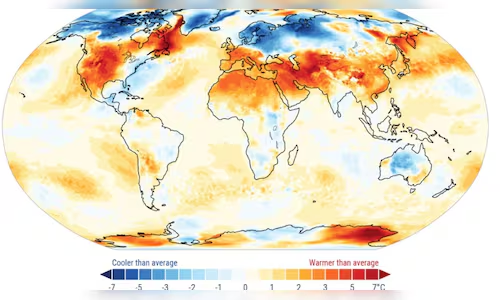
A recent report, State Of Global Climate Report 2025, by the World Meteorological Organization (WMO) reinforces this reality, identifying Earth’s energy imbalance as a critical driver of the crisis.
The report places renewed focus on this imbalance as a key climate indicator, noting that it reached a record high in 2025 — underscoring the accelerating disruption caused by human-driven greenhouse gas emissions.
The imbalance means more heat is being trapped in the Earth system, driving long-term warming trends.
What is Earth’s energy imbalance?
Earth’s energy imbalance refers to the difference between incoming solar radiation and outgoing heat from the planet, according to WMO. Under stable conditions, this balance is roughly equal.
However, rising concentrations of heat-trapping gases such as carbon dioxide, methane and nitrous oxide — now at their highest levels in at least 800,000 years — have significantly altered this equilibrium.
“Scientific advances have improved our understanding of the Earth’s energy imbalance and of the reality facing our planet and our climate right now,” said Celeste Saulo. “Human activities are increasingly disrupting the natural equilibrium and we will live with these consequences for hundreds and thousands of years.”
The report said that the imbalance has been rising since observations began in 1960, with a sharp acceleration over the past two decades.
This excess energy is not evenly distributed: more than 91% is absorbed by the oceans, around 5% is stored in land, 3% contributes to melting ice, and warming of the atmosphere including near the Earth’s surface (the temperatures that humans feel) represents just 1% of the excess energy.
According to WMO, the growing imbalance is closely tied to record-breaking ocean heat content, which hit a new high in 2025, continuing a streak of annual records over the past nine years.
The rate of ocean warming between 2005 and 2025 has more than doubled compared to the 1960-2005 period, reinforcing the ocean’s role as a critical but increasingly strained buffer against global warming.
The report also confirms that the past 11 years, from 2015 to 2025, have been the warmest on record, with 2025 ranking as the second or third warmest year depending on datasets. Global temperatures in 2025 were estimated at 1.43°C above pre-industrial levels, while 2024 remains the hottest year recorded.
Greenhouse gases at record highs
Atmospheric concentrations of key greenhouse gases continue to rise. In 2024, carbon dioxide levels reached their highest in the last 2 million years, while methane and nitrous oxide hit their highest levels in 800,000 years.
The increase in CO2 concentration in 2024 was the largest since modern measurements began in 1957. Real-time observations indicate that levels of all three gases continued to increase in 2025.
During 2015–2024, about 50% of CO2 emissions remained in the atmosphere, while oceans absorbed 29% and land sinks accounted for 21%.
This has contributed not only to rising temperatures but also to ocean acidification. Oceans absorbed around 29% of CO2 emissions between 2015 and 2024, contributing to a steady decline in global average ocean surface pH over the past 41 years.
There is very high confidence that current surface pH levels are unprecedented in at least 26,000 years, according to the Intergovernmental Panel on Climate Change (IPCC).
The decline in pH is not uniform, with the largest decreases observed in the Indian Ocean, Southern Ocean, eastern equatorial Pacific, northern tropical Pacific and parts of the Atlantic. Ocean acidification is already affecting biodiversity, ecosystems and food production from fisheries and shellfish aquaculture.
Ice melt and sea-level rise accelerate
The excess energy is also driving cryospheric changes. About 3% of the additional heat is used to warm and melt ice.
Both Greenland and Antarctic ice sheets continue to lose mass, while Arctic sea-ice extent in 2025 was the lowest or second lowest in the satellite record. Exceptional glacier mass loss was reported in Iceland and along the Pacific coast of North America.
Also Read: Early Southwest heat latest in parade of weather extremes as Earth warms
These changes are contributing to long-term sea-level rise, which has accelerated since satellite observations began in 1993.
“On a day-to-day basis, our weather has become more extreme. In 2025, heatwaves, wildfires, drought, tropical cyclones, storms and flooding caused thousands of deaths, impacted millions of people and caused billions in economic losses,” said Celeste Saulo.
India angle: Rising heat stress and vulnerability
While the report does not directly outline country-specific impacts, its findings carry serious implications for India, according to Vishwas Chitale, Fellow at the Council on Energy, Environment and Water (CEEW).
Chitale said that the WMO’s assessment confirms that recent years have been the warmest on record globally, with most of the excess heat now being absorbed by the oceans, accelerating long-term warming and contributing to rising humidity levels worldwide.
He said heat extremes are no longer isolated events but part of a rapidly intensifying climate system, reflected in higher daytime temperatures, more warm nights, longer heatwaves and rising humidity levels that heighten risks to human health.
Referring to a CEEW study, Chitale explained that nearly 60% of districts in India face high to very high risk from extreme heat.
He added that, as a tropical nation with high population density and a large outdoor workforce, India is already close to physiological limits of heat tolerance. Rising temperatures combined with increasing humidity are likely to intensify heat stress, with impacts on health, labour productivity and local economies.
Chitale highlighted the need for a long-term approach to heat resilience, including strengthening heat-health early warning systems, implementing localised heat action plans, and investing in cooling solutions and public health preparedness.
Also Read: Climate change could drive millions globally into physical inactivity by 2050: Study


World Bank deletes report about Nigeria’s development from its website three days after release

Evaluating Peter Obi’s mental, physical fortitude for the task ahead, by Ike Abonyi

Cuba to free 2,010 prisoners in ‘humanitarian gesture’ amid US oil blockade
Cuba to free 2,010 prisoners in ‘humanitarian gesture’ amid US oil blockade

Transcorp speaks on ‘cancellation’ of ADC’s booking

Nigerian Breweries confirms no casualties after Aba fire incident

Dozens of nations are searching for a diplomatic solution to the Hormuz blockade

 News1 year ago
Abiodun attracts battle line: Ogun gained’t cede Ode-Omi, Makun to Lagos, Ondo
- News1 year ago
Engr. Sheriff Daramola Elected as fifteenth President of IFMA Nigeria Chapter
- Business1 year ago
Marketsquare expands with two new shops in Lagos
- Business1 year ago
MTN implements 50% tariff hike, raises knowledge costs
- Business1 year ago
MDAs should prioritise capability constructing in public service reforms – BPSR DG
- Politics12 months ago
Yobe gov not becoming a member of coalition — Aide
- Business11 months ago
GTCO Shareholders Approve N8.03 Per Share Dividend Payout
- Business1 year ago
The Rabiu Impact: Why Energy and Status Patronize BUA Boss