World
Saudi Aramco boss pulls out of major international energy conference due to Iran conflict

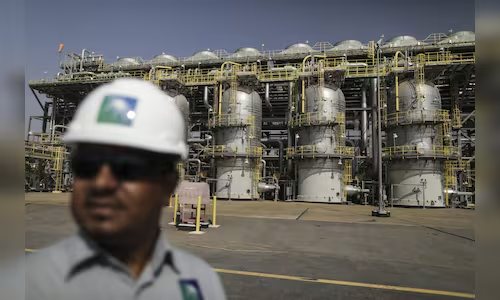
CERAWeek, which is organised by S&P Global and begins on Monday, draws top executives, government officials and policymakers from around the world to discuss the global energy market outlook.
Nasser’s withdrawal highlights the scale of the challenge he faces in dealing with the Iran crisis. An S&P Global spokesperson did not have an immediate comment and said any program updates would appear on the published agenda online.
The conflict, now in its fourth week, has killed more than 2,000 people, upended global markets and spurred Iranian retaliatory strikes that have effectively shut the Strait of Hormuz and targeted Gulf energy infrastructure, including Aramco’s.
US President Donald Trump and Iran have threatened to escalate the war, targeting energy and fuel facilities in the Gulf. Trump on Saturday threatened to bomb Iran’s power plants if Tehran did not fully reopen the Strait, through which a fifth of the world’s oil supplies normally flow.
Also Read: Treasury’s Bessent says US has ‘plenty’ of funds for Iran war
Sheikh Nawaf Al-Sabah, CEO of state-owned Kuwait Petroleum Corporation, will also not attend the Houston gathering but will join a Tuesday session at the conference virtually from Kuwait, a separate source said.
ENERGY INSTALLATIONS UNDER ATTACK
Aramco is facing its biggest crisis since the COVID-19 pandemic and the 2019 attacks on Aramco’s Abqaiq and Khurais facilities that temporarily knocked out more than half of Saudi crude output.
During a March 10 earnings call, Nasser told reporters there would be “catastrophic consequences” for the world’s oil markets if the Iran war continues to disrupt the Strait of Hormuz.
To bypass the strait, Aramco is piping millions of barrels per day (bpd) of crude from its east coast to its west coast. It has cut oil output by about 2 million bpd from two fields, Reuters has reported.
The alternative route means tankers load at the Red Sea port of Yanbu, which temporarily stopped loadings last week, sending prices surging, after a ballistic missile interception and drone strike at an adjacent refinery.
The SAMREF refinery, an Aramco-Exxon joint venture, was struck by a drone on March 19, when Iran targeted energy installations across the Gulf – including Kuwait’s – in response to Israel’s strikes on its South Pars gas field.
That wave of attacks hit Qatar’s Ras Laffan liquefied natural gas complex, with QatarEnergy’s chief telling Reuters 17% of Qatar’s LNG capacity would be offline for up to five years.
KEY ABU DHABI EXECUTIVES
Abu Dhabi wealth fund Mubadala is unlikely to have any representatives at the event, a source familiar with the matter said.
It was not immediately clear if Sultan Al Jaber, CEO of the UAE’s oil company ADNOC, would attend in person. He is listed as a speaker on the event website. ADNOC did not immediately respond to a request for comment.
At last year’s conference, Jaber said it was time to “make energy great again,” mirroring Trump’s Make America Great Again slogan while pledging large investments in the U.S. by ADNOC’s international investments arm XRG.


Former VP Osinbajo Gets International Appointment

OAU hails First Lady for donation of 50 buses, 30 tricycles

South Africa deports three Nigerians over ‘insulting’ social media posts about government

‘You’ve made history’ – Trump praises Artemis astronauts

Police reunite missing teenager from Spain with family

Two UBA leaders shine at 2026 Guardian Women Festival

COAS boosts troop morale with easter luncheon in Edo

 News1 year ago
Abiodun attracts battle line: Ogun gained’t cede Ode-Omi, Makun to Lagos, Ondo
- Business1 year ago
Marketsquare expands with two new shops in Lagos
- News1 year ago
Engr. Sheriff Daramola Elected as fifteenth President of IFMA Nigeria Chapter
- Business1 year ago
MTN implements 50% tariff hike, raises knowledge costs
- Business1 year ago
MDAs should prioritise capability constructing in public service reforms – BPSR DG
- Politics11 months ago
Yobe gov not becoming a member of coalition — Aide
- Business11 months ago
GTCO Shareholders Approve N8.03 Per Share Dividend Payout
- Business1 year ago
The Rabiu Impact: Why Energy and Status Patronize BUA Boss