World
West Asia war | Oil may not return to $80 anytime soon despite ceasefire hopes, says energy analyst Art Berman

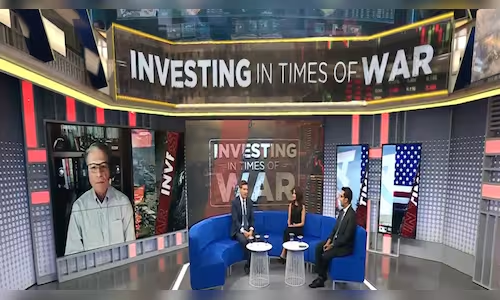
Berman said that even in the most optimistic scenario where hostilities end quickly, “the very best case is maybe $80 Brent”, adding, “I do not believe everything will end tomorrow, or that we will get back to $80 any time soon.” He stressed that a “permanent risk premium” of at least $10 per barrel is now embedded in oil markets, with prices likely to remain elevated through 2026 within a broad $100–$150 range flagged by BlackRock.
His comments come amid continued uncertainty on the ground, with Ben Powell, Chief APAC & Middle East Investment Strategist at BlackRock Investment Institute cautioning against reading too much into recent diplomatic signals. While markets have reacted to softer rhetoric from Donald Trump, Powell said the situation remains “still very tense”, pointing to ongoing drone and missile attacks and the arrival of US Marines in the region.
“I think we need to be careful about being too confident and too optimistic because, sadly, the facts on the ground continue to be quite alarming,” Powell said, adding that recent developments feel “more like an escalation… than a de-escalation”.
Berman echoed that view, stating, “I see no de-escalation; I see more potential for escalation,” and described current diplomatic messaging as “purely performative”. He added that Iran’s strategic leverage over the Strait of Hormuz will continue to shape outcomes, making a quick resolution unlikely.
On supply dynamics, Berman said efforts by countries to build or release petroleum reserves would have limited impact, calling it “a rounding error” compared with the scale of potential supply disruption. Even if tensions ease by mid-year, he warned that economic damage could linger and potentially push the global economy towards a slowdown.
Overall, both experts indicated that while ceasefire hopes may support sentiment intermittently, underlying risks to oil supply and regional stability remain firmly in place, keeping crude prices structurally elevated.
Also Read | Conflict far from over; oil to carry lasting premium as risks escalate: Experts
Below is the edited excerpt of the discussion.
Q: So it’s a simple question with not such a simple answer, I guess: is the world winding down? Ben, what’s your sense?
Powell: I recognise there’s a degree of optimism in the air over the last 24–48 hours, as the US President has made warmer noises and spoken about his hope for a deal, a 15-point plan and so forth. So I recognise that the market is responding to that, and it’s definitely relevant and interesting. However, we have to observe what is happening on the ground. I live in Abu Dhabi; the drone strikes have continued. The missiles have continued, and the US Marines, I believe, arrived later this week. So I think the situation is, frankly, still very tense. The facts on the ground are mostly unchanged. Indeed, it feels more like an escalation in the last week than a de-escalation. So I recognise President Trump’s words. Of course, I’m watching with huge interest, both as a resident of the UAE and as a markets professional, but I think we need to be careful about being too confident and too optimistic because, sadly, the facts on the ground continue to be quite alarming. There is the potential for this to continue and worsen, with attacks on physical infrastructure. Just overnight, we had an attack on Kuwaiti airports, with a fuel depot struck there. So I recognise President Trump’s words as very important—he is the most powerful man in the world—but the facts on the ground continue to be unsettling, and that has not changed in the last 24–48 hours.
Q: If I can get Art Berman into the conversation as well—Art, same question to you. Do you believe the war is winding down? Ben, of course, is cautious. I just wanted to get your sense, because things have moved over the last 48 hours or so, and many believe directionally this is the first sign that things are starting to cool down and that we are de-escalating rather than escalating.
Berman: I think Ben has summarised it very well. My view is that I see no de-escalation; I see more potential for escalation. I think the words from President Trump are purely performative. It is very difficult for your negotiating partner to take you seriously when you are moving combat units into the area. I think Trump is managing this like a reality television programme. He needs lots of plot twists and interesting, spicy developments to keep everyone engaged. But at the end of the day, I see only escalation in the coming weeks.
Q: So, Art, what is your base-case scenario right now? And in that event, where do oil prices end up? The best case is that perhaps the conflict ends in the next couple of days. In that scenario, where do you think oil prices will settle? Because even if the conflict ends, there are facilities that are damaged and will not come back on stream immediately. And even if there is a ceasefire, there will be uncertainty surrounding that. There will be a geopolitical risk premium attached. So give me your base case, worst case and best case.
Berman: Obviously, no one knows the answer to that, but this is about informed speculation. For instance, Ben’s boss just came out this morning and said $100–$150 is BlackRock’s base case. I see that as a possibility. But let me make it very clear: there will now be a permanent risk premium on oil, regardless of how this ends. I would say that premium is no less than $10 per barrel. So if everything ends tomorrow, the very best case is maybe $80 Brent. Now, I do not believe everything will end tomorrow, or that we will get back to $80 any time soon. My bottom line is that this is a probability distribution. Somewhere in BlackRock’s range is reasonable for the rest of 2026. In the longer term, when all this trickles into the global economy, prices may fall as the global economy weakens.
Q: Several nations, considering the energy shock, are likely to increase their purchase and storage of petroleum reserves. How much can that push up prices?
Berman: We are talking about a few million barrels a day. Even if all storage could be released at once—which it cannot—let’s say 3 million barrels versus a 17 million barrel shortfall; it is a rounding error. I am not saying it is insignificant, but it does not make a major difference. It is an urgent situation.
Q: None of you believe this is ending anytime soon. Are we watching the same news? Or do you not believe what President Trump is saying?
Powell: A couple of things. President Trump is sophisticated, so it is possible he is buying time for the Marines to arrive. Secondly, the US is the world’s hyperpower, but it is not the only player. The Gulf countries have faced thousands of drones and missiles and may not be in a conciliatory mood. The same could apply to Iran. So it is not obvious that parties will simply shake hands.
Q: The betting market shows 60% odds that the war will end by mid-May.
Berman: As an American, I can say Trump does not always tell the truth. I discount what he says as performative. Iran currently holds enormous strategic leverage due to the Strait of Hormuz. It is not going to give that up without extracting a cost. Even if fighting stops by mid-May, the damage could already push the global economy towards recession.
Q: Iran has said it will allow non-hostile ships through the Strait. Is that a pivot?
Berman: Iran also uses strategic messaging. It may be trying to establish a tolling mechanism to assert control and gain revenue. Even then, the volumes would be insufficient relative to global demand.


Iran war LIVE: Kharg Island 'under fresh attack' after Trump's chilling warning

Nigeria, Jamaica, others at risk of UK visa ban

US-Israeli Strike Reportedly Destroys Synagogue In Tehran

Alfred Temile: Advancing Africa’s place in global energy transition

Russia brutally mocks Trump as Iran 'has him by the golf balls'

Panic in Mallorca over calls for a new £13 tourist tax – 'now is not the time'

NARD suspends nationwide strike; resident doctors resume on Wednesday.

 News1 year ago
Abiodun attracts battle line: Ogun gained’t cede Ode-Omi, Makun to Lagos, Ondo
- Business1 year ago
Marketsquare expands with two new shops in Lagos
- News1 year ago
Engr. Sheriff Daramola Elected as fifteenth President of IFMA Nigeria Chapter
- Business1 year ago
MTN implements 50% tariff hike, raises knowledge costs
- Business1 year ago
MDAs should prioritise capability constructing in public service reforms – BPSR DG
- Politics11 months ago
Yobe gov not becoming a member of coalition — Aide
- Business11 months ago
GTCO Shareholders Approve N8.03 Per Share Dividend Payout
- Business1 year ago
The Rabiu Impact: Why Energy and Status Patronize BUA Boss