World
World could face worst energy crisis in decades, warns IEA chief Fatih Birol

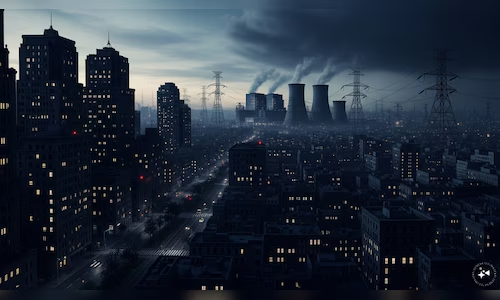
Speaking at the National Press Club in Australia’s capital on Monday, March 23, Birol warned that escalating tensions and conflict in West Asia have significantly disrupted global oil supplies, posing a serious threat to the global economy.
Birol highlighted that the scale of the current disruption surpasses historic oil shocks. He noted that while the oil crises of the 1970s led to a combined loss of around 10 million barrels per day, the present situation has already resulted in a loss of approximately 11 million barrels per day.
“Many of us remember the two consecutive oil crises in the 1970s… at that time, in each of the crisis, the world has lost about five million barrels per day, both of them together, 10 million barrels per day. As of today, we lost 11 million barrels per day, so more than two major oil shocks put together,” he was quoted as saying by France 24.
He described the ongoing crisis as ‘very severe,’ emphasising that its impact could exceed that of previous global energy disruptions.
The IEA is currently in discussions with governments across Asia and Europe regarding the possible release of additional oil “if necessary”, he said. “If it is necessary, of course, we will do it. We look at the conditions, we will analyse, assess the markets and discuss with our member countries,” the Executive Director was quoted as saying by Reuters.
Earlier this month, member countries agreed to release a record 400 million barrels of oil to counter rising global prices. However, Birol clarified that no specific crude price level would trigger another release.
The crisis has been exacerbated by geopolitical tensions, including conflict involving Iran and the closure of the Strait of Hormuz—one of the world’s most critical oil transit routes. Birol stressed that reopening the strait would be the most effective step toward easing the situation.
He further warned that the global economy faces a ’major threat’ if the crisis continues to escalate.
He warned that at least forty energy assets had been “severely or very severely” damaged in the Middle East. Birol cautioned that no country would be immune to the consequences, calling for urgent international cooperation to address the crisis.
The chief of the IEA further said, “The global economy is facing a major, major threat today, and I very much hope that this issue will be resolved as soon as possible. No country will be immune to the effects of this crisis if it continues to go in this direction. So, there is a need for global efforts.”
Meanwhile, US President Donald Trump issued a stark ultimatum to Iran on Saturday, threatening to ‘obliterate’ its power facilities if Tehran does not completely reopen the Strait of Hormuz within 48 hours. Iran responded by threatening to target US infrastructure in the Gulf, particularly oil and desalination facilities, if Washington followed through on its threats.


Former VP Osinbajo Gets International Appointment

OAU hails First Lady for donation of 50 buses, 30 tricycles

South Africa deports three Nigerians over ‘insulting’ social media posts about government

‘You’ve made history’ – Trump praises Artemis astronauts

Police reunite missing teenager from Spain with family

Two UBA leaders shine at 2026 Guardian Women Festival

COAS boosts troop morale with easter luncheon in Edo

 News1 year ago
Abiodun attracts battle line: Ogun gained’t cede Ode-Omi, Makun to Lagos, Ondo
- Business1 year ago
Marketsquare expands with two new shops in Lagos
- News1 year ago
Engr. Sheriff Daramola Elected as fifteenth President of IFMA Nigeria Chapter
- Business1 year ago
MTN implements 50% tariff hike, raises knowledge costs
- Business1 year ago
MDAs should prioritise capability constructing in public service reforms – BPSR DG
- Politics11 months ago
Yobe gov not becoming a member of coalition — Aide
- Business11 months ago
GTCO Shareholders Approve N8.03 Per Share Dividend Payout
- Business1 year ago
The Rabiu Impact: Why Energy and Status Patronize BUA Boss