World
200 ancient sites discovered in Greece reveal 6,000 years of hidden human history

This Video Is Trending Right Now
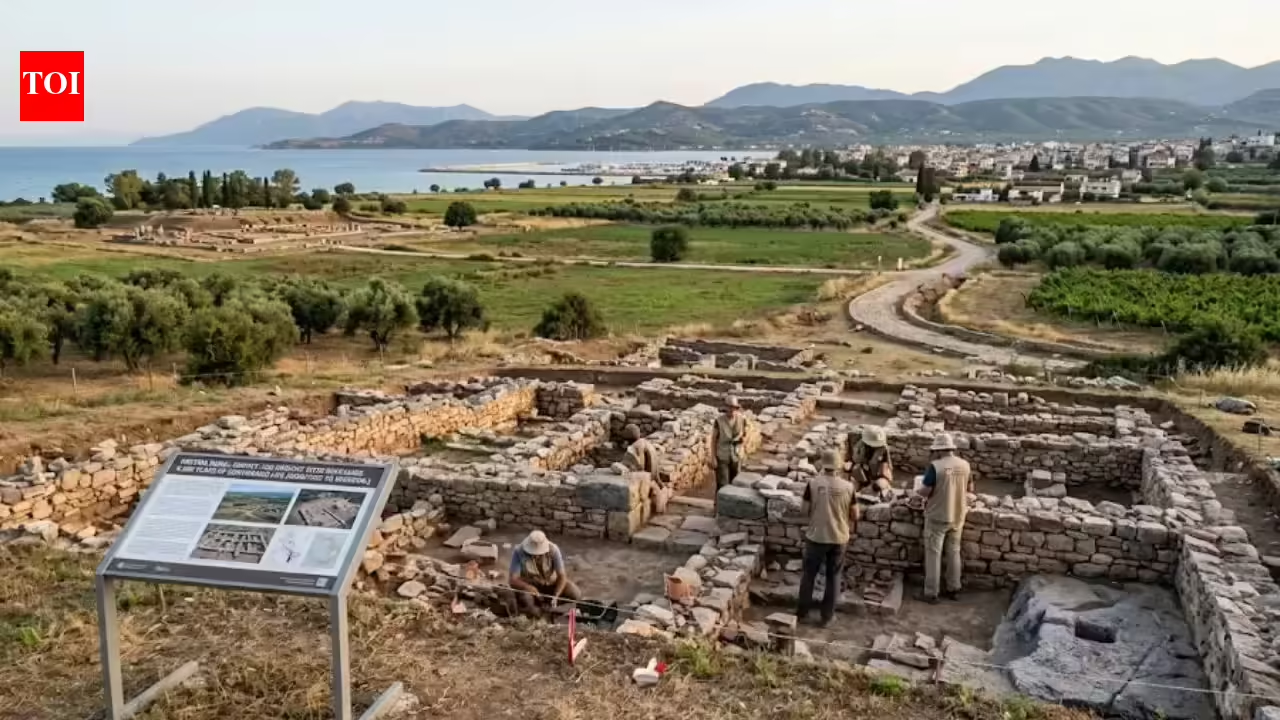
Through a lens of advanced technology, researchers have finally unmasked the enduring architectural and economic heartbeat of this ancient Greek landscape. A recent archaeological survey by the Swiss School of Archaeology in Greece (ESAG) has identified a sprawling rural network of over 200 sites covering an impressive period of 6,000 years of continuous human activity in the Eretrian plain region of Evia, Greece. ESAG conducted the survey using state-of-the-art LiDAR technology to penetrate the dense canopy and document a complex rural organisation connecting prehistoric settlements with the medieval churches of the area. More than 30 square kilometres of land were mapped, yielding results such as ancient farms, industrial quarries, and medieval roads that connected different demes (areas of rural settlement) with the urban area of Eretria and the Sanctuary of Artemis at Amarynthos. The survey results provide an unprecedented view into how the people of Greece have been able to evolve and sustain themselves for 6,000 years from their earliest agrarian beginnings to the end of the 19th century.
Archaeologists discover 200 ancient sites in Greece
The survey, conducted between 2021 and 2025, researched land around Eretria. Upon conducting extensive fieldwork, the team gained new insights into the many settlements or administrative units that functioned as the city-state’s hinterland. Many of these areas have been designated as separate demes, some resembling organised social units. As part of their findings, the team documented the existing rock-cut olive presses at most demes and the extensive road systems that provided socio-economic and cultic connectivity to the populous regions, such as to the Sanctuary of Amarynthos.
The role of 3D terrain mapping in modern archaeology
The use of LiDAR (Light Detection and Ranging) is crucial to further detecting hidden sites related to these demes. According to the Swiss School of Archaeology in Greece – Annual Reports, by employing LiDAR as a remote sensing technology, the researchers were able to obtain high-resolution, 3D terrain maps revealing the locations of buried walls, terraces and ancient routes that are otherwise invisible. By integrating this information into a GIS (Geographic Information Systems), the team analysed the factors influencing the spatial distribution of human activity over time throughout this part of Greece.
How Eretria’s rural communities outlasted empires
The artefacts found in the area demonstrate that the Eretrian plains always had a population. According to the Hellenic Ministry of Culture, the rulers changed from Mycenaean to Roman and Ottoman administrators; there was a persistent agrarian population living there, tending the farmland and maintaining the farms for 6,000 years.
Why mapping 200 sites matters today
The act of mapping the 200 settlements achieves two goals. First, it enhances our historical understanding of the area. Second, the mapping creates the basis for protecting the cultural heritage of the area under Greek law. Amidst increasing urban development on Evia, this mapping will provide a record of the archaeological heritage sites that existed in the area in order to mitigate the destruction of unexcavated cultural strata before they can be excavated.


Abike Dabiri-Erewa Loses Email Account To Hackers

RSPB Urges New Bird Feeding: charity warns over disease risk; households asked to change habits

Fuel import recommendation: World Bank backtracks, removes Nigeria development update report from website

INEC postpones nationwide voter revalidation until after 2027 polls

‘Tripadvisor-style’ smuggling racket: UK jails Kurdish-origin men who brought 100 migrants weekly to Europe

24 Christians and Muslims k!lled, church and mosque razed in Kebbi terrorist attack â Catholic diocese

Artemis II returning to Earth for splashdown to end historic moon mission

 News1 year ago
Abiodun attracts battle line: Ogun gained’t cede Ode-Omi, Makun to Lagos, Ondo
- News1 year ago
Engr. Sheriff Daramola Elected as fifteenth President of IFMA Nigeria Chapter
- Business1 year ago
Marketsquare expands with two new shops in Lagos
- Business1 year ago
MTN implements 50% tariff hike, raises knowledge costs
- Business1 year ago
MDAs should prioritise capability constructing in public service reforms – BPSR DG
- Politics12 months ago
Yobe gov not becoming a member of coalition — Aide
- Business11 months ago
GTCO Shareholders Approve N8.03 Per Share Dividend Payout
- Business1 year ago
The Rabiu Impact: Why Energy and Status Patronize BUA Boss