News
Borno Airstrike: Tinubu, security heads meet in Aso Villa

By Johnbosco Agbakwuru
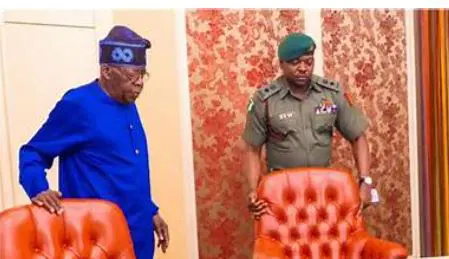
ABUJA – President Bola Tinubu convened an urgent security meeting on Monday with top brass at Aso Rock Villa, Abuja, as Nigeria battles escalating threats nationwide.
The closed-door session was attended by the Chief of Defence Staff General Olufemi Oluyede; Army Chief Lt. Gen. Waidi Shaibu; Naval Chief Vice Admiral Idi Abbas; and Chief of Air Staff, Air Marshal Sunday Anele;
Also present were the Director-General, Department of State Services, DSS, Oluwatosin Ajayi; Director-General, National Intelligence Agency, NIA, Ambassador Mohammed Mohammed; Inspector-General of Police Tunji Disu; National Security Adviser, NSA, Mallam Nuhu Ribadu; and other key officials.
Though details remain under wraps, the meeting follows a stark US State Department advisory on April 8, authorizing voluntary departure of non-essential embassy staff and families from Abuja amid a “deteriorating security situation.”
It slapped “Level 4: Do Not Travel” on 23 of Nigeria’s 36 states—including new additions Plateau, Jigawa, Kwara, Niger, and Taraba—citing Northeast insurgency, Northwest/North-Central banditry, and violence in the South/Southeast oil regions.
It also temporarily stopped Abuja visa services but Lagos office was not affected.
But the Nigeria’s government brushed it off as routine US protocol. The Minister of Information, Mohammed Idris insisted no nationwide law-and-order collapse exists, with most areas stable despite isolated incidents.
It was also expected that the meeting would address fallout from a Saturday Nigerian Air Force airstrike in Borno’s Jilli Market along the Yobe border, which reportedly recorded casualties mostly civilians while targeting Boko Haram.
The Air Force confirmed “precision mop-up” on terrorist sites but skipped civilian casualty claims. The Presidency defended it, with Senior Special Assistant Tope Ajayi telling Bloomberg the market had morphed into an insurgent logistics hub, making it a legitimate target.
Nigeria’s security woes persist: Northeast insurgency, Northwest/North-Central banditry and kidnappings, Southeast separatist unrest—all straining the nation’s defenses.





Nigerian Army arrests teenage suspect linked to k!lling of brigadier-general in Borno (video)

Int’l Day For Street Children: Expert Calls For Enforcement Of Child Rights

Eedris Abdulkareem in Edo, lauds Okpebholo on infrastructure, roads

Jeff Bezos’ Blue Origin extracts oxygen from Moon dust in a breakthrough for long-term human life on Moon

El-Rufai phone hacking: Amaechi accuses Ribadu of plotting 2031 presidency

Gov. Lawal approves 120-day rapid intervention plan to tackle education crisis in Zamfara

BREAKING: ADC Announces New Venue For Tomorrow Convention [DETAILS]

 Breaking2 weeks ago
Outrage as video of secondary school students in Benue state str!ping their classmate surfaces online
 News2 weeks ago
I Joined A Cult, Worked So Hard For Demons – Tonto Dikeh Confesses While Ministering (Video)
- News2 weeks ago
Heartbreaking Story Of 300-Level Ekiti University Student Who Was K!lled After Truck Crashed Into His Building (Video)
- Breaking1 week ago
Mother Abandons 4 Children with Neighbor and Disappears for Months — Shocking Case Raises Questions
- National2 weeks ago
Environmental Sanitation: Lagos meets with LG, LCDA bosses
- News2 weeks ago
WAEC Releases 2026 WASSCE Timetable (Full List)
- Breaking2 weeks ago
Singer Flavour shows off Italian woman and vows to shower her with so much love that she’ll have no choice but fall in love (video)
- World5 days ago
Trump LIVE: Iran war bombshell as Trump could be 'removed from Presidency'