World
Full transcript: IMF's Kristalina Georgieva on "Face the Nation with Margaret Brennan"

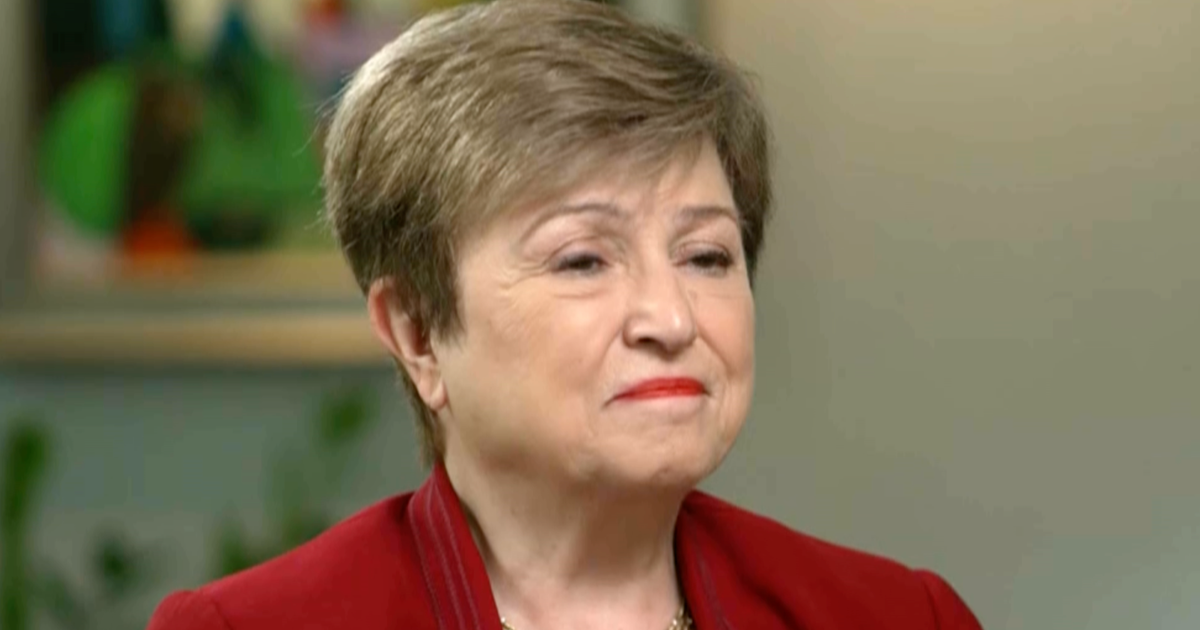
The following is the full transcript of an interview with Kristalina Georgieva, managing director of the International Monetary Fund, that aired on “Face the Nation with Margaret Brennan” on April 12, 2026.
MARGARET BRENNAN: Director, thank you so much for making time for us. We’re in an incredible moment right now. How do you calculate the economic shock from this Mideast war?
INTERNATIONAL MONETARY FUND MANAGING DIRECTOR GEORGIEVA: We look at the size of the impact and the duration of impact. And what I can tell you is that this shock is large. Thirteen percent of oil, 20% of gas that would have flown in the world is now stuck for five weeks and counting. It is global. Everybody uses energy. Everybody feels the pinch of prices going up. And it is asymmetric. It affects different countries differently. If you are in the vicinity of the conflict, it’s a big hit on you. If you are an oil importer, it is a big hit on you. If you have no reserves to protect yourself, you are in a very tough situation. We are running scenarios depending on the duration of the war. Now we have hopes for peace that would improve the conditions for everybody, but we are also looking at impact on infrastructure. A lot has been damaged, and it would take time to bring back to full operation.
MARGARET BRENNAN: So let’s pull that apart a little bit. It appears like Asia bore a lot of the economic impact here. South Korea, they’ve got a big computer chip industry. They have called on their citizens to conserve energy. India, they’re rationing energy. The Philippines had a national energy emergency. The Australian gas stations are running out of fuel. It seems like there’s a large part of the planet that’s really in pain.
MANAGING DIRECTOR GEORGIEVA: Oh yes, people are hurting. They’re hurting because of sheer lack of quantities. If you are in the Philippines, you’re queuing the same way people were queuing here in the ’70s to fill your tank. They are hurting because they may be in need of helium, for semiconductors or for MRIs. And now–
MARGARET BRENNAN: And that comes out of Qatar. Out of the Middle East.
MANAGING DIRECTOR GEORGIEVA: That comes out of Qatar, and now it is cut to size. They may be hurting because of fertilizers. Now is the planting season. If you are not getting fertilizers or not getting them at a reasonable price, we may see spike in food prices coming. They’re hurting because of remittances. Just think, how many people live in the Gulf, work in the Gulf, send money home to places like India and Bangladesh, and this money is not coming. They’re hurting because of transportation. I’ll tell you, my heart goes for Sri Lanka, a country that is coming out of a big shock, they were now affected because a third of flights to Sri Lanka go through the Gulf. Now, tourism is going to be- to be hammered. So for many, many reasons, countries are affected. And when you look at the size of the impact, it depends on how much your- your reliance on imports is, but it also depends on what is your fiscal position. Do you have capacity to absorb the shocks? Yes, who has this capacity? Poor, vulnerable countries, whether they’re in Asia or in Sub-Saharan Africa, they’re being hammered dramatically, and when we discuss our response, we will zero in on these highly vulnerable countries.
MARGARET BRENNAN: So the United States. Here Americans, they’re still spending, they’re still driving, but they have seen inflation go up, prices at the gas pump.
MANAGING DIRECTOR GEORGIEVA: Right, I mean, the U.S. is in the category of countries that are somewhat less impacted, because U.S. is energy exporter. But as I said, everybody feels the pinch of prices going up. Why? This is a negative supply shocks. You have less energy, but the demand is still the same. What happens? Prices go up, and here in the United States, people have not quite yet seen inflation going down to target. We were projecting this to happen by early ’27. Now that may be somewhat delayed. And what does it mean? It means that people experience a tax on their income. Who is most affected? Of course, low income, part of the population.
MARGARET BRENNAN: Right. Well, at- at one point, oil prices surged nearly 50% because of this war in Iran, and you called it the largest disruption to global energy markets in modern history, as increases, as you said, to fertilizer, to other prices that are going to push up food. Do you see this impact stretching through 2026 even if we get a cease fire that sticks?
MANAGING DIRECTOR GEORGIEVA: So the impact is baked in, because already the tankers that should have arrived in Asia have not arrived, right? So we already have that impact. But then on top of it, we have the infrastructure impact. Seventy-two energy facilities have been hit, one-third of them severe damage. You take the gas field in Qatar, it would take three to five years to reach its full capacity. That has significance. And then we have other infrastructure impacts, like refineries. If they don’t receive oil on a regular schedule, they have to shut down. When they shut down, to restart, that is with delay. So yes, we are going to see some drag of this crisis over the year. But if we have peace, of course, conditions are likely to improve faster. Above all, because confidence is going to benefit from the knowledge that there is a resolution of the fighting. Before- something that- that is very, very important to recognize. The world economy has been incredibly resilient. We have been hit by one shock and another and another. We were actually projecting a small upgrade for growth in 2026 had it not been for this war. Now we are going to have a downgrade, and the size of this downgrade will depend on these two things, duration and speed with which everything can come back to the same level of production that we had before.
MARGARET BRENNAN: Well, but just to put a fine point on it, when you’re- when people look at the effort to get even a ceasefire or some kind of peace deal, if they think, well, if this works, my prices are going to go back to where they were on February 27, the day before this war began. You’re saying no–
MANAGING DIRECTOR GEORGIEVA: Not right away. It will take time.
MARGARET BRENNAN: It’s going to take- it is going to take awhile in 2026.
MANAGING DIRECTOR GEORGIEVA: It will take- it will take some time, yes, and it will take more time for locations that are experiencing higher degree of disruption. And that’s why we need to remember the asymmetry of this shock. And spare a thought for these destinations where it would be still a matter of scarcity of supplies for some time.
MARGARET BRENNAN: And we’re hearing from European airlines issues with access to jet fuel. You’re talking about Asia there. People are going to see their airline ticket prices elevated. They’re going to experience this for some time.
KRISTALINA GEORGIEVA: Yes, the one good thing that we need to remember is that whenever we have an energy shock, we improve. Every energy shock in the past would lead to two things: more energy efficiency and more diversification of energy supplies.
MARGARET BRENNAN: More green energy.
MANAGING DIRECTOR GEORGIEVA: More green energy. We- we- we can show how that goes up. You get the shock, and then say, wait a minute, what can I do to reduce the impact? That would come. The problem is it would take a year and year and a half, two years. In meanwhile, people and businesses will be hurting.
MARGARET BRENNAN: Right. Well, at- at one point, oil prices surged nearly 50% because of this war in Iran, and you called it the largest disruption to global energy markets in modern history, as increases, as you said, to fertilizer, to other prices that are going to push up food. Do you see this impact stretching through 2026 even if we get a cease fire that sticks?
MARGARET BRENNAN: So what is the IMF doing right now to soften the blow of this crisis for those who are hardest hit?
MANAGING DIRECTOR GEORGIEVA: Well, the first thing we do is to give good advice to countries. The- at a moment like this, everybody rushes to take action, and sometimes it’s good, and sometimes not so good. Don’t impose restrictions on your trade with petrol products. Why? Because if we make the situation worse, prices would go up even more. We are telling countries, if you are to be helping people and businesses, do it in a targeted manner, do it carefully, because the world has a problem with fiscal space. All these shocks have led us to borrow more, and it has increased the cost of this borrowing on budgets. So if you are to help, help the most vulnerable, target your support, and do it on a temporary basis.
MARGARET BRENNAN: So we have seen so many shocks, as you said, two major military actions in Iran. You’ve got the war in Ukraine still going on. You have the trade war, all of this still just coming out of COVID. Have you been surprised that we are not in a global recession, and the United States is not headed for recession?
MANAGING DIRECTOR GEORGIEVA: We were not so surprised for one reason. What we have seen over these last shocks is that the world is building resilience to it, and the resilience is a product of three things. Number one, across the world, governments have pulled out of managing the economy, managing companies, and let the private sector do the job. Private sector is more agile, more adaptable. So when we are hit, the response is faster and more efficient. Two, we have seen over the last decades many countries, emerging market economies, taking actions to strengthen their fundamentals. Independent central banks, fiscal councils, that leads to good policies that protect countries, especially at the time of a shock. And number three, innovation. Look at the technological transformation–
MARGARET BRENNAN: Yes.
MANAGING DIRECTOR GEORGIEVA: –that is taking place in the world. It’s incredible. So all these two things have buffered our world against recession. Now, we are not immune against recession, Margaret, so we still have to be careful, to follow good policies and to keep our institutions in good health, to protect us.


Tinubu’s Aide Breaks Silence On Writing Press Statement For INEC

INEC denies copying press statement from presidential aide

Killings in Nigeria underreported — Olawepo-Hashim

MAAUN hails KHAIRUN Vice Chancellor at 67

Opposition scared of defeat in Osun, says APC chieftain

Delta police officer recounts how 17-year-old male student was discovered to have hacked Whatsapp accounts of some celebrities and sold âadult contentsâ to his classmates

Supreme Court to decide on ADC leadership dispute on Tuesday

 Breaking2 weeks ago
Outrage as video of secondary school students in Benue state str!ping their classmate surfaces online
 News2 weeks ago
I Joined A Cult, Worked So Hard For Demons – Tonto Dikeh Confesses While Ministering (Video)
- News2 weeks ago
Heartbreaking Story Of 300-Level Ekiti University Student Who Was K!lled After Truck Crashed Into His Building (Video)
- News2 weeks ago
WAEC Releases 2026 WASSCE Timetable (Full List)
- Breaking7 days ago
Mother Abandons 4 Children with Neighbor and Disappears for Months — Shocking Case Raises Questions
- National2 weeks ago
Environmental Sanitation: Lagos meets with LG, LCDA bosses
- Breaking2 weeks ago
Singer Flavour shows off Italian woman and vows to shower her with so much love that she’ll have no choice but fall in love (video)
- World4 days ago
Trump-Iran ceasefire 'collapses' as UAE, and Bahrain attacked and oil refinery targeted