World
How archaeology turns political in the West Bank

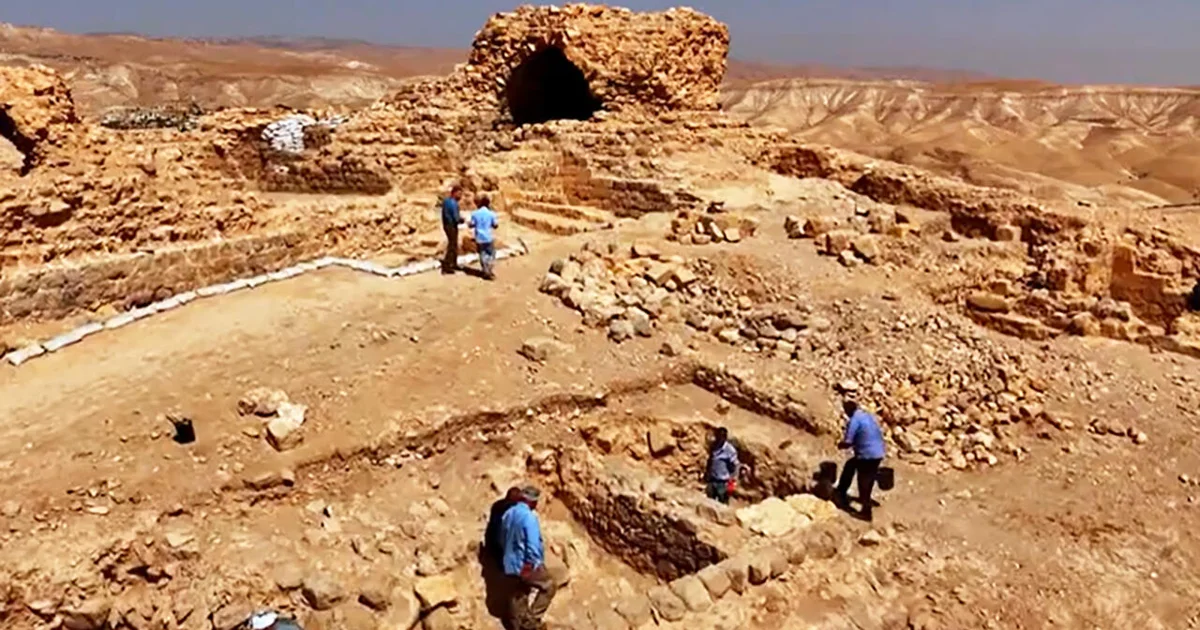
In the Judean desert, a complex past is being unearthed into a complicated present. This site, at Tala’at Ad-Dam, sits along an ancient pilgrimage route to Jerusalem, one Jesus’ parents were said to have walked.
Back then, this land was called Judea, after the people who would become known as the Jews. Over the centuries, it would be conquered by empires of varying beliefs. It’s one of at least 5,000 archaeological sites here, a place most commonly known as the West Bank. Some call it by its ancient or Biblical name — Judea and Samaria. The U.N. says it’s occupied Palestinian territory.
Eyal Freiman, deputy staff officer for archeology of Israel’s Civil Administration of Judea and Samaria, knows well the complexity of performing excavations here. “I don’t act by political views,” he said. “If we weren’t excavating this site, it would probably be half-buried.”
Asked if his role was inherently political, being an Israeli on Palestinian land, Freiman replied, “I’m just an employee of a civil administration. My job is to protect, preserve, and make approachable all the archaeological sites.”
But for whom? That’s the question Talya Ezrahi raises. “Archaeology has become a way of proving that we were here,” she said. “So, whenever we look in the ground, we’re always hoping to find something that has some indication of Jewish life in the land of Israel” – to make the claim we were here first.
Ezrahi is with the left-wing Israeli archeology group Emek Shaveh. She claims archaeology has been weaponized to make certain lands off-bounds to Palestinians: “It’s been weaponized in the service of enhancing and entrenching settlements and claiming more and more lands that were once Palestinian lands,” she said.
Take Nebi Samuel, where it’s believed the prophet Samuel was buried a thousand years before Christ. A Palestinian village was dismantled to make way for what’s become a tourist site.
Eid Barakat was forced to move from here when his house was demolished. He’s been in temporary housing since 1971, because he claims he cannot get a building permit. Israel is now allocating nearly $100 million in part to develop archeological and tourism sites in the West Bank.
Asked whether it was good that the land where Barakat once lived has been excavated, Ezrahi replied, “First of all, it is a beautiful site. But at the same time, there is a very important chapter of the site that is missing, and that is the story of the Palestinian village that lived here.”
We met Israeli archeologist Adi Shragai in the West Bank town of Sebastia, what was once the capital city of the Kingdom of Israel. “So many parts of history were completely erased just because someone decided to come and build on top of it,” she said.
Shragai says humanity benefits when these ancient sites are protected. She’s part of an Israeli archaeology group called Preserving the Eternal, which works in the West Bank. “For 100 years, there hasn’t been proper excavations in this site, [or] academic research,” she said.
But can performing excavation be completely divorced from today’s political realities? “The political reality is that sites are being destroyed,” Shragai said.
The group identifies archeological sites they deem need preservation, including this theater, which is more than two thousand years old.
But to get here, the Israelis had to drive off-road around the Palestinian town, because tensions are so high.
Asked if such excavations by Israelis amount to a land grab on the West Bank, Shragai replied, “My main mission is to have these sites safe, protected and preserved. If it were to be done by the Palestinian Authority, fine. But unfortunately, they don’t do that.”
Zaid Azhari says his family has lived in Sebastia for at least 20 generations. He makes a living giving tours of these sites, including the theater. As a Palestinian, he says he’s not allowed near them when the Israelis are working the site.
“The Israelis are not allowing us to work inside this site,” he said. “If you start working here, you will see the drones above you. The soldiers will come. The settlers will come.”
In November, Israel issued a land expropriation order to take control of more than 300 acres of Sebastia. Azhari says this would sever the town from their heritage, farmland, and a major part of their economy. “It’s just about controlling land, stealing land,” he said.
To Israelis who say this is simply about archaeology and is not political, Azhari said, “This is totally political. We protect our culture and our ruins since thousands of years.”
We met Israeli archeologist Adi Shragai in the West Bank town of Sebastia, what was once the capital city of the Kingdom of Israel. “So many parts of history were completely erased just because someone decided to come and build on top of it,” she said.
Rafi Greenberg is a professor of archeology at Tel Aviv University, and is co-founder of the group Emek Shaveh. “I thought that archeology was going to be only about facts,” he said. “The finds themselves are not actually in the past, they’re in the present.”
He remembers being a student first studying artifacts: “They’re on our table, they’re looking at us. We’re looking at them. And those pieces of evidence don’t add up to anything unless we make them add up to something.”
Archeology is storytelling, Greenberg says, which is exemplified at the City of David, the site where Israeli archaeologists are convinced Israel’s most powerful king built his capital a thousand years before Christ. Greenberg was excavating there around the same time CBS’ Bob Simon visited in 1980. Then, Simon reported that the United Nations condemned Israeli archaeologists for digging in what the U.N. called Occupied Territory.
Today, the City of David is a national park, complete with a zip-line.
“So, that became sort of a blueprint,” Greenberg said … a blueprint which, he argues, is partly a “settler project,” and a roadmap for other archaeological sites.
In neighboring Silwan, dozens of Palestinian families have been displaced, or have eviction proceedings against them. (Israeli authorities say they only demolish structures without proper permits and after all legal proceedings are exhausted.)


Wedding called off on D-Day as traffic cops arrest groom and his father for drunk driving

Bruges Boudewijn Seapark horror as 'attraction collapses' – at least four children injured

Speaker Of Kebbi State House Of Assembly Is Dead

Donald Trump dubbed 'out of control' following 'bonkers' update on Iran war

NMA says Blessing CEO’s stage 4 cancer report fake

Niger State varsity student st@bbed to d3ath during freshers’ party

18 people killed in strikes outside Tehran – Iranian media

 News1 year ago
Abiodun attracts battle line: Ogun gained’t cede Ode-Omi, Makun to Lagos, Ondo
- Business1 year ago
Marketsquare expands with two new shops in Lagos
- News1 year ago
Engr. Sheriff Daramola Elected as fifteenth President of IFMA Nigeria Chapter
- Business1 year ago
MTN implements 50% tariff hike, raises knowledge costs
- Business1 year ago
MDAs should prioritise capability constructing in public service reforms – BPSR DG
- Politics11 months ago
Yobe gov not becoming a member of coalition — Aide
- Business11 months ago
GTCO Shareholders Approve N8.03 Per Share Dividend Payout
- Business1 year ago
The Rabiu Impact: Why Energy and Status Patronize BUA Boss