News
Just in: Dangote Refinery fixes jet fuel price at ₦1,820/litre

By Udeme Akpan
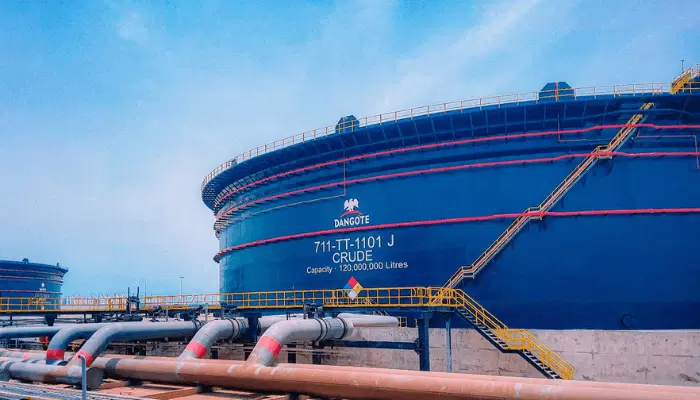
The Dangote Petroleum Refinery has fixed the gantry price of aviation fuel at ₦1,820 per litre, a move aimed at enhancing transparency in the sector.
This development comes at a time when airline operators have raised concerns over the high cost of the product and its impact on the aviation industry.
Despite advisory guidance from the Nigerian Midstream and Downstream Petroleum Regulatory Authority (NMDPRA), oil marketers have continued to sell aviation fuel to airlines at ₦2,230 per litre and above, deepening concerns across Nigeria’s aviation sector.
The NMDPRA had earlier indicated that aviation fuel should sell within a price band of ₦1,760 to ₦1,988 per litre in Lagos and about ₦2,037 per litre in Abuja, based on prevailing market fundamentals.
The guidance followed a series of stakeholder engagements involving aviation operators, oil marketers, depot owners, and other industry players aimed at resolving recent disputes over pricing.
However, market checks by Vanguard show that actual transactions remain significantly above the regulator’s benchmark, with airlines still paying as much as ₦2,230 per litre.
In an interview with Vanguard, Olatide Jeremiah, Chief Executive Officer of Petroleumprice.ng, said:
“There is a lack of transparency in jet fuel pricing. Dangote Refinery should, as a matter of urgency, publish its daily jet fuel gantry prices. This would erode abnormal margins by middlemen and help curb artificial hikes in jet fuel prices that are threatening to cripple businesses in Nigeria’s aviation sector.”
Also speaking, the spokesperson for United Nigeria Airlines, Chibuike Uloka, said: “It’s not a controlled market; it’s a free market. So, the NMDPRA cannot fix prices. Rather, based on its findings and market assessments—such as landing cost and other factors—it is only suggesting what the price should be.
“But marketers are still selling at their own rates, and no one has been able to call them to order. This issue goes beyond United Nigeria Airlines; it affects all members of the Airline Operators of Nigeria (AON), not just a single airline.
“If we are to speak on how this affects us, we can say—as Ibom Air earlier noted—that the cost of fuel per operation rose from ₦2.9 million in January to ₦7.6 million. For operators like us that use Airbus aircraft, with higher fuel capacity and longer endurance, the cost is even double that figure.”






Top 10 countries with most approved asylum claims in Canada 2025

Egg sellers blame transport costs for price hike

Israel intercepts Gaza aid flotilla off Greek coast, activists say

FG intensifies push for online verification, enrolment for retiring civil servants

Ashley Young announces retirement from football aged 40

Singer D4vd gro0med and used chainsaw to dismember 14-year-old Celeste Rivas in his garage

FULL LIST: US lawmakers propose stricter conditions on Nigeria financial aid

 Breaking3 days ago
Man falls asleep after r@ping 89-year-old woman in South Africa
- World3 days ago
Trump humiliated as major NATO leader tears apart US plan in Iran war
- Breaking3 days ago
CCTV footage shows final moments of 22-year-old Kenyan student before she fell to her d3ath from sixth floor of apartment
- News2 days ago
UCL: Arsenal receive double injury boost ahead Atletico Madrid semi-final
- World3 days ago
Trump dinner shooting suspect charged with attempted assassination of president
- World1 day ago
Trump and Iran issue fresh warnings as standoff continues
- Breaking3 days ago
I am sorry – OAP Roby Ekpo apologises for crying during tell-all interview about his marriage to ex-wife, Mayowa Lambe
- Breaking3 days ago
NDLEA intercepts terror drug âcaptagonâ in Kwara as bizman excretes 45 cocaine wraps