News
JUST IN: FG secures 386 convictions in mass trial of terrorism suspects

The Federal Government on Friday said it secured 386 convictions out of 508 terrorism-related cases prosecuted at the Abuja Division of the Federal High Court.
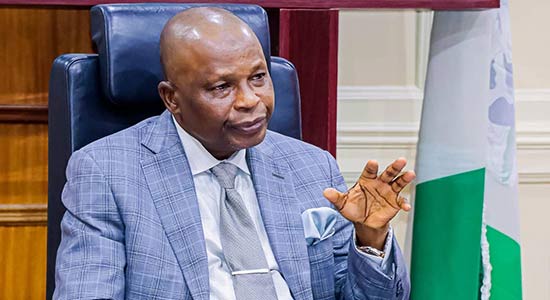
The Attorney-General of the Federation and Minister of Justice, Lateef Fagbemi, disclosed this to journalists at the conclusion of the ninth phase of the mass trials.
The AGF added that eight defendants were discharged, two acquitted, while 112 cases were adjourned to the next phase of proceedings.
“Well, in total, we brought about 508 cases. Of these 508, we were able to secure 386 convictions. Eight discharges, two acquittals and 112 adjourned to the next session or phase,” he said.
Fagbemi noted that the next phase of the trial had already been scheduled.
“Don’t forget that this is the ninth phase. The 10th phase will come up between the 15th and the 18th of June by God’s special grace,” he added.
PidomNigeria Online reports that the trial began on Tuesday, April 7, 2026, and ended on Friday, April 10, 2026.
The AGF had earlier disclosed that over 500 suspects would be arraigned in the exercise for various offences bordering on terrorism in contravention of the Terrorism (Prevention and Prohibition) Act.
The proceedings, which marked the ninth phase of the exercise, saw defendants arraigned before 10 judges of the Abuja Division of the Federal High Court, despite the Easter vacation which commenced on the same Tuesday.
The AGF stressed that the inclusion of discharges and acquittals underscored the government’s adherence to due process and the rule of law.
“The fact that you have discharges and acquittals speaks to the fact that we have been following due process. Anybody who is not guilty will not be sent to jail,” he said.
He added that subjecting the suspects to trial reflected respect for the judiciary’s constitutional oversight role.
“The fact that we brought them to court also speaks to the fact that they recognise the oversight function of the judiciary, and this is what has taken place,” Fagbemi stated.
Expressing satisfaction with the exercise, the minister said the trials were conducted transparently, with the participation of key stakeholders, including representatives of the United Nations Office on Drugs and Crime and members of the media.
“I’m satisfied, and that’s why it’s taking place in the full glare of the public. All the representatives of critical stakeholders are here. We have people from the UNODC, you the press, you are here, and you can speak to how the proceedings were conducted,” he said.
Fagbemi maintained that the sentences handed down by the court were meant to serve as a deterrent to terrorism and its financing.
“The type of punishment that the judges dished out is to send a clear signal to people involved in terrorism and terrorism-financing that there is no space for them here in Nigeria,” he said.
He added, “We cannot stop them from going elsewhere. But as far as the Nigerian space is concerned, there is no space. We will not be able to accommodate them. We have been able to bring them to justice.”
The AGF also commended the leadership of the court, particularly the Chief Judge, John Tsoho, and the head of the 10-member trial team, Binta Nyako, for their commitment.
“I also want to seize this opportunity once again to thank the Federal High Court under the able leadership of the Chief Judge and the leader of the 10-member team. They have done very well, and we are grateful to them for their patriotism,” he said.
He noted that the judges demonstrated exceptional dedication by sitting during a period ordinarily reserved for rest.
“These are not normal times. They are supposed to use this week, in particular, to be at home resting if they cannot travel. But they have shown great patriotism in answering the clarion call,” Fagbemi said.
He equally appreciated the media for its role in covering the proceedings and informing the public.
The minister added that, beyond sentencing, courts also ordered rehabilitation and de-radicalisation for convicted persons as part of efforts to reform offenders.
“And part of the consequential order made by judges after the sentencing is that they should go for rehabilitation and de-radicalisation,” he said.
According to him, the approach reflects the government’s broader objective of ensuring that punishment also facilitates reformation and reintegration.
“This speaks to the effort of government to ensure that the purpose of punishment is also to make offenders turn a new leaf and jettison terrorism,” Fagbemi added.







Florida to add legal status on drivers' licenses from 2027: US citizen or legal immigrant

Military officers spotted exchanging blows in Bayelsa earlier today (video)

Ex-Kentucky cheerleader pleads not guilty to k!lling newborn son found stuffed in trash bag

I slept in classrooms for 13 months, says UniCal’s best graduate

Five things to know about the planned Iran-US talks in Islamabad

The fuel price is biting hard but thank God that you are better off than those in Kenya and other African countries – President Tinubu tells Nigerians

Laura Loomer reacts as President blasts Candace Owens and others, takes dig at her looks in viral post

 News1 year ago
Abiodun attracts battle line: Ogun gained’t cede Ode-Omi, Makun to Lagos, Ondo
- News1 year ago
Engr. Sheriff Daramola Elected as fifteenth President of IFMA Nigeria Chapter
- Business1 year ago
Marketsquare expands with two new shops in Lagos
- Business1 year ago
MTN implements 50% tariff hike, raises knowledge costs
- Business1 year ago
MDAs should prioritise capability constructing in public service reforms – BPSR DG
- Politics12 months ago
Yobe gov not becoming a member of coalition — Aide
- Business12 months ago
GTCO Shareholders Approve N8.03 Per Share Dividend Payout
- Business1 year ago
The Rabiu Impact: Why Energy and Status Patronize BUA Boss