News
Tackling criminality, land disputes will mitigate violence in Plateau – Stakeholders

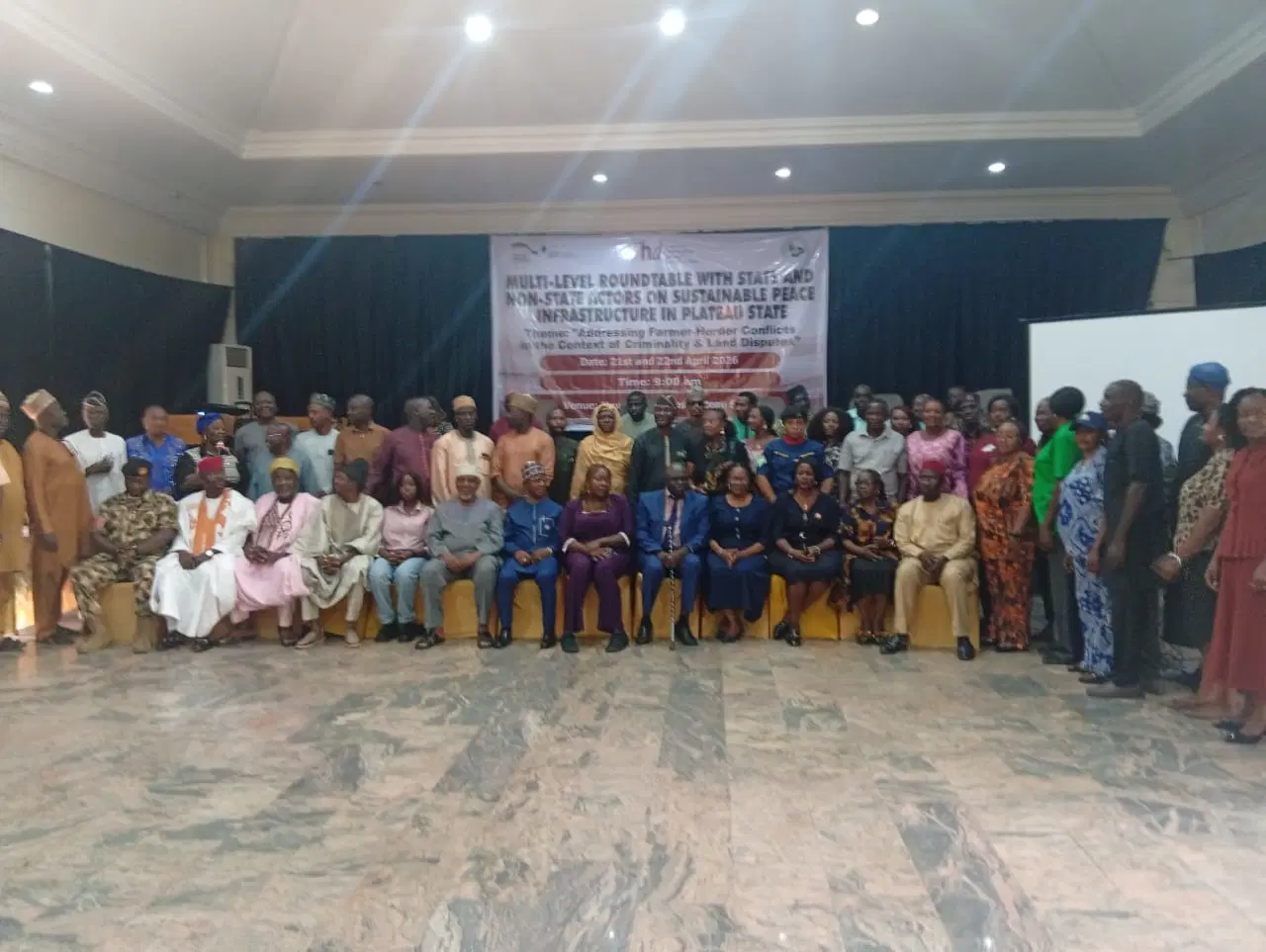
Jos – Land disputes, climate stress, criminal networks and political interference are among the key forces fuelling recurring violence in Plateau State, stakeholders said on Tuesday as they gathered in Jos to chart a path towards lasting peace.
The multi-level and multi-sectoral roundtable with the theme: Addressing farmer-herder conflicts in the context of criminality and land disputes brought together government officials, traditional rulers, security agencies and civil society actors to confront the persistent farmer–herder crisis.
Convened by the Centre for Humanitarian Dialogue in partnership with the Plateau State Peace Building Agency, the forum was supported by GIZ under the Peacecore II Project.
Participants emphasised that the conflict has evolved beyond disputes over grazing routes into a broader security challenge.
In a remark, HD’s Country Manager, Chris Agoha, said a complex web of factors—including banditry, environmental change and governance gaps—now drives instability across the Middle Belt.
He noted that incidents such as kidnapping, cattle rustling and the spread of illicit weapons have deepened insecurity.
Agoha cautioned that the increasing reliance on vigilante groups risks worsening the situation by escalating reprisals and encouraging the circulation of arms.
His words, “… Violent conflicts between farmers and herders continue to be a source of insecurity. The conflicts are rooted in factors such as rural banditry and the contestation over the increasing scarcity of water and land resources induced by climate change…
“In many parts within the Middle Belt Region, political and business elites from some parts of the country have been accused of arming herdsmen to attack agrarian communities.
“Some religious leaders also escalated the conflict by riling up sentiments that perpetuate animosity between the two groups.”
He further stressed that Nigeria is increasingly demonstrating limited capacity to effectively govern and secure it’s territory saying, “The inability to provide security and enforce justice, particularly in rural and semi-rural areas, has created a vacuum that enables armed groups to emerge and expand.
“In response, communities are increasingly resorting to vigilante groups and calls for civilian armament. While understandable, such responses deepen instability by generating security dilemmas, fuelling arms proliferation, and eroding governance norms.”
Also, the State Commissioner for Livestock Development, Veterinary Services, and Fisheries, Sunday Akpa, reiterated the symbiotic relationship between the farmers and herders and urged citizens to be peaceful as no one benefits from violent conflicts.
He argued that in the past, conflicts between the two groups were localised disputes which were promptly addressed and wondered why it had now turned into widespread conflict requiring external interventions.
He stressed that community-level dialogue and reconciliation remain
essential, pointing to ongoing State efforts to promote livestock value chains and public awareness campaigns aimed at easing tensions and creating economic opportunities.
Providing an overview of progress under Peacecore II, HD’s National Expert Adviser, Sam Godongs, said the initiative has focused on strengthening coordination among peace actors across Plateau’s three senatorial zones.
According to him, the programme has produced tangible outcomes, including local and zonal agreements, structured dialogue platforms and greater inclusion of women in peace processes.
He highlighted a notable breakthrough in northern Plateau, where women led cross-border peace discussions that influenced neighbouring communities in Kaduna State to reconsider women’s roles in traditional institutions.
However, Godongs warned that election cycles continue to heighten tensions, citing youth mobilisation, substance abuse and winner-takes-all politics as persistent triggers.
Representing the Director-General of the peace agency, Julie Sanda, Kyermun Bulus described the roundtable as both timely and necessary.
She underscored that disputes over land, identity and livelihoods lie at the heart of the conflict, requiring coordinated and inclusive responses.
Two panel discussions further explored stakeholder roles and community-driven solutions, with participants examining early warning systems, local conflict-resolution mechanisms and avenues for improved collaboration.
Attendees expressed cautious optimism that stronger partnerships and institutionalised peace structures would enhance resilience across Plateau communities.
The meeting forms part of wider efforts under Peacecore II to build sustainable peace frameworks and reduce violence in conflict-affected areas.
Meanwhile, the event ended with a communiqué calling for inclusive governance.







Parents to face charges after their 13-year-old son allegedly k!lled tourist with statue he tossed from balcony

ICPC Secures Conviction of Ex-NECO Staff for Certificate Forgery

Police hunt 17-year-old suspect in shooting near University of Iowa

Africa faces 86m tonne fuel shortfall by 2040 — Report

Countdown to 2026 FIFA World Cup: Czechia return after 20-year wait

Families concerned over disappearance of 2 doctoral students: "It's very unusual"
World’s longest road with no U-turns: A 30,000 km journey across 14 countries

 Breaking3 weeks ago
Outrage as video of secondary school students in Benue state str!ping their classmate surfaces online
 News3 weeks ago
I Joined A Cult, Worked So Hard For Demons – Tonto Dikeh Confesses While Ministering (Video)
- News4 weeks ago
Heartbreaking Story Of 300-Level Ekiti University Student Who Was K!lled After Truck Crashed Into His Building (Video)
- Breaking3 weeks ago
Singer Flavour shows off Italian woman and vows to shower her with so much love that she’ll have no choice but fall in love (video)
- News3 weeks ago
WAEC Releases 2026 WASSCE Timetable (Full List)
- World1 day ago
Millionaire's son beheaded and disemboweled on trip with girlfriend to holiday hotspot
- National3 weeks ago
Environmental Sanitation: Lagos meets with LG, LCDA bosses
- Breaking3 weeks ago
Mother Abandons 4 Children with Neighbor and Disappears for Months — Shocking Case Raises Questions