Breaking
UN Deputy Secretary-General declares Zamfara ‘accessible,’ pledges partnership

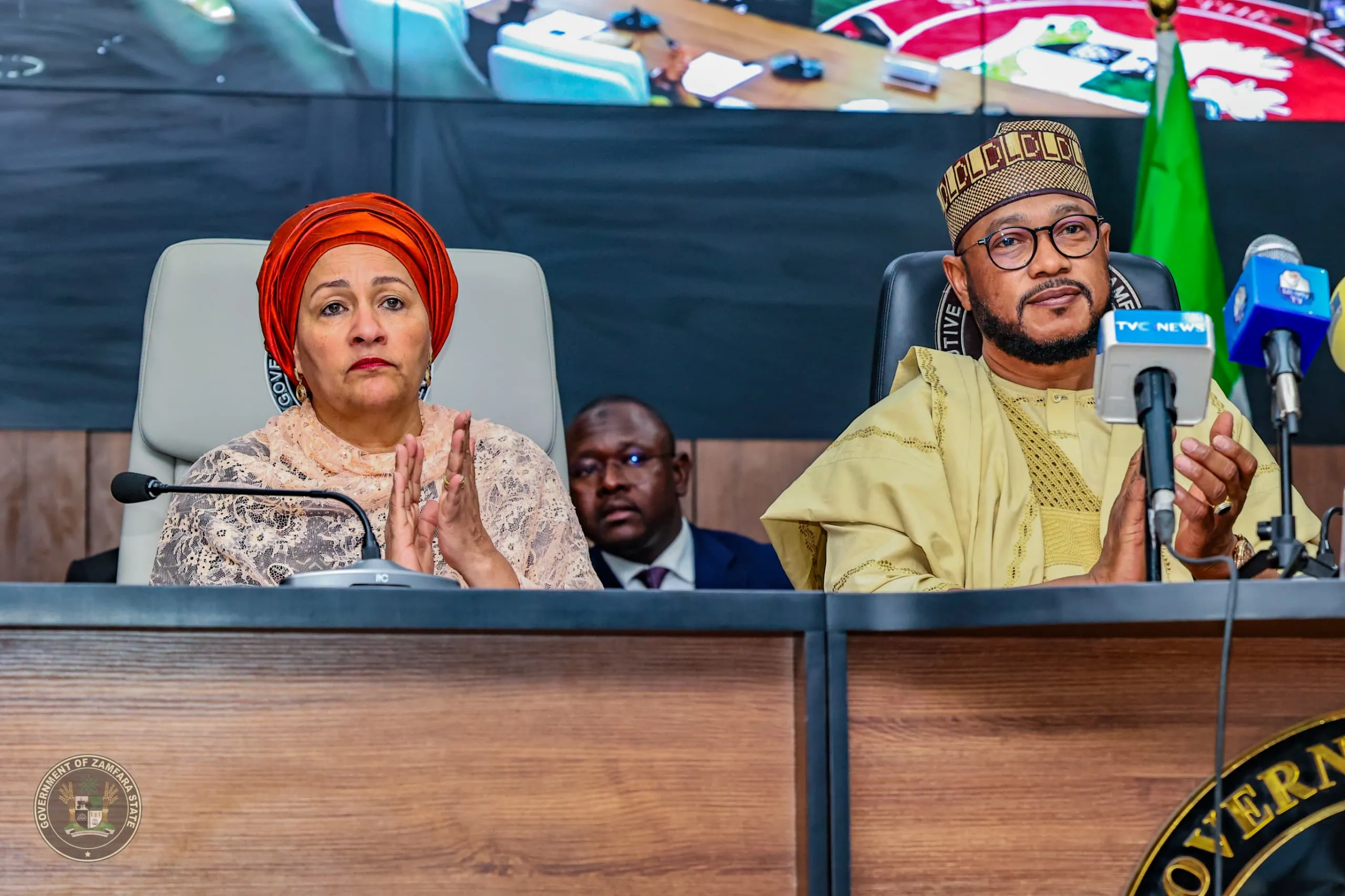
The Deputy Secretary-General of the United Nations, Amina Mohammed, has declared that Zamfara State is now accessible and open for development, expressing the UN’s readiness to partner with the state government to drive sustainable growth.
Mrs Mohammed made the remarks during an official visit to Zamfara on Thursday, where she led a high-level UN delegation on an on-the-spot assessment of development efforts and security conditions in parts of the state, including Maru Local Government Area.
The visit, according to a statement issued by the spokesperson to the governor, Sulaiman Bala Idris, also featured key officials from various UN agencies.
Among them were the UNDP Country Representative, ; UNODC Country Head, ; UNICEF Country Head, ; IOM Country Head, ; UNHCR Country Head, ; UNAIDS Country Head, ; and UNFPA Country Head, .
During a multi-sectoral briefing by the Zamfara State Government, the governor outlined his administration’s development agenda, highlighting plans to promote sustainable development, climate resilience, and inclusive economic growth through strategic partnerships.
He described Zamfara as being at a “turning point,” noting that the state, with a population of about 5.3 million people, relies heavily on agriculture, with over 80 per cent of residents engaged in farming.
According to the governor, his administration’s Six-Point Rescue Agenda is designed to stabilise the state, rebuild critical sectors, and transition Zamfara toward inclusive and sustainable development.
Responding, Mrs Mohammed said the presentations by the state government were clear and provided a solid basis for collaboration.
“This is enough for us to be able to partner,” she said, stressing that peace and stability remain critical to attracting investment.
“Investors want an enabling environment. Peace is what you need today for people to come. The Zamfara narrative focuses on conflict related to solid minerals, and this needs to change,” she added.
The UN deputy chief noted that her visit was aimed at drawing global attention to local-level challenges and opportunities, especially in regions where governance structures and resources are limited.
“I am happy to be here because I want to show the world that we should pay attention to what is happening at the local level—where people are most vulnerable and resources are scarce,” she said.
Mrs Mohammed also pointed to ongoing infrastructure development, particularly road construction projects, as a sign of improving accessibility and economic prospects.
“Zamfara State is accessible today, and it will be even more accessible when ongoing road projects are completed. This will revive businesses and markets and, hopefully, we will see more peace,” she said.
She further highlighted the state’s economic potential, particularly in mining and agriculture, while commending the state leadership for its willingness to strengthen institutions and pursue partnerships.
“I see the mining potential, the markets, and the demand. I also see leadership that is ready to build the necessary frameworks and partnerships to get the job done,” Mohammed stated.
She emphasised that development efforts would require collective responsibility, noting that progress cannot be driven by the government alone.
“There is a lot of hope and potential here. Everyone must play their role. The United Nations is willing to be a genuine partner to Zamfara State,” she added.
The visit marks a significant engagement between the UN and Zamfara State, as the government seeks to reposition the state from a history of insecurity and economic challenges toward a path of stability and development.


E-invoicing forces Nigerian firms into real-time transparency

JD Vance flies to Pakistan for talks with Iran

President Trump tells his vice JD Vance to find a way out of Iran war as he prepares to fly to Pakistan for peace talks
JD Vance flies to Pakistan for talks with Iran

Trump says US has ‘won’ war with Iran, but fighting continues

Artemis astronauts describe lunar voyage as surreal ahead of Earth return

Melania Trump blasts ‘lies’ linking her to Epstein

 News1 year ago
Abiodun attracts battle line: Ogun gained’t cede Ode-Omi, Makun to Lagos, Ondo
- News1 year ago
Engr. Sheriff Daramola Elected as fifteenth President of IFMA Nigeria Chapter
- Business1 year ago
Marketsquare expands with two new shops in Lagos
- Business1 year ago
MTN implements 50% tariff hike, raises knowledge costs
- Business1 year ago
MDAs should prioritise capability constructing in public service reforms – BPSR DG
- Politics12 months ago
Yobe gov not becoming a member of coalition — Aide
- Business11 months ago
GTCO Shareholders Approve N8.03 Per Share Dividend Payout
- Business1 year ago
The Rabiu Impact: Why Energy and Status Patronize BUA Boss