World
'Unbelievable' discovery as archaeologists 'find' Jesus' tomb

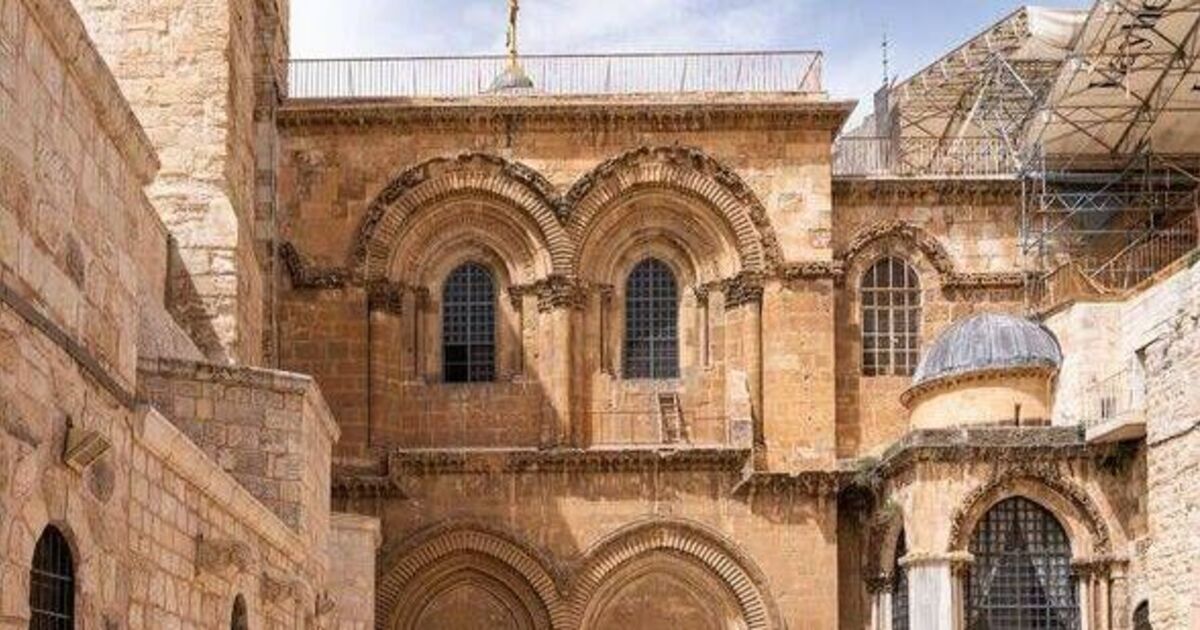
Archaeologists believe they may have discovered Jesus’ tomb (Image: (Image: Getty))
Archaeological findings in Jerusalem have corresponded almost precisely with the biblical account of Jesus’ burial site.
The exact location, as described in the Gospel of John, has been uncovered by architects working at the Church of the Holy Sepulchre in Jerusalem: “Now in the place where he was crucified there was a garden; and in the garden a new sepulcher, wherein was never man yet laid. There laid they Jesus.”
Examination of ancient plant remains and pollen extracted from samples collected beneath the historic basilica’s floor confirmed the existence of olive trees and grapevines.
These findings suggest that the site dates back to the pre-Christian era, though radiocarbon dating results are yet to be confirmed.
“We know that the area was already part of the city at the time of Emperor Hadrian when the Romans built Aelia Capitolina,” Prof Francesca Romana Stasolla of the Sapienza University of Rome told the Times of Israel, referencing the Roman settlement constructed atop Jerusalem’s ruins during the first half of the 2nd century CE, reports the Mirror US.
“However, at the time of Jesus, the area was not part of the city yet.”
Christian faith holds that the Church of the Holy Sepulchre marks the site of Jesus’ crucifixion (known as Calvary or Golgotha) and his neighbouring tomb, which is currently topped by a shrine erected in 1810.
Stasolla has been leading the endeavour since the groundbreaking archaeological work began at the sacred site in 2022.
After decades of deadlock, the three religious bodies responsible for overseeing the church — the Orthodox Patriarchate, the Custody of the Holy Land, and the Armenian Patriarchate — came to an agreement on a restoration project in 2019.
Their aim was to replace the basilica’s predominantly 19th-century flooring, representing the first significant restoration since a catastrophic fire in 1808.
Securing authorisation from the Israel Antiquities Authority was vital, as all excavations throughout the country require official approval.
“During the renovation works, the religious communities decided to also permit archaeological excavations beneath the floor,” Stasolla explained in her first interview with The Times of Israel since excavations started.
She said: “However, currently, we do not have any active excavation sites as the church is preparing for Easter, when it needs to be fully accessible to pilgrims.”
She stressed the sensitive nature and practical difficulties of the historic site demand the greatest care throughout their work.
The archaeological team working under Stasolla’s leadership is made up of Italian specialists connected to La Sapienza University of Rome.
Stasolla said: “We work in shifts, but our team in Jerusalem always comprises 10 or 12 individuals. The atmosphere here is truly unique; we have received a warm welcome and established strong bonds with everyone.”

Samples have been found underground which could prove the discovery (Image: (Image: Getty))
Stasolla, a member of the archaeological team carrying out work at the Church of the Holy Sepulchre in Jerusalem, revealed that their group regularly collaborates with specialists including geologists, archaeobotanists, and archaeozoologists from Rome.
The church was undergoing restoration work in March 2025.
“We take turns, but our team in Jerusalem always includes 10 or 12 people,” Stasolla said.
“The atmosphere here is very special; we have been welcomed warmly and built strong relationships with everyone.”
Periodically, specialists from Rome travel to join the team in Jerusalem.
The excavation of the Church of the Holy Sepulchre is being undertaken by archaeologists from the Sapienza University of Rome. (Archivio Università di Roma La Sapienza).
“However, most of our team remains based in Rome, where we send the data for the post-production work,” Stasolla added.
“While we have not been able to see the entire church excavated in one glance, new technologies are allowing us to reconstruct the bigger picture in our labs,” Stasolla noted.
“If we were talking about a puzzle, we could say we are only excavating one piece at a time, but eventually, we will have a complete multimedia reconstruction of the full picture.”
The Holy Sepulchre, a site of profound historical significance, has endured a turbulent past marked by repeated cycles of destruction and rebuilding.
Originally built in the fourth century by Emperor Constantine, the first Christian convert amongst Roman emperors, the church has weathered numerous disasters including a devastating fire started by Persians in the seventh century and an attack by caliph al-Hakim in 1009.
Its current form is largely due to the extensive reconstruction work undertaken during the Crusader period in the 12th century.
Stasolla explains that the hidden layers beneath the church’s floor, rather like a historical archive, offer a remarkable chronicle of Jerusalem’s past, reaching back to the Iron Age (1200-586 BCE).
“The church is built on a quarry, which isn’t surprising as a large portion of the Old City of Jerusalem is situated on a quarry,” said Stasolla.
“The quarry was operational during the Iron Age. During our excavation, we discovered pottery, lamps, and other everyday items from that era.”

The discovery has been described as ‘unbelievable’ (Image: (Image: Getty))
After the quarry’s closure and prior to the church’s construction, the location was utilised for agricultural purposes.
“Low stone walls were constructed, and the space between them was filled with soil,” explained Stasolla.
“The archaeobotanical findings have been particularly intriguing for us, given what is mentioned in the Gospel of John, believed to be written or compiled by someone familiar with Jerusalem at the time.
“The Gospel refers to a green area between the Calvary and the tomb, and we identified these cultivated fields.”
Excavations at a Jerusalem site dating to Jesus’ era, identified both as a quarry and an ancient necropolis containing rock-hewn tombs, have shed light on the Constantine period.
An expert noted: “We need to imagine that as the quarry was progressively abandoned, tombs were carved at different levels.”
The site clearly contains numerous burials from that era, including the one venerated as Jesus’ tomb, which Constantine isolated during construction around what is now the rotunda.
The expert said: “The area, therefore, featured several burials from that period. Constantine selected the one that had been venerated as the tomb where Jesus was buried, and he excavated around it in the area that corresponds to the current rotunda, isolating it from the other burials.”
Within the Holy Sepulchre compound, multiple ancient burial sites exist, including one believed to belong to Joseph of Arimathea who, according to Christian tradition, provided his own burial chamber for Jesus.
Stasolla’s team discovered numerous artefacts thought to date back to the 4th century.
Excavating beneath the existing structure, Stasolla explained: “Under the current aedicule, we found a circular basis that is part of the first monumentalization of the tomb, made out of marble.”
Highlighting the significance of the find, Stasheolla said: “It is interesting because the most ancient depictions of the aedicule, which date back to the 5th and 6th centuries, describe it as circular. We therefore believe that this circular basis was part of the original structure built by Constantine.”
Further study of this remarkable artefact, which spans an impressive six meters (nearly 20 feet) in diameter, is anticipated to offer scholars a greater understanding of the rich history of this iconic structure.
“We are conducting geological analysis to verify the origin of the marble, and we are also testing the mortar,” Stasolla explained.
“Both tests can provide us with crucial information.”
Among other notable findings, researchers have unearthed a collection of coins originating from the fourth century in the structure’s eastern section.
The oldest coin dates back to the reign of Constantius II (337–361 CE), while the most recent are from the period of Valens (374–378 CE).
Furthermore, the archaeological team has uncovered hundreds of animal bones, remnants of ancient banquets shared by priests and pilgrims.
A preliminary report published in the prestigious “Liber Annuus,” journal in 2023 meticulously outlines discoveries from a structural trench dating to the Crusader period, alongside a modern manhole pit, with both sites producing various remains including those of sheep, goats, pigs, chickens, geese, and pigeons, together with a substantial quantity of fish remains.
Especially significant were a ponyfish native to the Indo-Pacific Ocean and a cod from the Atlantic.
“We also discovered several shells of a terrestrial snail species that is still consumed today,” Stasolla said.
“This species originated here and spread around the Mediterranean following the Crusades.”
The archaeologist highlighted that only after a thorough analysis of the unearthed bones can we gain a more complete picture of the changing dietary habits of those who lived in and visited the Church across the centuries.
With roughly 100,000 pottery fragments amongst the excavation discoveries, researchers expect it will take years to examine everything.
Nonetheless, excavations are due to recommence after Easter and are expected to conclude within months.
“We only have a part of the northern aisle left to excavate,” Stasolla said.
When asked about archaeology’s capacity to conclusively confirm Jesus’s burial at the Holy Sepulchre, Stasolla stressed the importance of separating faith from historical evidence.
“However, it is the faith of those who have believed in the sanctity of this site for millennia that has allowed it to exist and evolve,” she added. “This is true for all holy sites.
“The real treasure we are uncovering is the history of the people who made this site what it is by expressing their faith here.
“Whether someone believes or not in the historicity of the Holy Sepulchre, the fact that generations of people did is objective. The history of this place is the history of Jerusalem, and from a certain point, it is the history of the worship of Jesus Christ.”


Cardoso living up to his promise 1

Kuwait Citizenship Law Amendments 2026: Decree expands revocation powers; naturalisation rules tighten

Senate 2027: Okowa bows to Anioma leaders’ demand, accepts to seek ticket

OPS seeks President’s help to stop beverage levy bill

“Tinubu understands every single opposition step against him” – Festus Keyamo

Ibadan indigenes to Fayose: Don’t drag Makinde into ‘baseless’ Olubadan controversy

2027: Abia APC split over Kalu’s gov nod

 Breaking2 weeks ago
Outrage as video of secondary school students in Benue state str!ping their classmate surfaces online
 News2 weeks ago
I Joined A Cult, Worked So Hard For Demons – Tonto Dikeh Confesses While Ministering (Video)
- News2 weeks ago
Heartbreaking Story Of 300-Level Ekiti University Student Who Was K!lled After Truck Crashed Into His Building (Video)
- Breaking1 week ago
Mother Abandons 4 Children with Neighbor and Disappears for Months — Shocking Case Raises Questions
- National2 weeks ago
Environmental Sanitation: Lagos meets with LG, LCDA bosses
- News2 weeks ago
WAEC Releases 2026 WASSCE Timetable (Full List)
- Breaking2 weeks ago
Singer Flavour shows off Italian woman and vows to shower her with so much love that she’ll have no choice but fall in love (video)
- World5 days ago
Trump LIVE: Iran war bombshell as Trump could be 'removed from Presidency'