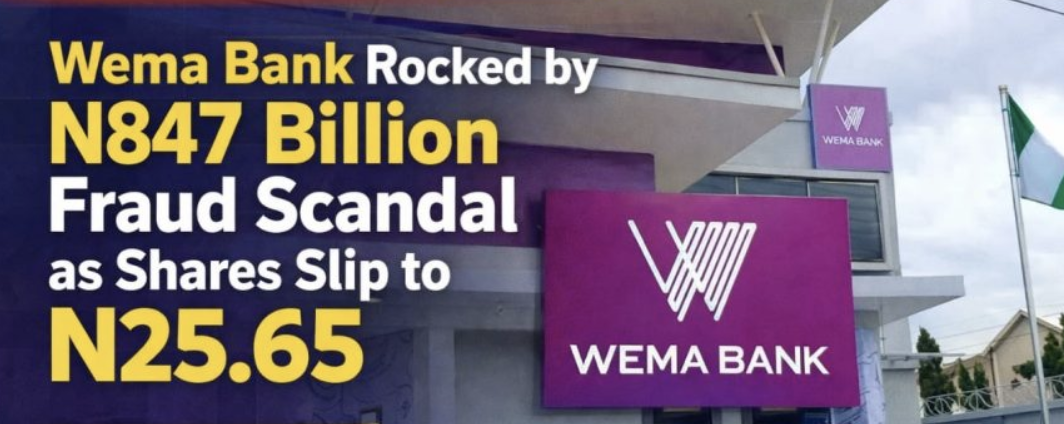
Wema Bank Nigeria Plc’s share price declined by 0.4 percent to close at N25.65 after reports revealed a significant fraud incident that impacted the bank in 2025. The disclosure has raised concerns among investors and triggered renewed scrutiny of internal controls within the financial institution.
An analysis of the bank’s 2025 financial statements showed that Wema Bank lost a total of N847.599 billion to fraud during the year. The scale of the loss has sent shockwaves across Nigeria’s banking sector, highlighting weaknesses in both operational systems and fraud prevention mechanisms.
The report indicated that fraudsters initially targeted N7.187 trillion from the bank but were able to successfully steal N847.599 billion. Of the total amount lost, approximately 14 percent was linked to insider involvement, while 86 percent was attributed to external actors.
Further breakdown of the losses revealed multiple channels through which the fraud was executed. Internet-related fraud accounted for N10.892 billion in losses, despite an attempted N84.189 billion. Mobile banking fraud led to a loss of N750.328 million, while point-of-sale transactions resulted in N929.2 million being stolen.
Web-based channels also proved vulnerable, with losses amounting to N17.894 billion. However, the largest portion of the fraud occurred under a category described as “operations and others,” which includes account management, transaction processing, and back-office activities. In this category alone, fraudsters targeted N6.928 trillion and successfully diverted N817.133 billion.
The bank also recorded a minor foreign currency loss, with $2,550 stolen from a targeted $6,850. Although relatively small compared to the naira losses, it further underscores the breadth of the security breaches.
Efforts to obtain official comments from Wema Bank were unsuccessful as of the time of reporting. Messages sent to the bank’s Head of Brand and Marketing Communications, Mabel Adeteye, requesting clarification on the fraud and measures being taken to prevent a recurrence were not answered.
The revelation is particularly striking given the bank’s increased investment in technology during the same period. Wema Bank’s spending on technology and alternative channels rose significantly to N19.042 billion in 2025, up from N5.55 billion in 2024. The bank also spent N491.856 million on digital banking professional fees, compared to N321.393 million the previous year.
Despite this substantial increase in technology expenditure, the bank still suffered one of the largest fraud losses in its history. Analysts say this raises questions about the effectiveness of its digital security infrastructure and oversight mechanisms.
A related case further illustrates internal vulnerabilities. On November 6, 2025, a Lagos court convicted a Wema Bank employee, Samuel Asiegbu, for his involvement in a N8.56 billion fraud. He was sentenced to three years in prison without the option of a fine. The case involved multiple defendants charged with conspiracy, stealing, and unauthorized access to computer systems.
The broader banking sector in Nigeria has also been grappling with rising fraud risks. According to the Financial Institutions Training Centre, banks recorded N3.3 billion in fraud-related losses in the first quarter of 2025, representing a 137 percent increase from the previous quarter.
Although the number of reported fraud cases dropped to 12,347 from 18,672 in the preceding quarter, the financial impact per incident increased significantly. The total amount involved in fraud rose to N22.27 billion, up from N6.5 billion.
The report noted that banks were able to prevent a large portion of attempted fraud, blocking approximately N19 billion, or 85.2 percent of the total value. However, actual losses still accounted for 14.8 percent, reflecting the persistent threat posed by increasingly sophisticated fraud schemes.
The developments surrounding Wema Bank have intensified calls for stronger regulatory oversight and improved internal controls across Nigeria’s banking industry to safeguard customer funds and restore investor confidence.