World
Why is Trump talking about action on Cuba and what could that look like?

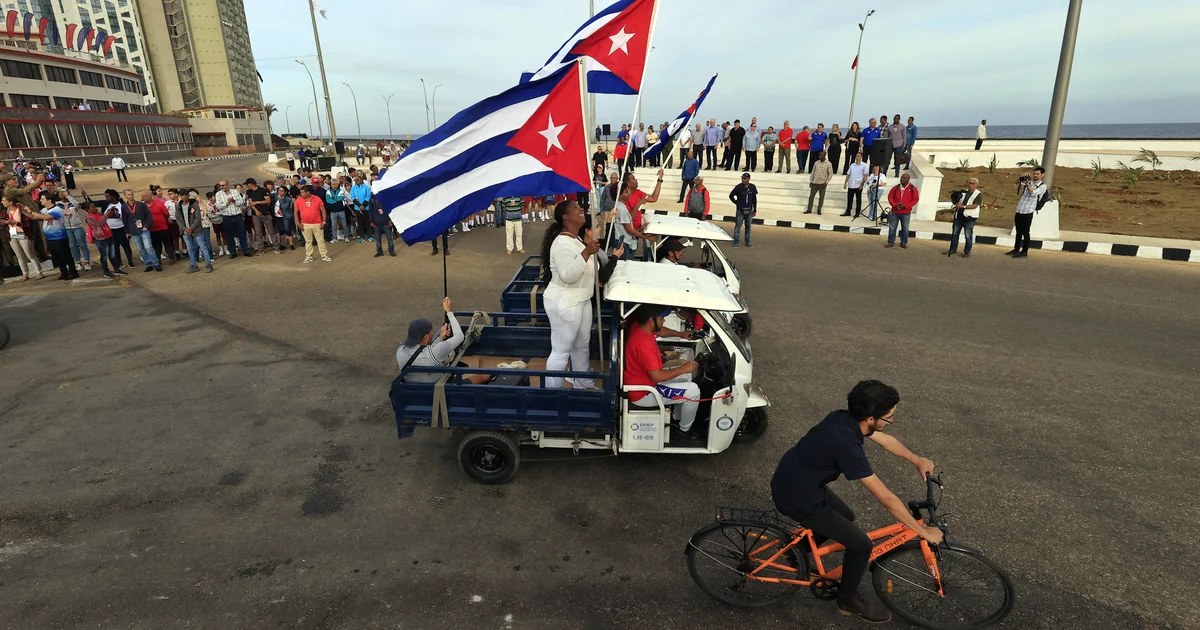
Washington — President Trump continues to dangle potential military action against Cuba, appearing to be emboldened by his administration’s interventions in Venezuela and Iran.
After the U.S. military captured Venezuelan President Nicolás Maduro in January, Mr. Trump warned that he had his sights set on Cuba. Standing alongside Mr. Trump at a news conference about the raid on Jan. 3, Secretary of State Marco Rubio said the regime should be “concerned.”
Since Iranian Supreme Leader Ali Khamenei was assassinated in U.S. strikes on Iran in February, Mr. Trump’s rhetoric against Cuba has escalated. On March 16, Mr. Trump told reporters in the Oval Office that he believed he would have “the honor of taking Cuba.”
“Taking Cuba in some form, yeah,” he said. “Taking Cuba. I mean, whether I free it, take it — I think I could do anything I want with it, if you want to know the truth.”
“Cuba’s going to be next,” Mr. Trump told reporters Sunday on Air Force One.
Rubio, the son of Cuban immigrants, has been more direct about the administration’s possible goals in Cuba, testifying to Congress in January, “we would love to see the regime there change,” saying it would be of “great benefit” to the U.S. Weeks later, Rubio said Cuba has to “change dramatically.”
“I mean Cuba has an economy that doesn’t work and a political and governmental system that can’t fix it,” Rubio said on March 17 in the Oval Office. “The people in charge, they don’t know how to fix it. So, they have to get new people in charge.”
Rubio reiterated the need for economic reform and political reforms on Tuesday, telling Fox News the administration will “have more news on that fairly soon.”
“You cannot fix their economy if you don’t change the system of government,” he said.
For now, experts on the region view the threats of military action in Cuba as bluster, saying it would involve much more effort than in Venezuela because of the political structure. Forcing gradual economic change, along with the resignation of Cuban President Miguel Díaz-Canel, through the threat of economic collapse and other sanctions is a more likely scenario, they said.
“I think there are a number of factions within the administration where some would be happy to do a deal with most of the existing Cuban government if it gave greater access to businesses, and particularly to Cuban Americans to come back and invest,” Paul Hare, who served as the British ambassador to Cuba from 2001 to 2004, told CBS News. “The other faction, I think, is insisting on a complete regime change.”
The Trump administration has been trying to choke Cuba’s economy by imposing an oil blockade that experts say has pushed the Communist-ruled island to its most dire state since the collapse of the Soviet Union, which heavily subsidized Cuba’s economy.
The two governments have been talking, though Díaz-Canel said earlier in March that they are “still far from an agreement.” The deputy foreign minister of Cuba, Carlos Fernández de Cossío, said in an interview with NBC that his nation does not see U.S. military action as “probable,” but their military is “prepared” for any U.S. aggression. Cossío added that regime change is “absolutely” off the table.
What regime change could look like is another question.
Christopher Hernandez-Roy, a senior fellow and deputy director of the Americas Program at the Center for Strategic and International Studies, said “regime management” is the “only realistic option.”
“Regime change is probably harder to accomplish than in Venezuela. Regime management, I would also argue, is probably harder to accomplish than in Venezuela because you have a power structure that’s been in place for almost 70 years and is expert at repression and expert at sniffing out dissent. So is there a pressure point at which certain elements in Cuba think that it’s better to change course? I think it’s possible. But is it as easy as it is in Venezuela? I don’t think so. I think it’s probably harder,” he told CBS News.
“A purely diplomatic solution that doesn’t rest on any sort of coercion, I don’t think is possible,” he added.
Raúl Castro handed the presidency to Díaz-Canel in 2018, marking the first time since 1959 that a Castro was not formally leading the country. But Díaz-Canel is widely considered a figurehead and the Castros still have considerable influence.
“He’s not the person that actually wields the power in the country, but it would be seen as a symbolic win by the United States,” Hernandez-Roy said.
For now, experts on the region view the threats of military action in Cuba as bluster, saying it would involve much more effort than in Venezuela because of the political structure. Forcing gradual economic change, along with the resignation of Cuban President Miguel Díaz-Canel, through the threat of economic collapse and other sanctions is a more likely scenario, they said.
It’s also unclear who would step in to run the country.
One scenario could be a Delcy Rodríguez figure who would lead the island “very much in concert with and under the pressure of the United States,” according to Lawrence Gumbiner, a career diplomat who led the U.S. Embassy in Havana during Mr. Trump’s first term.
“The first steps would be economic openings,” Gumbiner said of how the U.S. could exert pressure over a regime-aligned leader. “I think the clear message will be like it is with Ms. Rodriguez — that you will do as we say, or else.”
Gumbiner said the “or else” carries the threat of military action, although he believes such a threat is minimal, and potential indictments. The top federal prosecutor in Miami has been exploring potential charges against Communist Party leadership, including economic crimes, drugs, violent crimes and immigration-related violations.
A more ambitious move would involve bringing in someone from outside the regime who would push for constitutional changes, Hare said.
Gumbiner said that Mr. Trump is less concerned about political change, instead seeing the nation as a big opportunity for U.S. businesses.


Best budget camera phones in 2026

Kebbi Assembly Speaker d!es in Egypt

Plateau women protest over planned mass burial of attack victims

Trending video of two women f!ghting at a party in London
Building Collapse: Wike Orders Arrest Of Owner, Seizes Land

‘They’ve been bought over’ — Mark-led ADC blasts rival camp as crisis deepens

ADC crisis deepens as Kachikwu faction backs INEC, disowns Mark, Gombe

 News1 year ago
Abiodun attracts battle line: Ogun gained’t cede Ode-Omi, Makun to Lagos, Ondo
- News1 year ago
Engr. Sheriff Daramola Elected as fifteenth President of IFMA Nigeria Chapter
- Business1 year ago
Marketsquare expands with two new shops in Lagos
- Business1 year ago
MTN implements 50% tariff hike, raises knowledge costs
- Business1 year ago
MDAs should prioritise capability constructing in public service reforms – BPSR DG
- Politics11 months ago
Yobe gov not becoming a member of coalition — Aide
- Business11 months ago
GTCO Shareholders Approve N8.03 Per Share Dividend Payout
- Business1 year ago
The Rabiu Impact: Why Energy and Status Patronize BUA Boss