World
Worst plane crash in history and harrowing final moments of 520 on board

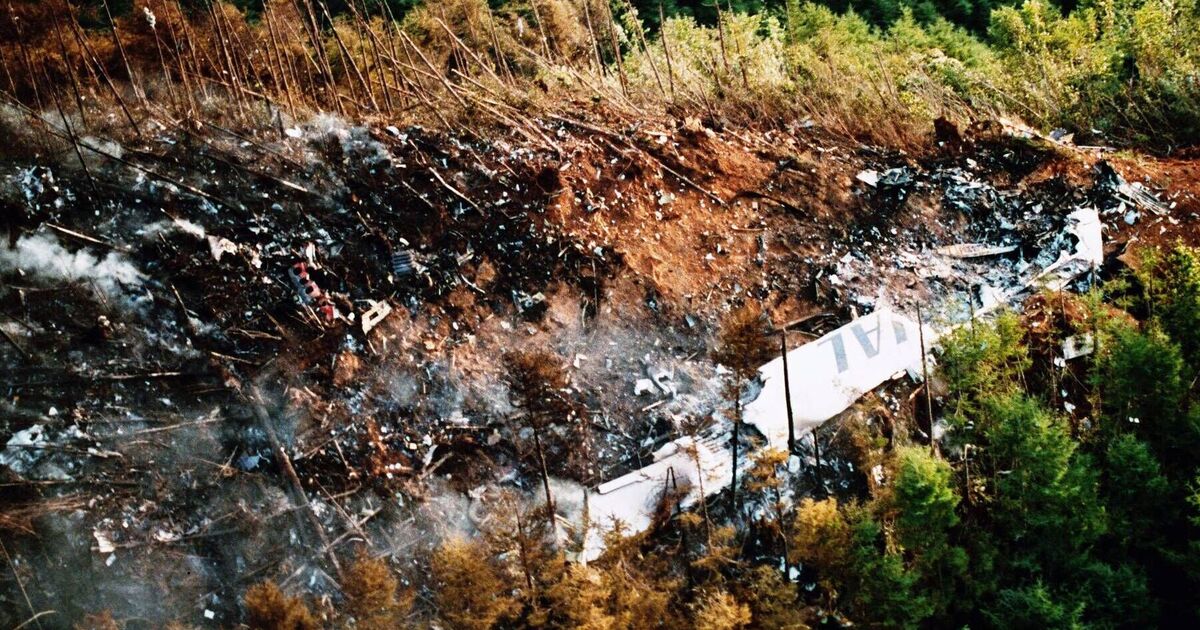
520 people died and four miraculously survived (Image: The Asahi Shimbun via Getty Images)
The deadliest single-aircraft disaster claimed the lives of 520 people in one catastrophic incident, leaving behind just four miraculous survivors.
For the aviation industry, August 12, 1985, remains one of the most devastating days on record, marked by unimaginable loss and terror.
The tragic day saw Japan Air Lines Flight 123, a Boeing 747 Jumbo Jet, carrying 509 passengers and 15 crew members from Japan’s capital city of Tokyo to Osaka on its scheduled service.
Complete hydraulic failure combined with explosive decompression just 12 minutes into the flight led to what can only be described as one of the worst catastrophes in aviation history, with those on board enduring the most harrowing and terrifying ordeal imaginable as they gradually ran out of oxygen.
What unfolded next was infinitely more tragic and horrifying.
Read more: Worst plane crash in history killed 583 as pilot uttered chilling last words
Read more: Horror plane crash killed all 132 on board and ‘may have been intentional’

August 12, 1985, remains a dark day for the aviation industry (Image: The Asahi Shimbun via Getty Images)
Final moments of those on board
Japan Airlines Flight 123 departed Tokyo at 6.12pm local time on August 12, 1985, travelling 400 kilometres west to Osaka with a scheduled flight duration of just 52 minutes. 509 passengers and 15 crew members brought the flight nearly to capacity, reports the Daily Record.
The aircraft was being piloted by First Officer Yutaka Saski, 39, who was being supervised by 49-year-old Captain Masami Takahama – the most senior pilot on board. Experienced flight engineer Hiroshi Fukuda completed the cockpit crew.
Roughly 12 minutes following take-off, the aircraft experienced a deafening explosion, and oxygen masks began dropping down before hysterical, panic-stricken passengers.
The cabin altitude alarm began blaring loudly, alerting the pilots to the fact that the air inside the aircraft had become too thin to breathe. The flight crew immediately radioed an emergency to air traffic control.
Captain Takahama remained oblivious to the fact that the bang heard in the cockpit was caused by a rupture in the aircraft’s rear — which had subsequently torn away a vast section of the plane’s tail, auxiliary power unit, rudder, and numerous other critical control mechanisms — as he requested a return to Haneda, some 70 miles behind them.
Captain Takahama instructed First Officer Saski to bank right in order to head back to Haneda, but the aircraft immediately began tilting at a dangerously steep angle. Despite his best efforts, the first officer was completely unable to level the plane’s wings.
It was at this moment that flight engineer Fukuda discovered the aircraft’s hydraulic pressure had plummeted, leaving them in a state of total hydraulic failure.
Flight 123 began lurching violently up and down, swaying from side to side as passengers grew increasingly distressed. By this point, it was devastatingly apparent that the pilots had lost all meaningful control of the aircraft.
In these terrifying final moments, passengers began frantically scrawling heartbreaking farewell messages to their loved ones, with most arriving at the dreadful realisation that death was almost certainly imminent.

It remains the deadliest single-aircraft crash in aviation history (Image: Corbis via Getty Images)
These poignant notes were later recovered amongst the wreckage of the stricken plane. At this altitude, both pilots had now succumbed to hypoxia – a condition in which the body’s tissues are starved of oxygen – having been too preoccupied to actually don their oxygen masks when the warning alarms initially sounded.
The situation throughout the cabin was no better, with passengers rapidly depleting their available oxygen supply.
A controlled emergency landing at Haneda represented their greatest chance of survival, yet to achieve this, the aircraft needed to shed altitude, and rapidly. The plane dropped below 20,000 feet for the first time since departing Tokyo, but this reduced altitude brought with it an entirely new and terrifying threat.
With a vast mountain range looming directly ahead and spelling certain disaster, the aircraft began plummeting at more than 18,000 feet per minute – some 10 times the normal rate of descent.
The captain’s final words were “Raise nose, raise nose…. Power”, a desperate last-ditch attempt to save his own life and those of every soul on board, as the aircraft slammed into the ridges of Mount Takamagahara in Japan’s Gunma Prefecture.
According to Japan’s Aircraft Accident Investigation Commission (AAIC), working alongside the US National Transportation Safety Board, the catastrophe was ultimately attributed to a structural failure resulting from a botched repair carried out by Boeing technicians following a tailstrike seven years earlier.
Speaking to the Mirror on the 40th anniversary of the disaster in 2025, David, a consulting editor at Flightglobal magazine, said: “I’ve lost count of the number of CVRs (Cockpit Voice Recordings) I’ve listened to and transcripts I’ve read from accidents – and the Japan Airlines 123 remains the only one that ever made me cry.
“The transcript was so harrowing I could not listen to the CVR. The pilots were talking to each other in a state of deep distress because they didn’t know what was going on and what they could do.
“It wasn’t just fear. They wanted to save their airplane, to save their own lives and the lives of everybody on board, and they didn’t know what to do.
“You’ve never heard that kind of distress.”
All 15 crew members died in the catastrophic crash, alongside 505 of the 509 passengers.
Four remarkable survivors — amongst them a 12 year old girl who heartbreakingly lost her parents and sister in the tragedy — were all seated towards the rear of the aircraft, where the forces of impact were considerably less brutal than at the front, and a combination of extraordinary luck and fate spared them from sharing the same terrible end.
It is believed that between 20 and 50 passengers initially survived the impact, but tragically succumbed to their injuries while awaiting rescue.
This devastating incident remains the deadliest single-aircraft disaster to date, and stands as the most catastrophic aviation tragedy in Japanese history.


Bandits suffer loss as Army, DSS, volunteer forces foil attacks on Niger communities

Iran agrees to safe passage through Hormuz strait for two weeks ‘if attacks halted’

‘₦3.3 Trillion Is Panic Button’ – Atiku’s Aide Knocks Tinubu’s Govt Over Electricity Fund

NAHCO shareholders to get N12.2bn dividend, bonus shares

Trump agrees to suspend bombing of Iran for two weeks

IIV to FG: Push for smaller pipeline surveillance contracts, move to revive illegal bunkering

Two residents jailed three months for indiscriminate dumping of refuse in Lagos

 News1 year ago
Abiodun attracts battle line: Ogun gained’t cede Ode-Omi, Makun to Lagos, Ondo
- News1 year ago
Engr. Sheriff Daramola Elected as fifteenth President of IFMA Nigeria Chapter
- Business1 year ago
Marketsquare expands with two new shops in Lagos
- Business1 year ago
MTN implements 50% tariff hike, raises knowledge costs
- Business1 year ago
MDAs should prioritise capability constructing in public service reforms – BPSR DG
- Politics12 months ago
Yobe gov not becoming a member of coalition — Aide
- Business11 months ago
GTCO Shareholders Approve N8.03 Per Share Dividend Payout
- Business1 year ago
The Rabiu Impact: Why Energy and Status Patronize BUA Boss