News
May Day: Labour rejects growth claims, says economy favors 1% as millions suffer


*Announces July for commencement of new minimum wage negotiations
*Threatens to direct workers to stay home over killings, kidnappings nationwide
*Adds Nigeria one of world’s most dangerous places
By Victor Ahiuma-Young & Johnbosco Agbakwuru
ABUJA — In a sweeping, fiery, and deeply critical address that touched virtually every sector of national life, Nigeria’s organised labour on Thursday declared that the country is drifting toward a dangerous tipping point, warning of a collapsing social contract, a failing economy, and a worsening security crisis that could force workers off their jobs nationwide.
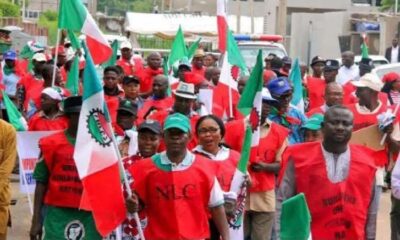
At the 2026 May Day celebration held at Eagle Square, Abuja, leaders of the Nigeria Labour Congress, NLC, and the Trade Union Congress of Nigeria, TUC, Joe Ajaero and Festus Osifo, delivered a joint speech that combined stark economic analysis, political warnings, and an unmistakable threat of mass action if conditions do not improve.
They described Nigeria as a nation where “poverty tightens its grip daily,” institutions are weakening, and citizens are increasingly left to fend for themselves in the face of violence and economic hardship.
Workers create wealth, live in poverty
Setting the tone early, labour leaders reminded the nation of the central role workers play in sustaining the economy, contrasting it sharply with their current condition.
They said: “Workers remain at the very heart of every industry, every economy, and every success story known to humanity. Without workers, no wheel can turn; without workers, no nation can be built.”
Yet, they lamented, those same workers “create immense wealth yet receive only a fraction of it,” enduring exploitation while “poverty tightens its grip around them.”
They described Nigerian workers as people who “rise before dawn and return home at dusk, exhausted yet unbroken,” but increasingly unable to meet basic needs despite their efforts.
Growth without relief, reform without impact
Labour took direct aim at the government’s economic narrative, arguing that macroeconomic indicators have become disconnected from reality.
According to them; “We are told that GDP growth may reach about 3.6%… yet poverty continues to rise. We hear official inflation figures… but these numbers do not reflect the reality experienced daily by workers.”
NLC and TUC argued that Nigeria’s economic model has produced a distorted outcome, saying “Paper growth without jobs, stability without prosperity, and reform without relief.”
They insisted that the benefits of economic policies are being captured by a narrow elite, noting that “An economy that serves only the top 1% while leaving the 99% behind cannot be sustainable. Perhaps, it is working for the ultra-few 1% and not the 99% majority.”
Nation sliding deeper into poverty
Labour painted a bleak picture of living conditions across the country, citing data that shows poverty now affects about 65% of Nigerians — roughly 150 million people.
“Approximately 10,000 people are pushed into poverty every day,” they said, warning that deprivation has reached “alarming levels.”
They described overcrowded cities strained by rural displacement, rising food insecurity, and the re-emergence of diseases linked to extreme poverty in internally displaced persons camps.
“In these camps and communities, diseases such as Kwashiorkor, Craw-craw, and Marasmus are re-emerging,” they noted, calling it “a grim picture of a nation under severe strain.”
Minimum Wage: Labour draws the line
Against this backdrop, labour announced that negotiations for a new national minimum wage will begin in July 2026.
“We will commence the process early to avoid the painful delays of the past,” they said.
But beyond future negotiations, the unions demanded immediate intervention:
“We demand that from July of this year, every worker be paid 100% of his basic salary… to cushion the effects of the renewed crisis of survival. We demand a living wage, not a minimum wage.”
Nigeria is s at War
On insecurity, labour delivered perhaps its most alarming assessment, declaring that Nigeria is effectively in a state of war.
“The scale of violence, the frequency of attacks, and the mounting loss of lives… place Nigeria among the most dangerous places to live on earth,” they said.
Rejecting the characterization of attacks as isolated incidents, they insisted: “It is not. It is a war against our people.”
They cited killings, bombings, and abductions across multiple states, noting that thousands have died and millions displaced.
“People are no longer safe in their homes, on the roads, or even in their workplaces. Daily life has become a gamble with fate”, they lamented.
Workers may stay home
In a major escalation, labour warned that it may take the unprecedented step of directing workers to stay home if insecurity persists.
They said “Nigerian workers may no longer continue going to work with this level of insecurity. We may be forced to advise our members… to stay at home to avoid being kidnapped, abducted or killed.”
They stressed that such a decision would not be taken lightly but could become unavoidable if the situation does not improve.
“The safety of workers is non-negotiable,” they added.
Energy sector under fire
Labour also delivered a scathing critique of Nigeria’s power and oil sectors, describing them as symbols of policy failure and elite capture.
“Over a decade after privatisation, Nigerians have little to show but deepening darkness,” NLC and TUC said of the electricity sector.
They pointed out that despite over N10 trillion in public spending, power supply remains unreliable.
“What was promised as reform has become a burden,” they said, adding that consumers now pay more for less.
On fuel, they highlighted the paradox of an oil-rich nation unable to protect its citizens from price shocks.
“The contradiction is stark and disheartening,” they said.
Governance under scrutiny
Labour raised serious concerns about governance, accusing political leaders of being disconnected from the realities of ordinary Nigerians.
“When leaders seek better education abroad for their children while neglecting domestic schools… it raises fundamental questions about commitment,” they said.
They warned that governance risks becoming “an extractive enterprise” serving narrow interests rather than the public good.
Labour also criticized weakening democratic institutions, warning that the erosion of checks and balances threatens national stability.
A system that bleeds nation
The unions described corruption and illicit financial flows as one of the greatest threats to Nigeria’s future.
“This is not mere corruption; it is a system… one that bleeds the nation continuously,” they said.
They cited trillions lost to subsidy fraud and billions to illicit flows, arguing that such losses directly translate into poor services and low wages.
To confront this, they launched a nationwide campaign: “Stop the Bleeding. Every stolen Naira is a stolen future.”
2027 elections: Labour draws battle lines
Looking ahead, labour signaled a more assertive political role as the 2027 general elections approach.
“2027 will be different. No more will we be voting fodder”, they warned.
NLC and TUC vowed to support only candidates committed to workers’ welfare and national development.
“Those who have undermined workers’ rights cannot expect our support,” they said.
Engines do not beg
Despite the dire warnings, labour ended on a note of defiance and resolve, urging workers to recognize their collective power.
They said : “You are not victims. You are the engine of this nation. And engines do not beg; they move.”
They called for unity, organisation, and sustained action: “The change we seek will not come from elsewhere; it must come from us.”
Among others, NLC and TUC added :
“Let this May Day mark the turning point; where Nigerian workers stopped asking and started demanding… Our nation can be saved! But only by us! Only together! Only now!”




Reps Speaker, others felicitate legislative aide at 60

How to watch, live stream Portable vs Carter Efe tonight

Changing lives: Virginia students repair old cars and donate them to single mothers

May Day: NLC demands ₦225,000 minimum wage for Lagos workers

Ex-presidential candidate challenges Tinubu, Atiku, Obi to debate

May Day: ‘We Recognize Your Challenges’ – Akpabio Tells Nigerian Workers, Pledges Better Welfare

‘Acceptable in my culture’: Indian man gives bizarre reason for luring 9-year-old into his car

 News21 hours ago
Explainer: What Supreme Court ruling means for ADC, INEC deadline
- News3 days ago
UCL: Arsenal receive double injury boost ahead Atletico Madrid semi-final
- Breaking13 hours ago
Abducted Kaduna woman returns with pregnancy after being repeatedly r@ped and beaten by bandits during her five-month captivity
- World2 days ago
Trump and Iran issue fresh warnings as standoff continues

 World3 days ago
Texas daycare accused of H-1B scam; visas tied to unrelated job roles
- Breaking3 days ago
When I had nothing, she handled the bills for seven years and never complained â Actress Seun Osigbesan’s husband praises her as she turns 40
- Breaking20 hours ago
Two suspects arrested over viral video of Kogi kidnapped victims being flogged in captivity
 News2 days ago
N’Assembly pushes bill to strengthen food security