World
Pilots' five harrowing words before Air India crash killed 260 people

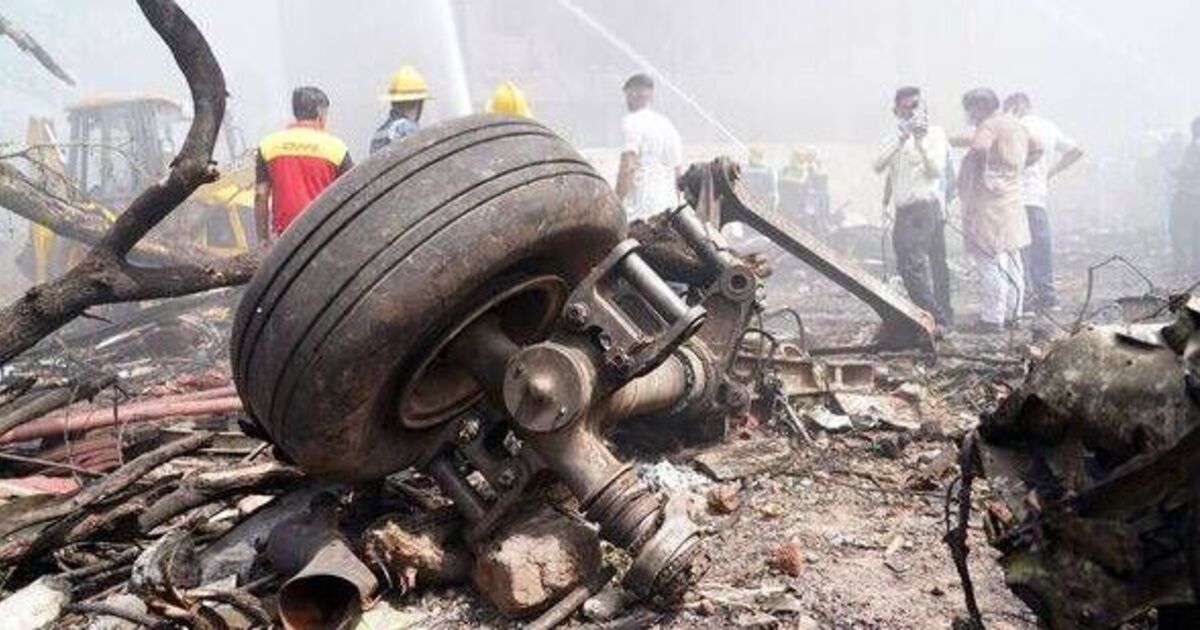
Some of the wreckage of the plane (Image: Bloomberg via Getty Images)
A year ago today, 260 people in the horror Air India crash.
Air India Flight 171 set off from Vallabhbai Patel International Airport in Ahmedabad, Gujarat, India, on June 12, bound for London.
There were 230 passengers on board and 12 crew members but just 32 seconds after take-off, the plane horrifyingly crashed into student accommodation just a mile from the airport.
All but one on board were killed along with 19 people on the ground. A further 67 people were seriously injured.
Following the crash, in a deeply unsettling development, five harrowing words exchanged between the pilots aboard the ill-fated Air India flight that crashed last month have now come to light.
The disturbing details of the conversation that took place in the cockpit moments before the Air India aircraft met its catastrophic end were disclosed in the official report published by the Aircraft Accident Investigation Bureau late on Friday.
Data retrieved from the black box had already confirmed that within less than 60 seconds of departing Ahmedabad’s Sardar Vallabhbhai Patel International Airport, the plane plunged and struck a building used as doctors’ accommodation at BJ Medical College and Civil Hospital.
Investigators believe that the Boeing 787 Dreamliner’s fuel flow switches for both engines were incorrectly toggled almost simultaneously, just seconds after take-off, cutting off the fuel supply and triggering the devastating incident as both engines failed.

The pilots’ cockpit exchange has sparked a key question over the crash (Image: AFP via Getty Images)
The chilling words captured on the cockpit voice recorder have been verified by the report: “In the cockpit voice recording, one of the pilots is heard asking the other “why did you cut off?” The other pilot responded that he did not do so.”
The report continues: “At about 08:09:05 UTC, one of the pilots transmitted ‘Thrust not achieved… falling… MAYDAY MAYDAY MAYDAY’. The ATCO enquired about the call sign. ATCO did not get any response but observed the aircraft crashing outside the airport boundary and activated the emergency response.”
The cockpit conversation between the pilots has raised a critical question within the aviation community regarding the crash. Experts are questioning how the fuel switches could have been accidentally switched mid-flight, particularly given they are deliberately engineered to be ‘highly reliable’ and designed specifically to prevent inadvertent activation.
To disengage each lever, it must first be lifted upwards before it can be switched. They’re also equipped with protective guard brackets to shield against accidental knocks or contact.
A Canada-based air accidents investigator told the BBC: “It would be almost impossible to pull both switches with a single movement of one hand, and this makes accidental deployment unlikely.”
US aviation safety expert John Cox reiterated: “You can’t bump them [the fuel switches that feed the engines] and they move.”
According to the investigators’ preliminary findings, there’s no evidence of any obvious defect with the Boeing aircraft or its engines, which indicates that neither GE, the engine manufacturer, nor Boeing will be held responsible for the accident.
The Aircraft Accident Investigation Bureau report also reveals the jet was carrying 54,200kg of fuel, well within the ‘allowable limits’. Fuel samples taken from the aircraft’s refuelling were also found to be ‘satisfactory’.

New details from the tragic Air India crash have emerged (Image: CENTRAL INDUSTRIAL SECURITY FORC)
The report further stated: “The aircraft achieved the maximum recorded airspeed of 180 Knots IAS at about 08:08:42 UTC and immediately thereafter, the Engine 1 and Engine 2 fuel cutoff switches transitioned from RUN to CUTOFF position one after another with a time gap of 01 sec.
“The Engine N1 and N2 began to decrease from their take-off values as the fuel supply to the engines was cut off. In the cockpit voice recording, one of the pilots is heard asking the other why did he cutoff. The other pilot responded that he did not do so.”
Yet the report stops short of explicitly explaining how the switch — ordinarily used to start and shut down the engines and typically left on during flight — could have moved to its cutoff position.
The preliminary findings focus on the startling discovery that the aircraft’s engine fuel flow switches were inexplicably deactivated following takeoff, triggering an apparent loss of thrust shortly after the plane climbed into the sky.
In a devastating turn of events, the commercial jet’s emergency power generator appeared to have activated mere moments before it plummeted to the ground, claiming the lives of all but one of the 242 passengers on board.
The doomed Flight AI171 had barely climbed to approximately 625 feet before it crashed into a medical college complex, also killing people on the ground.
Contrary to early speculation, the AAIB’s preliminary report has since ruled out the possibility of bird strikes causing dual engine failure, as there was “no bird activity” near Ahmedabad at the time of the crash.
The report states: “No significant bird activity is observed in the vicinity of the flight path. The aircraft started to lose altitude before crossing the airport perimeter wall.”
The damage assessment makes for grim reading; the report notes: “The Aircraft was destroyed due to impact with the buildings on the ground and subsequent fire. A total of five buildings were impacted and suffered major structural and fire damages.”
Detailing the aircraft’s final moments, the report reveals: “As the aircraft was losing altitude, it initially made contact with a series of trees and an incineration chimney inside the Army Medical Corps compound before impacting the northeast wall of the first building.”
The destruction continued as the aircraft broke apart further upon striking additional structures and surrounding vegetation.
According to the report: “As the aircraft moved forward, it continued fragmenting and collided with other structures and vegetation. The impact witness marks on the building and airplane indicated a likely nose-up attitude (about 8°) and wings level.”
Vishwash Kumar Ramesh, a British national, was the only survivor among the 242 passengers and crew aboard the Boeing Dreamliner, miraculously escaping the wreckage despite sustaining injuries.
The final report confirms that he has since provided a statement to investigators.


2026 World Cup: Burna Boy, Shakira perform at Opening Ceremony [VIDEO]

Court fixes June 18 for trial of factional PDP Chairman Turaki

Edo Govt. condemns use of substandard materials in collapsed two-storey building

U.S. cruise passengers accused of assaulting police in Bahamas

Tinubu names Kaduna petroleum institute after Shehu Yar’Adua

U.K. defense chief resigns, says military funding plan "falls well short"

Over 13,000 terrorists eliminated in 2025 – Tinubu

 Breaking2 days ago
"Unless you’re d£ad, you must pay" â Young truck driver calls out motorist who allegedly damaged his side mirror and fled
- Breaking2 days ago
UNIJOS emerges top winner at JAMB Admissions Awards, receives ₦500m grant
- Politics3 days ago
Police dismiss Lagos school attack rumours
- National2 days ago
Court Adjourns ₦337 Million Fraud Case Involving NASS Officials to September 23, 2026
- Breaking1 day ago
Nobody can stop me from visiting any part of Nigeria â Sheikh Gumi
- Business2 days ago
NIPR Lagos to host forum on public trust
- National3 days ago
Why I celebrate when people get divorced – Comedian, Bovi
 News3 days ago
Armed Groups Allegedly Force Niger Communities to Buy Food, Pay ₦12m Demand