World
Why AI means 'actually Indians' for Silicon Valley in 2026

This Video Is Trending Right Now
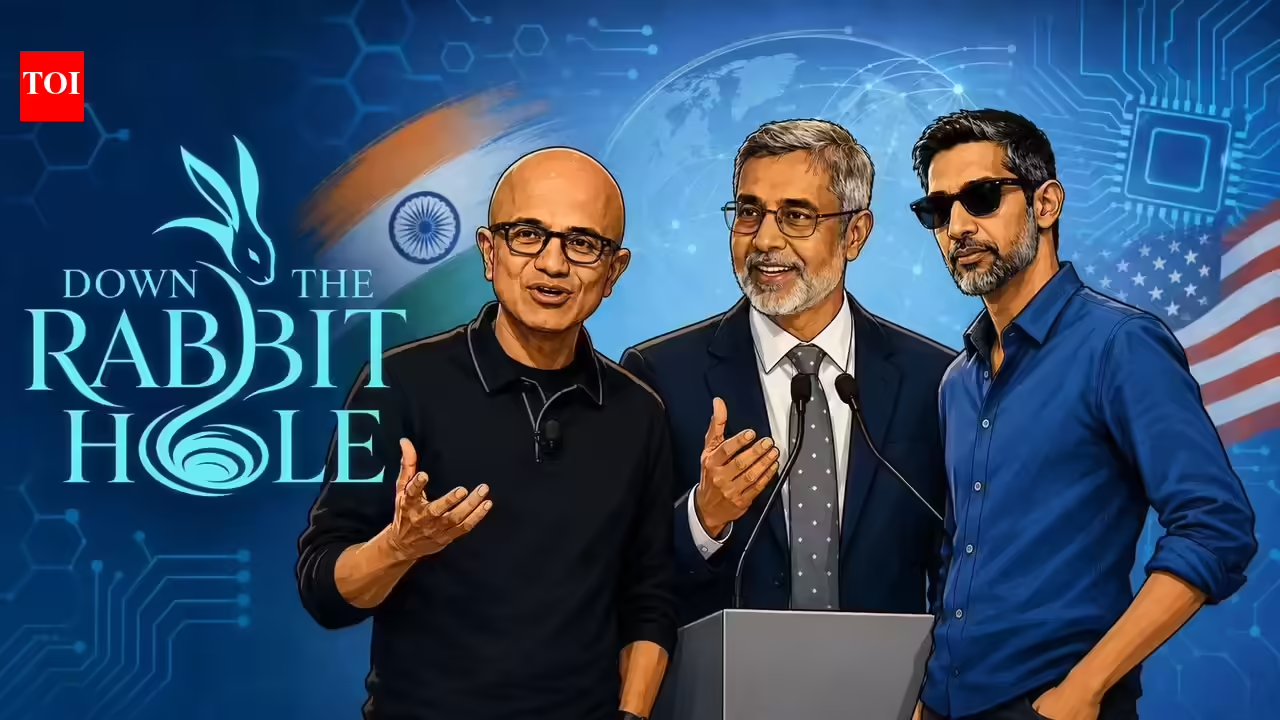
Even the most ardent, tanned-fully-orange MAGA supporter would admit that Trump 2.0 hasn’t gone according to plan. The Epstein files have hurt the Republicans more than Democrats. Iran has realised that it can hold the Strait of Hormuz hostage and dangle it like the Sword of Damocles over the global economy. China, unperturbed by bluster around reciprocal tariffs, is holding sermons on avoiding the Thucydides trap. The Middle East war expanded to engulf the entire region, including those that were hitherto considered untouchable, like Saudi Arabia and the UAE. Oil prices are through the roof, and the administration’s immigration policies are so haphazard that the world is wondering how America will host the FIFA World Cup in the year it celebrates its freedom in its semiquincentennial. But there has been one silver lining: the humour is off the charts, as it’s wont to be in societies going through tragicomic eras.Now, when one says humour, one doesn’t mean the late-night shows, which long ago turned into despondent pearl-clutching, proselytising and moral policing instead of anything that can make one chuckle, but the usual goings-on in the corridors of Washington, which are so surreal that they never would have made it to the scripts of shows like House of Cards or Madam Secretary.What show could imagine a president who wants to put his own face on the currency, a Secretary of Defence who is more frat-boy hazer than someone you would trust with a pickaxe, let alone the nuclear codes, and an FBI chief who appears more interested in handing out personally branded bourbon bottles than in the defence of the realm?This has made recent episodes of Saturday Night Live rather funny, though one will have to say it’s less comedy and more documentary at this point, with Colin Jost repping Pete Hegseth, Matt Damon playing a beer-loving Brett Kavanaugh and Aziz Ansari headlining as Kash Patel. From a remarkable rendition of Chumbawamba’s Tubthumping to jokes about polygraph tests — “draw a graph of everyone in the FBI that’s poly” — the last few cold opens have been comedic entelechy. But for many of us with a desi persuasion, the joke that hit home was Ansari’s Patel saying: “I am a trailblazer. I am the first Indian person to suck at their job. Everyone says that Indian people are smart, hardworking, incredibly intelligent, but I prove without a shadow of doubt that we can be just as incapable and incompetent as the whites.”All stereotypes, good or bad, often have a tinge of truth to them, and the idea that Indians are extremely capable and competent seems to have travelled the space-time continuum.The debate was revisited when Sanjay Mehrotra became the third Indian-American of note to head a tech company with a trillion-dollar market cap. The other two are Satya Nadella at Microsoft, which crossed $4 trillion in 2025, and Sundar Pichai at Alphabet, which crossed $3 trillion the same year.So why is America’s Silicon Valley handing Indian-born CEOs the keys to the kingdom in the age of AI? Perhaps because, in the old Silicon Valley debate between Founder Mode and Manager Mode, the age of AI has elevated a third figure: the Operator. Or why is AI standing for ‘actually Indian’ in 2026? For that, we have to, as this column promises, go deep into the rabbit hole.
Three origin stories
Anyone familiar with comics will know the importance of origin stories. Tony Stark would never have become Iron Man if he hadn’t been kidnapped by terrorists in a cave in Afghanistan. Batman wouldn’t have become a masked vigilante beating up mentally ill patients if his parents hadn’t been shuffled off their mortal coil in a dark alley. Mehrotra, Nadella and Pichai thankfully have less startling origin stories, but they share a common thread, even though the three came from very different Indias.Mehrotra was born in 1958 and came from the pre-liberalisation phase, having grown up in India in the early 1960s and 1970s. One of his most striking memories as a young student is jostling on a crowded Delhi bus with a mechanical drawing board and a T-square.His journey to the US was through BITS Pilani, though he did have two older siblings, both engineers, to look up to. His academic career hit a roadblock because, in the old days, he had reached BITS Pilani with just 11 years of school experience under his belt, which initially made him ineligible for US undergraduate admission. After two years of engineering school in India, he was admitted as a junior transfer student to UC Berkeley and other US universities. But it still looked very hard, and his US visa was rejected thrice before his belligerent father tracked down the consul in Delhi and badgered him until he agreed to stamp his son’s visa.Nadella, on the other hand, was born nearly a decade later in 1967 in Hyderabad to an IAS officer father and a Sanskrit lecturer mother, and did his engineering at the other MIT: Manipal Institute of Technology, where he got a degree in electrical engineering. Pichai, on the other hand, was born in 1972 and grew up in an India where a household telephone was still a landmark event. The young Pichai LARPed a little as a young Sheldon Cooper by remembering every single phone number. But even a soothsayer would have failed to predict that the young man who studied metallurgical engineering would one day be helming Google’s parent, Alphabet.They took different routes to the top.Mehrotra worked at Intel and other semiconductor companies before co-founding SanDisk in 1988. Now, SanDisk might not be glamorous in the same way as Apple, but most folks of our vintage remember storing everything on either small pen drives or huge hard drives, which we guarded like contraband because they had our entire library of shows or movies. A person’s social worth was often directly linked to the contents of his hard disk, and size definitely mattered.In 2016, Western Digital acquired SanDisk and Mehrotra became CEO of Micron Technology a year later, putting him at the centre of the memory business right before AI made memory chips one of the hottest parts of the semiconductor economy. Nadella, on the other hand, rose through Microsoft’s ranks building business software, servers, tools and cloud infrastructure, technologies that won’t have teenagers queuing outside stores but would define Microsoft’s future. Under him, Microsoft moved from its old Windows-first identity towards cloud and AI, helped by Azure, Microsoft 365, GitHub, LinkedIn and its partnership with OpenAI.Meanwhile, Pichai joined Google in 2004, working on Google Toolbar when Microsoft’s Internet Explorer lorded over the browser world, before being vanquished by one of Pichai’s babies: Chrome. He also worked on Google Drive, Gmail and Maps, and in 2013 took charge of Android. By the time he became Google CEO in 2015 and Alphabet CEO in 2019, he had become one of the few people trusted to operate the front door of the internet.Between the three, they juggled many of the bedrocks of modern technology that we take for granted while fighting with strangers about sportsmen and asinine political opinions: storage, cloud, search, browsers, memory, mobile operating systems and now AI infrastructure.And in their own way, they buttress the old Indian middle-class adage: complete engineering first and then the world will be your oyster.
Shared traits
The three also share similar traits: engineering before becoming managers. They are not silver-tongued finance bros armed with consulting-firm jargon, parachuted into tech firms to optimise synergies, improve ROAS, fix the moat or discover “efficiencies”. They are people who made their machines purr and hum before being asked to run them.It’s unlikely any of them would have the sort of messianic appeal that the likes of Elon Musk or Steve Jobs evoked. They spent years in the trenches before reaching leadership positions, as opposed to the Jungian Founder-Showman archetype that founded the companies they now manage: part magician, part king, part ringmaster, the figure who conjures the future with messianic vision.The troika, on the other hand, evoke a different archetype: the Steward-Operator.All three are translators: operating between engineering and management, product and policy, users and infrastructure. In their own way, they add a third dimension to the Founder vs Manager debate that started in 2024 after a Paul Graham essay.
The Operator in the age of Founder Mode vs Manager Mode
In 2024, Y Combinator co-founder Paul Graham, riffing on a speech by Airbnb founder Brian Chesky, argued that founders are often given terrible advice once their companies become too large. The advice usually goes something like this: hire good people, delegate authority, do not interfere too much and let professional managers run their departments.Graham argued that this risks turning the company into a set of black boxes. The founder is told to stay out of the details because getting too involved would be “micromanaging”. The professional manager takes over, the org chart becomes sacred, everyone starts using words like “alignment”, and somewhere in the middle of all this, the original instinct of the company quietly dies in a meeting room.
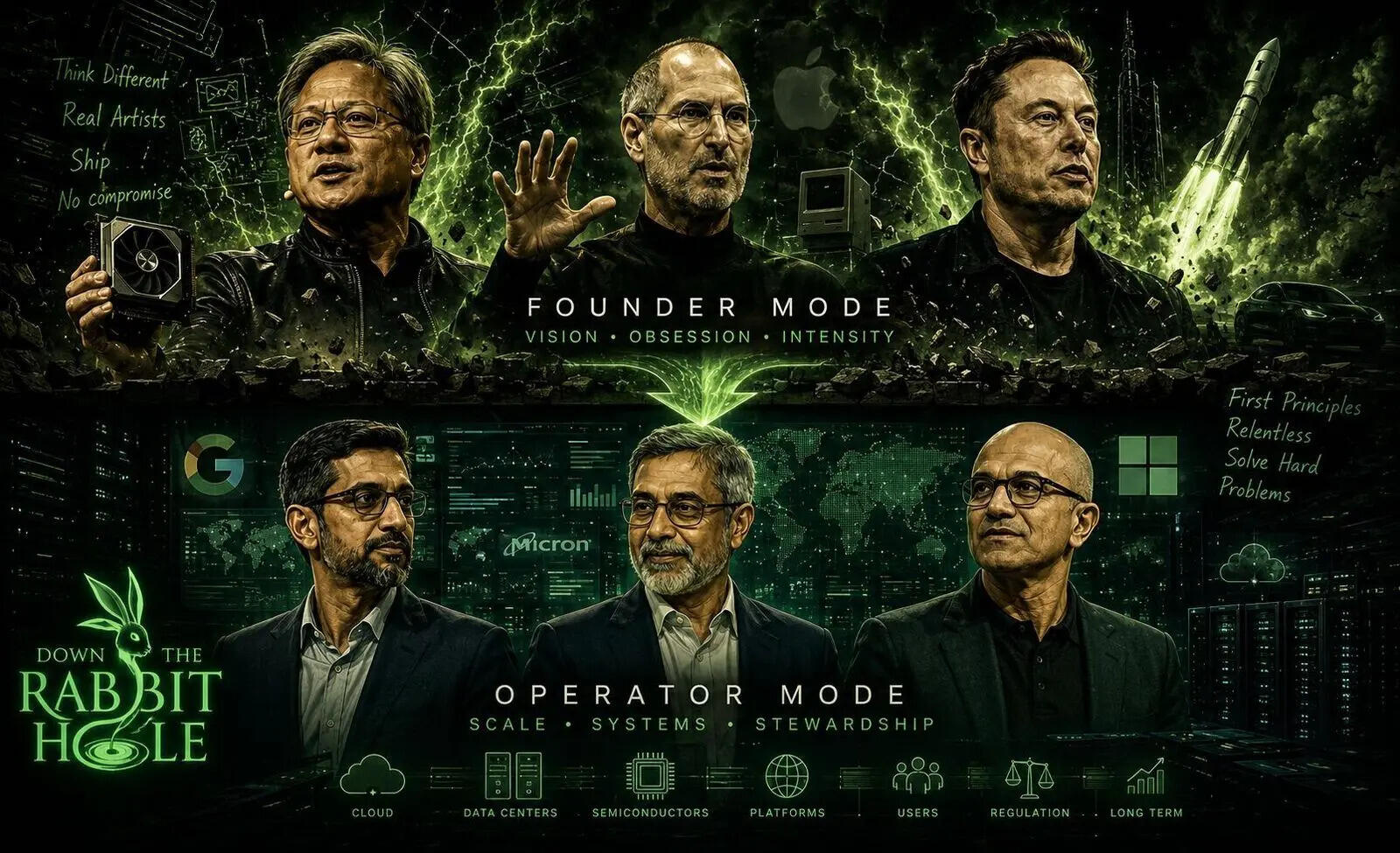
Founder Mode, in Graham’s telling, is the refusal to let that happen. It means staying close to the product, cutting through layers, asking uncomfortable questions and continuing to run the company with the obsessive intensity it had when it was still a start-up. It is the Silicon Valley ideal associated with Steve Jobs, Jensen Huang and Elon Musk: temperamental, obsessive, often unbearable, but capable of seeing around corners that a professional manager would turn into a committee.Both modes have their uses. Manager Mode gives a company stability, scale, order and predictability. Founder Mode gives it instinct, urgency, obsession and the occasional evolutionary leap. The problem begins when Manager Mode becomes bureaucracy and Founder Mode becomes narcissism with a product roadmap. One can suffocate a company with process. The other can burn it down because one man mistook his mood for vision.Graham ended his essay by arguing that we still know surprisingly little about Founder Mode, writing that founders had already achieved extraordinary things despite “a headwind of bad advice”, and wondering what they might do once people understood how to help them run companies like Steve Jobs instead of John Sculley. On the flip side, he also warned that founders who simply cannot delegate could use Founder Mode as an excuse.That is where Nadella, Pichai and Mehrotra complicate the binary.Silicon Valley’s largest companies are no longer scrappy start-ups looking for product-market fit. They are civilisation-sized machines with cloud contracts, data centres, antitrust battles, semiconductor supply chains, employees, investors and regulators spread across the planet. In the age of AI, their CEOs run civilisational machines whose decisions affect how billions of people work, search, communicate, learn, create or think.Nadella, Pichai and Mehrotra are not Founder-Showmen in the classic Silicon Valley sense, though Mehrotra did co-found SanDisk. Nor are they Manager Mode creatures floating above the machinery armed with consultant-speak and “approved” emails.They are Operators: technical men who understand the machine, patient climbers who spent years in the trenches, and translators who have a handle on engineering, management, policy, investors and infrastructure without sounding like passengers.In the age of AI, Operator Mode has become even more valuable. Microsoft must turn Azure into an AI distribution engine without losing the enterprise trust that made it powerful. Google has to rebuild Search around AI without killing its advertising business. Micron must supply the memory that lets AI systems store and move oceans of data. These are not founder-in-a-garage problems. They are gargantuan civilisational infrastructure issues.At this stage, charisma might help, but competence keeps the machine humming. The founder can build the temple. The manager may keep the queue moving. But it is the Operator who understands every part well enough to ensure that the process carries on unabated.
AI = Actually Indian
In 2024, Amazon’s Just Walk Out technology at Fresh grocery stores, touted as an AI-powered system where one could pick up items and be charged automatically, became the subject of widespread mockery after reports claimed the process relied partly on human reviewers in India. Amazon denied that workers were watching shoppers live, saying they reviewed and annotated data to improve accuracy, but the company later replaced the technology in many Fresh stores with Dash Cart, a smart shopping cart. The internet joke was that Amazon’s AI system was one where Artificial Intelligence stood for Actually Indian.As the age of AI dawns on our lives, that joke may turn out to be less wrong than intended. The true power of Artificial Intelligence may well be harnessed by actual Indians.There’s a certain irony to all this. As comedian Nimesh Patel once joked, Indians looked at America and came to a simple conclusion about the natives: “They like to sleep, they like to eat, they like to drive. So they’re going to need gas stations, motels and cardiologists. Gas, beds and meds, baby.”So they decided to own gas stations, create a motel mafia and become doctors. It was immigrant capitalism at its most practical. Observe the host civilisation’s appetites, identify the recurring need, then quietly build the infrastructure around it.The AI-age update is only slightly more expensive. America likes to prompt, search, scale and panic about China. So it will need cloud, memory and models. It will need people who understand the pipes, the platforms, the chips, the servers, the interfaces and the unglamorous systems that make the magic trick work.The old diaspora economy was gas, beds and meds. The new one is prompts, chips and clicks. Still operated by Indians. Thank you, come again.


JUST IN: Political Aide Sacked After Calling on Tinubu to Resign

Pop Queen Madonna’s b00bs spill out of her dress in racy video to kick off Pride Month (Video)

Tinubu returns to Abuja after holiday, official engagements

Plateau attack: Eight victims laid to rest amidst tears, anger

Imota LCDA debunks kidnap, killing report in school
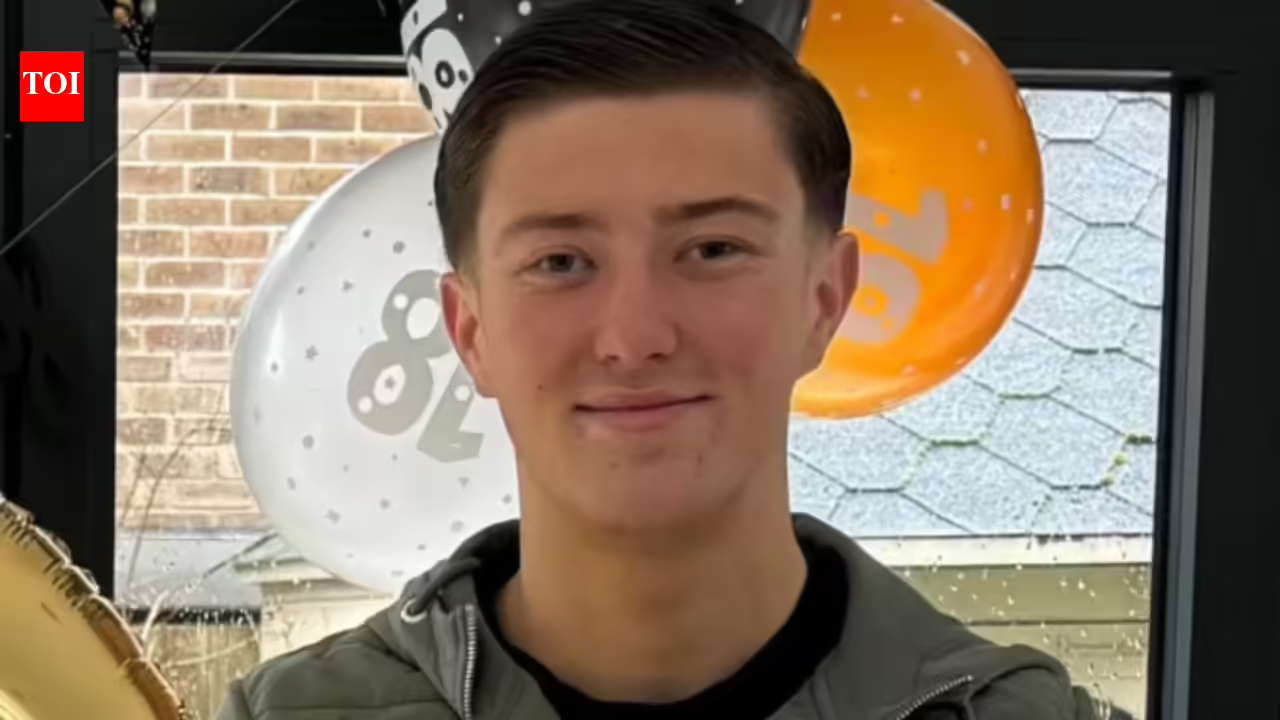
Who was Henry Nowak? 18-year-old UK student killed in Southampton stabbing

SCOAN Marks 5 Years Of T. B Joshua’s Enduring Legacy

 World3 days ago
5/30: Saturday Morning
- Breaking2 days ago
I received a threatening call simply because I spoke about Nigeria bleeding, Russian-born actress Fari Elysian reveals
- World2 days ago
Silence from the White House after Trump said he would make a "final determination" on Iran
- Breaking1 day ago
Father allegedly left baby daughter in bathtub filled with water while he scrolled on his phone in another room
- Breaking1 day ago
Content creator Mark Angel weds again months after ex-wife did exposé on him and he admitted if he were his daughter he wouldn’t marry a man like himself (video)
- World1 day ago
Iran issues horror threat to attack Israel as Trump's ceasefire collapsing
- News3 days ago
Kalu applauds Tinubu’s courage, rallies support for Renewed Hope agenda
- News3 days ago
IG promotes 17,952 junior police officers nationwide