World
Five of the Main Challenges Awaiting Britain’s New Prime Minister

This Video Is Trending Right Now
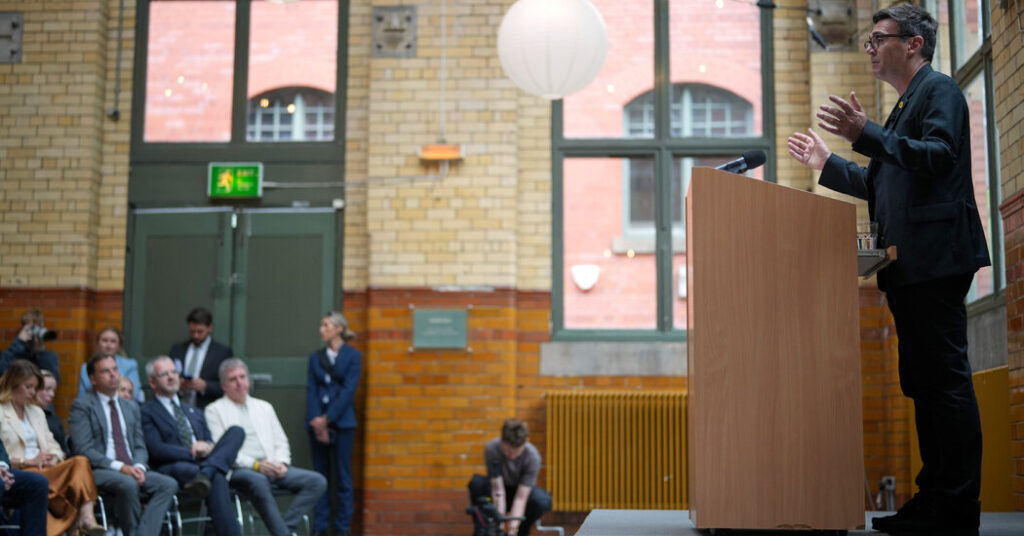
It’s the biggest job in British politics, and Andy Burnham has had relatively little time to prepare. Once installed in Downing Street as prime minister on Monday, Mr. Burnham will need to make dozens of decisions each day, resolve disputes among ministers and act as the political figurehead of the government.
He faces a long and daunting list of issues facing 21st-century Britain. Here are some of the big ones.
1. An economy in the doldrums
After years of stagnating living standards dating back to the 2008 global financial crisis and made worse by Brexit and the Covid-19 pandemic, Mr. Burnham needs to introduce tangible improvements for Britons. He has vowed to stick to his party’s 2024 general election pledge not to increase the main taxes, however, and will face many of the same challenges as Keir Starmer, whom Mr. Burnham is replacing as prime minister. One key decision: who will be chancellor of the Exchequer.
2. Conflicts abroad and a fraying ‘special relationship’ with the United States
With the war in Ukraine continuing and the conflict in the Middle East escalating, foreign policy will be an unavoidable priority even if Mr. Burnham might prefer to focus on domestic issues. So far, the indications are that Britain’s stance on the two conflicts is unlikely to change significantly, given that Jonathan Powell, who played a key role as Mr. Starmer’s national security adviser, is expected to remain in his job.
Mr. Starmer cultivated close ties with President Trump before enraging him by refusing to give his full-throated support for the U.S.-Israeli attacks on Iran. The United States remains Britain’s most important security partner, but Mr. Trump and his policies are deeply unpopular here. So the new prime minister will have to decide how to balance those considerations and how much energy to devote to cultivating a mercurial U.S. president.
3. Finding more cash for military spending
Frustration over military spending levels prompted the resignation last month of Mr. Starmer’s defense secretary, John Healey, who argued that a proposed increase in the money destined for the military was insufficient. A few weeks later, Mr. Starmer announced plans to raise military spending by 15 billion pounds (about $20 billion) over the next four years. But he left the details of where that money would come from — and which departments might need to cut their budgets as a result — to Mr. Burnham.
4. Navigating a knotty immigration debate
Net migration to Britain has dropped sharply in recent years because of more restrictive policies introduced at the end of the previous Conservative government’s term in office, which the Labour Party has continued and extended.
However, opinion polling suggests that concern about immigration remains a top issue for many voters, and only a minority of people surveyed are aware that net migration has fallen.
In May, Mr. Burnham acknowledged that the “trend is significantly down,” but said that net migration “needs to fall further.” He has signaled that he will largely continue the tough policies of Mr. Starmer’s home secretary, Shabana Mahmood. Her approach, including making it harder for legal migrants to gain permanent residency, has provoked opposition among some Labour lawmakers and progressive voters, so Mr. Burnham may try to find a compromise.
5. The rising cost of welfare and pensions
Britain’s welfare bill is rising. One reason is the growing number of claims from working-age people with mental health conditions, many of whom are young and unemployed. But the biggest chunk of Britain’s social security spending — more than half of the total — goes to retired people, through state pensions and other support. That spending has been pushed higher by an aging population and the so-called triple lock, which guarantees pensions increase by the highest of three measures.
Controlling those costs could free up resources for other policies, including Mr. Burnham’s plan to build more social housing. But Mr. Starmer’s efforts to curb welfare entitlements provoked a rebellion among Labour lawmakers that forced him to retreat, underscoring the political challenge of the task.


3 Underrated Songs From the Late 90s That Accidentally Invented 2000s Indie Rock

AAGP gets major boost as ECOWAS member states sign historic intergovernmental agreement

Family members of Argentina players detained after FIFA World Cup final loss to Spain

Will a Sex Scandal Matter in an Arizona House Race?

Kwankwaso opposes Tinubu’s Muslim-Muslim ticket

NYSC announces August 5 for 2026 Batch B Stream II orientation

Veteran Was Targeting ICE in Attack on Federal Building, Authorities Say

 Society3 days ago
Heartbroken Girlfriend Storms Studio To Remove Portrait Tattoo Of Cheating Boyfriend From Her Back
- Breaking2 days ago
Ondo police arrest father for burning his 10-year-old daughter’s private part with hot iron over bedwetting
- Society17 hours ago
2026 Ballon d’Or: Top 4 players to win award after World Cup final revealed
- Investigation2 days ago
âI canât date a man who earns less than me. Iâve supported men financially before, and Iâm done with thatâ â Mercy Eke
- Society14 hours ago
Pepper Seller Caught On Camera Applying Pepper On Newborn Baby As Rituals To Usher Her Into The Business
- World24 hours ago
Spain earns $51 million for World Cup win and runner-up Argentina gets $34 million as total payout for all 48 teams hits record-high $871 million
- Investigation2 days ago
US President Trump questions Thomas Tuchelâs tactics in England World Cup loss to Argentina
- Society2 days ago
Man Finds Beautiful Lady Stripped Totally ‘Nɛkɛd’ In Deep Forest, Says She Doesn’t Know How She Got There