World
Judges accused of denying Sikh student points in national civics contest

This Video Is Trending Right Now
The Education Department hosted a televised civics game show for students last month to celebrate America’s 250th birthday. Weeks later, the results are being disputed and members of Congress called the contest “rigged”after judges rejected a Sikh student’s answers.
And constitutional law experts who reviewed the questions and answers are torn.
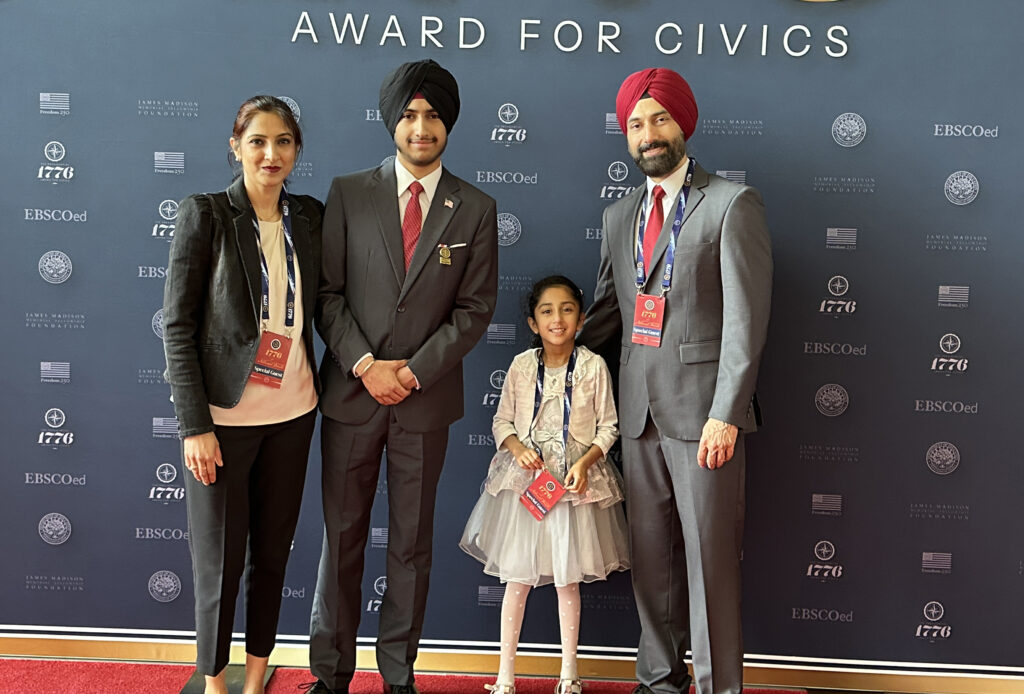
Aangad Singh, 15, had studied for months for the Presidential 1776 Award, hosted in partnership with a constitution education group. His family had forgone vacations so he could stay home and practice. When an illness spread through their Connecticut home, everyone donned masks so that Aangad could stay healthy enough to keep studying.
Under bright lights at the Kennedy Center on June 9, he stood before the cameras alongside seven other contestants in a suit and turban for the taping of the show, hosted by TV personality Mario Lopez. He answered questions about federal courts, declaring war, and slavery incorrectly, according to the judges — mistakes that led to his elimination from the competition.
Okay, that happens, he reasoned. But something felt off to him and his parents. He would later learn that if at least one his answers had been scored differently, he could have advanced in the competition — and contest organizers were unwilling to address the alleged discrepancies.
After his experience was reportedthis week by NOTUS, the congressional Asian Pacific American Caucus called foul in a post on X.
“Why did the judges improperly grade a Sikh student’s correct responses as wrong?” the group asked. “Why did the Department of Education refuse to conduct a review? This Trump-led civics competition has the words RIGGED written all over it.”
To Aangad, it’s straightforward: If he answered a question correctly, he should have been awarded points. He’d been told by his parents, who immigrated from India in the early 2000s, that in the U.S., hard work gets rewarded and success is based on merit. But the civics competition challenged the family’s concept of what’s fair.
“We try to do everything right. We follow the laws, we follow the rules, we pay our taxes. We do everything right that’s expected of good citizens, and the only thing we want in return is justice,” said Aangad’s father, Bhalindar Singh, who immigrated in the pursuit of a good education. “I know it’s a different world that we live in, not everybody feels that way.”
After watching the broadcast on June 30, Aangad’s family debated what to do, and eventually decided to send an email July 14 to the Education Department asking for a review of the responses and information on the scoring. Their emails went unanswered for days.
On Tuesday, an agency official told them in an email that they enjoyed working with Aangad and directed them to rules stating the judges’ decision is “final and binding.”
The civics competition was unveiled early this year as one of many celebrations of America’s semiquincentennial. The event tested high school students on the country’s founding, the Constitution and other historical documents. Aangad, who is used to public speaking, decided to give it a shot.
“I just thought it was an extraordinary opportunity to really delve into the founding documents,” he said in an interview with The Washington Post. “I did it mainly for the learning aspect of it, going deep into our history.”
The competition consisted of three rounds: an online multiple-choice exam, an in-person oral competition and the final show at the Kennedy Center. The top three finalists would split a $250,000 scholarship prize and get to visit with President Donald Trump in the Oval Office.
For weeks, Aangad would return home from school, have a snack and a glass of milk, then study. His father peppered him with questions about the Constitution and the American Revolution.
He passed the online test and made it through the oral competition.
At the televised finals, he advanced through the third challenge before getting eliminated with most of the other students.
It came as a surprise, Aangad said. There was no scoreboard, so it was unclear how many points each participant had racked up.
After Aangad left the stage to join his parents in the audience, he replayed every answer in his head. He pulled up the Constitution on his phone, hoping to see where he’d messed up.
“We didn’t know where he lost the points,” his father said.
Then his competitors suggested something was amiss. “They were like, ‘I don’t know what happened. We don’t know how he did not make it to top three,’” Bhalindar recalled another parent saying. “They were, kind of, more shocked than us.” But without knowing the official score, they couldn’t know for sure.
Later, the winner would tell her hometown paper she was surprised at who made it to the top three.
Weeks passed, and Aangad went back to his normal routine. He played pickleball and prepared for a public speaking competition in California. On June 30, he watched the game show’s broadcast on CBS with his family.
After the third challenge, a scoreboard flashed on screen.
Aangad was in sixth place with 16 points. He had just missed a question about federal courts.
“According to Article III of the U.S. Constitution, in which cases do the federal courts have jurisdiction? List at least four for full credit,” the proctor said.
“Our federal courts have jurisdiction over maritime or admiral jurisdictions; cases in which the state may be a party and citizens of another state; controversies between citizens of different states; controversies between multiple states; and controversies in which a state and a subject of a foreign nation is involved,” Aangad said.
The judges said just three of them were correct. Some constitutional experts are split.
“They’re basically accurate,” David Super, a Georgetown Law professor whose expertise includes constitutional law, said about Aangad’s answers. He said he would have given the teen credit.
Elizabeth Earle Beske, a constitutional law professor at American University, said the judges’ grading was “stingy,” but ultimately agreed with them.
Maeva Marcus, a leading constitutional studies scholar at George Washington University, said the categories Aangad named were originally in Article III, but two of them were removed by the 11th Amendment. “He was wrong,” she said. “The judges were right.”
If that is the case, the question should have been worded differently, the Singhs said.
In the fourth challenge, a lightning round where students scored points by answering as many questions as possible in 30 seconds, Aangad was asked which amendment ended slavery. “Thirteenth,” he said. A red X flashed on screen.
It was the correct answer — when other students provided that response, they earned two points. Aangad still doesn’t know why he wasn’t awarded points as well. However, the broadcast’s captions show that Aangad said “13th.”
The questions were developed and scored by the James Madison Memorial Fellowship Foundation, which works to improve the way the U.S. Constitution is taught in schools. The organization’s board, appointed by the president, includes Education Secretary Linda McMahon and circuit court Judge Raymond Kethledge, who was on Trump’s Supreme Court shortlist in 2018.
The foundation’s leaders did not respond to multiple requests for comment about the competition or how it was scored.
In response to questions from The Post, the Education Department referred to the competition’s rules.
“The contest was designed so that judges exercised independent good faith judgment in selecting finalists and winner,” a spokesperson said in an email. “This fact was outlined in the competition rules to which every participant agreed.”
The judges did not respond to requests for comment.
Katy Forsythe, a high school social studies teacher who proctored the game show, said her role was to read questions and relay the judges’ rulings.
“The main relevant context is that everyone involved in the competition is under contract to help maintain its integrity,” Forsythe said in an email. “As with any dispute, I will put my faith in the due process of law enshrined in our Constitution rather than the court of public opinion.”
If Aangad had scored points for either of the missed questions he would have made it to the final round and secured at least $25,000 in scholarship money, according to calculations by his family and The Post.
That fact has nagged at him since he left D.C.
In an emailed response to the family’s request for a review of Aangad’s incorrect answers, an Education Department staffer called Aangad an “incredibly personable and driven student,” but did not answer questions about how the competition was scored.
“They did not engage with the substance of our questions,” Bhalindar said. He’s grown distrustful; he isn’t sure if bias is at play. “The more you withhold the facts, the more suspicious it becomes.”
Aangad’s mom, Ramandeep, can’t help but wonder if her son, a first-generation American, a Sikh boy in a turban, was denied what he deserved.
“Talk to me, clarify my doubt,” she said about the contest organizers. “Tell us the reason this question is marked incorrect. At least that will give us some closure.”
Aangad is a bit more diplomatic about it all.
“I don’t think we can jump to conclusions until we actually have the information. There’s nothing more dangerous than just throwing around baseless conclusions,” he said, adding that all the students he competed against deserved to be there. “Right now, we’re just trying to solidify the facts, what actually happened.”
If he was wrong, he’ll accept it, he said. His dad said the family won’t stop until they know for sure.
“We just want some justice, you know?” Bhalindar said. “I mean, in the United States, that shouldn’t be an exception.”


GOP lawmakers bracing for a rough summer recess: Politico

School Pupils Risk Lives Crossing River By Canoe To Attend ‘Our Day’ Celebration In Western Region Community

Kaduna NDC gov candidate rejects imposition claim

2027: I have no intention to dump APC for APM – Ex-Tinubu’s minister, Adelabu

Family of grandma killed in senseless stabbing outside mall reveal heartbreaking new details

A federal appeals court rejects Trump’s bid to keep in place the $100,000 H-1B visa fee

Trump roasts his own Cabinet member during WHCD speech: ‘He’s a piece of work’

 Investigation2 days ago
Married woman humiliated after allegedly being caught cheating on her husband with another man in Kogi community
- Investigation2 days ago
âIt is an honour to stand with you in fight against terroristsâ- Trump tells Tinubu
- Society2 days ago
FULL TEXT: Trump’s letter to Tinubu
 Breaking1 day ago
âFailed nation, failed parenting and lack of home training’- Lawyer, Deji Adeyanju blasts podcast host for saying a poor man has no place in her heart’
- Society3 days ago
Etafia appointed Young Africans goalkeeper trainer
- Investigation3 days ago
âI just landed in Lagos and everything was smoothâ â Foreigner reacts after arriving in Nigeria despite online warnings
- News3 days ago
Yomi Gold Breaks Silence After Business Losses
 Investigation2 days ago
âI have gone back to our family â- Gov. Fubara says as he declares support for Wike’s governorship candidate