National
Lagos journalists trained to strengthen reporting on corruption, illicit financial flows

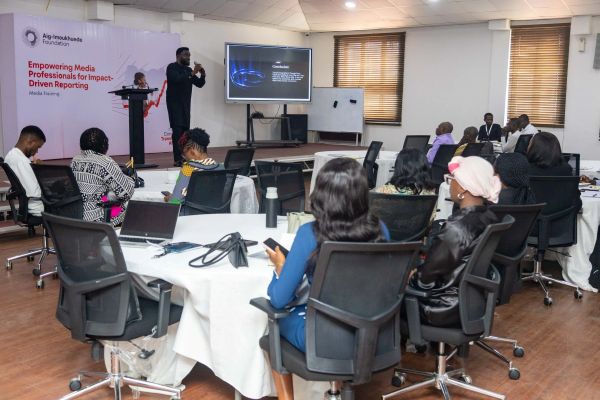
Journalists, media practitioners and civil society representatives recently gathered in Ikeja, Lagos State, for a workshop aimed at strengthening the media’s capacity to investigate and report on corruption and illicit financial flows (IFFs) in Nigeria.
The workshop was organised by the Africa Network for Environment and Economic Justice (ANEEJ) in partnership with SecFin Africa and the Nigerian Financial Intelligence Unit (NFIU), under the project, “Strengthening CSOs and Media Capacity to Promote Transparency and Accountability.”
The initiative is being implemented with support from the European Union.
According to the organisers, the training was designed to sharpen participants’ investigative skills, deepen their understanding of how illicit financial flows operate, and foster stronger collaboration among journalists, civil society organisations and anti-corruption institutions.
They described such partnerships as essential to curbing the vast resources Nigeria loses annually to corruption, money laundering and related financial crimes.
The organisers noted that corruption remains one of the greatest obstacles to Nigeria’s development.
Speaking at the opening of the workshop, the Editor-in-Chief and Chief Operating Officer of Premium Times, Musikilu Mojeed, described corruption as the country’s biggest impediment to progress.
He commended the organisers for offering the training free of charge, noting that similar programmes elsewhere often cost participants hundreds of dollars.
“We are discussing procurement, corruption, money laundering and transparency. These are complex but critical issues that we all need to understand,” Mojeed said.
He urged journalists to expand and deepen investigative reporting on corruption, stressing that specialised training opportunities should be extended to more states and reporters across the country.
“The major problem we face in our country is corruption. If we don’t tackle it, our nation cannot make the progress it deserves,” he said, adding that building journalists’ capacity to report accurately on financial crimes is crucial to national development.
Mojeed also encouraged participants to share the knowledge gained with colleagues after the workshop.
Ms Aisha Bantam, delivering the NFIU’s goodwill message, described the media as one of the most powerful institutions in a democratic society, saying its role in exposing financial crime is indispensable.
“Every illicit dollar that leaves Africa unlawfully represents a school not built, a hospital not equipped, a road not completed, or an opportunity denied to future generations,” she said.
She described the fight against illicit financial flows as both a national security priority and a development imperative.
Bantam explained that financial crimes have become increasingly sophisticated, transnational, and technology-driven, with criminal networks exploiting weaknesses in financial systems, transferring illicit funds across borders and concealing the proceeds of crime through complex ownership structures.
“Exposing such schemes requires informed, ethical, professional and dedicated journalism,” she said.
She highlighted the NFIU’s support for investigations into corruption, money laundering, terrorism financing, organised crime, kidnapping for ransom, cyber-enabled fraud, and oil theft.
She also pointed to the Joint Financial Intelligence Collaboration (JFIC), which brings together government agencies and the private sector, as an internationally recognised model for combating financial crime.
According to Bantam, the NFIU has also advanced beneficial ownership transparency, strengthened targeted financial sanctions and improved intelligence-sharing frameworks to protect the integrity of Nigeria’s financial system.
With Nigeria preparing for its 2027 Financial Action Task Force (FATF) Mutual Evaluation, she said the media has a crucial role in shaping public understanding of financial integrity issues.
“Accurate reporting on corruption, money laundering, beneficial ownership, terrorism financing, sanctions implementation, asset recovery and financial transparency contributes significantly to building a culture of accountability and compliance,” she stated.
While noting that financial intelligence is confidential by nature, Bantam said the NFIU remains committed to engaging more closely with journalists.
Representing SecFin Africa, Professor Abdullahi Shehu told participants that illicit financial flows, driven by corruption, money laundering, tax evasion, trade misreporting, procurement fraud and profit shifting, continue to divert enormous resources from productive use in Nigeria and across Africa.
“Every naira lost to illicit financial flows is one less available to fund education, healthcare, infrastructure, social protection, environmental sustainability and public trust in government,” he said.


House of Representatives Advances 13 Commerce Bills, Prioritising AfCFTA Domestication for Enhanced Trade and Digital Economy

Keke Palmer gushes over ‘genuine’ chemistry with ‘Hot Ones’ host Sean Evans after NYC date

People Look Down On Me Like I’m Nothing — Woman Living With Hirsutism Opens Up On Stopping Shaving

Is GehGeh Married? The Truth Behind the Alleged Marriage, Viral Wedding Photos and Videos

Lagos seals six iron, steel companies in Ikorodu over environmental violations

I prayed my grave wouldn’t be in the forest — Oyo school principal

Man reacts to video allegedly showing Oko Poly hostel before collapse, says he has âno sympathyâ for victims

 Investigation3 days ago
âThey believe Presidency will write resultsâ â Kwankwaso speaks about Governors joining the APC
- Investigation2 days ago
Iâm running for a fourth term as President of the United Statesâ – President Trump
- Investigation3 days ago
âI hate when men call women gold diggers. If you can’t afford it, don’t dateâ â Actress Bukky Wright shares her views on relationships
- Investigation3 days ago
âI am in the era of overcoming my fear" – Nigerian acid attack survivor writes as she reveals her amazing transformation after getting a beauty makeover
- Breaking1 day ago
âIf my son ever gets a girl pregnant, he’s leaving my house immediatelyâ â Cardi B shares parenting stance
- Investigation2 days ago
IG did not issue âshoot-on-sightâ order in Benue- Police
- Investigation22 hours ago
âThe Olodo uprising term was not coined by meâ â Nigerian musician Ycee
- Investigation3 days ago
2027: "The Grave is not a witness box" â Atiku accuses Obasanjo of using late Speaker NaâAbba for Politics