World
Nanobubbles Tested In Reflecting Pool: Engineers deploy ozone system; scientists eye oxygen-starved seas

This Video Is Trending Right Now
zThe Lincoln Memorial Reflecting Pool in Washington, DC has become more than a landmark. It is now a real-world testing ground for nanobubbles, microscopic gas bubbles that can clean water, control algae and may eventually help restore oxygen-starved lakes and seas.Ahead of celebrations marking the 250th anniversary of the US Declaration of Independence, authorities turned to the technology after the famous reflecting pool developed a bright green algal bloom, despite having undergone a major clean-up only months earlier.To tackle the problem, a US$1.7 million (£1.27 million) ozone nanobubble system was installed. The equipment injects microscopic ozone bubbles into the water, helping to break down algae and organic matter while keeping the pool clear.Although the system has proved effective in a controlled setting, scientists say its greatest promise could lie far beyond ornamental pools, in some of the world’s most polluted lakes, reservoirs and coastal waters.
What are nanobubbles?
Nanobubbles are extremely small gas bubbles, commonly filled with oxygen, air or ozone. Unlike ordinary bubbles that quickly rise to the surface and burst, nanobubbles can remain suspended in water for much longer.When ozone is used, the bubbles act as a powerful oxidising treatment, attacking algae and organic material that cloud the water.That made them well suited to the Lincoln Memorial Reflecting Pool, which is shallow, has a hard artificial base and relies on clear water to maintain its appearance.The pool is also much easier to manage than a natural lake because the water can be circulated continuously and the treatment can be carefully controlled.
A bigger challenge beneath the surface
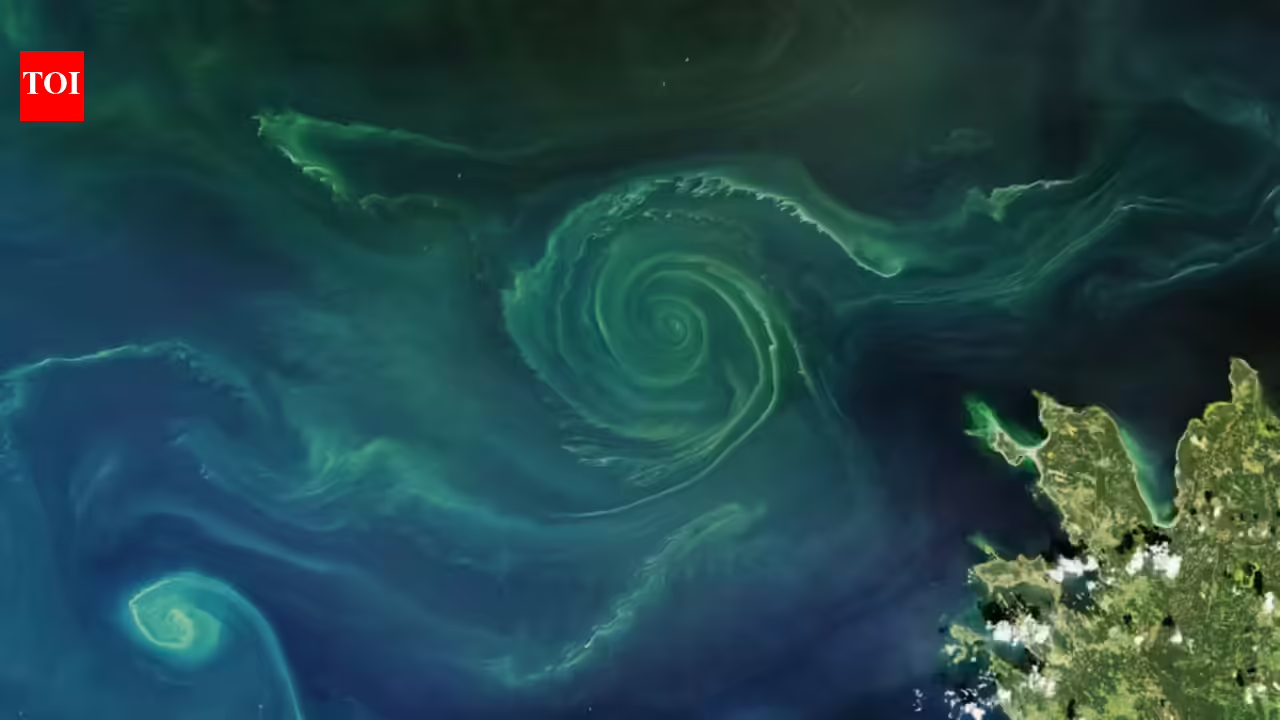
Cleaning an ornamental pool is only part of the story.Scientists are now investigating whether nanobubbles can tackle a far more difficult environmental problem, restoring oxygen to lakes and seas where aquatic life is disappearing from the bottom up.Many lakes and coastal waters suffer from eutrophication, a condition caused by excessive amounts of nutrients such as phosphorus and nitrogen entering the water through sewage, fertilisers and agricultural runoff.The extra nutrients encourage rapid algae growth. While the blooms are easy to spot on the surface, they are only one sign of a much larger problem.When the algae die, they sink to the bottom where bacteria begin breaking them down. This process consumes large amounts of oxygen, leaving the deeper water hypoxic, meaning oxygen-poor, or even anoxic, where oxygen is almost completely absent.Once oxygen levels collapse, the lake or sea floor starts releasing more phosphorus trapped in the sediment. Those nutrients then feed even more algal blooms, creating a cycle that becomes increasingly difficult to break.Fish die, biodiversity declines and large areas of water can become so depleted of oxygen that they turn into so-called “dead zones”.
Delivering oxygen where it is needed most
For years, engineers have searched for ways to increase oxygen levels in damaged water bodies.The challenge is not simply adding oxygen to the water. It is getting oxygen to the thin layer where the water meets the sediment at the bottom. This is where phosphorus is released, methane is produced and many of the chemical processes that damage ecosystems take place.Researchers are exploring two different ways of using nanobubbles.The first involves bulk nanobubbles. Machines pump oxygen-filled or ozone-filled nanobubbles throughout the water. This method already works well in fish farms, wastewater treatment plants, swimming pools, tanks and smaller bodies of water where circulation can be maintained.Using the same approach in large lakes or seas is much more complicated.The equipment must run continuously and depends on pumps, pipes, cables and electricity to distribute oxygen. Covering large areas would require extensive infrastructure while still offering no guarantee that enough oxygen would reach the bottom sediments.
A different approach using sinking particles
Scientists are also studying another technique that could reduce those challenges.Instead of dispersing bubbles throughout the water, oxygen nanobubbles can be attached to the surfaces and tiny pores of solid materials such as modified clay or other naturally porous particles.These oxygen-loaded particles sink under their own weight and deliver oxygen directly to the sediment layer where it is most needed.The approach could reduce energy use while avoiding some of the ecological disruption caused by large-scale artificial mixing of lakes and seas.If enough oxygen reaches the sediment surface, it may reduce the release of phosphorus, suppress methane production and create healthier conditions for aquatic life living near the bottom.Unlike traditional oxygenation projects, the goal is not to oxygenate the entire lake or sea but to target the area where many of the environmental problems begin.Scientists caution that the technology is not a complete solution. If untreated sewage or fertiliser runoff continues entering rivers, lakes and coastal waters, oxygenation alone cannot stop eutrophication.Instead, restoration depends on removing excess algae and nutrients from the water, locking nutrients into bottom sediments and maintaining oxygen at the sediment surface to reduce future nutrient release.
Lessons from the Baltic Sea
The importance of targeted oxygen delivery is illustrated by the Baltic Sea, one of the world’s best-known oxygen-depleted marine environments.The sea is naturally vulnerable because it exchanges relatively little water with the ocean through its narrow connecting waterways. It also has distinct surface and deep-water layers that rarely mix, allowing oxygen levels in deeper water to fall while nutrients continue to leak from the seabed.One of the most ambitious attempts to tackle the problem began in 2009 through a deep-water oxygenation project.The plan relied on around 100 offshore wind-powered pumps to move oxygen-rich water from depths of about 50 metres down to oxygen-starved water roughly 125 metres below the surface.While pumping increased oxygen levels, the project also highlighted the scale of the challenge. Such systems require major infrastructure, ongoing maintenance and significant energy, while also raising questions about long-term costs and possible impacts on natural water circulation and marine ecosystems.Researchers believe oxygen-carrying nanobubble-clay materials could offer an alternative by allowing oxygen to sink naturally to the seabed, potentially lowering both energy use and ecological disturbance.


2026 World Cup: Trump speaks on FIFA’s shock decision to reverse Balogun’s red card

PFIPC scandal: Turaki PDP faction seeks independent investigation

Nigerian man d!es in South African police custody

‘Very dangerous’ Super Typhoon barrels towards US Pacific islands with 280 kmph winds

Gunmen storm Plateau smoking spot, kill three, injure teenage girl

US-based Nigerian woman recalls how a friend cut her off after she advised him to dump his fiancee over a crime she committed

World Cup: French players with most goals for country, club in history [Top 5]

 National1 day ago
Against Nigerian Law, CBN Deputy Governor Emem Usoro Allows Her Eleven Years Old Twin Daughters To Be Company Boss
 Investigation2 days ago
Inside American businessman Michael Rubinâs annual White Party with A-list celebrities in attendance (photos/video)
- World1 day ago
Girl, 16, repeatedly raped by her older brother who 'saw his late wife in her'
- Investigation2 days ago
Oyo state govt denies VDMâs claim of paying ransom for release of abducted students and teachers
- Investigation2 days ago
"Sometimes a man can genuinely love a woman and still not marry her because his spirit isn’t at peaceâ â X user shares opinion
- Investigation1 day ago
âWhatâs my sin?â â TV host Morayo Afolabi-Brown reacts after caller cÂ¥rses her over questions asked during interview
 Society14 hours ago
Sad Video emerges showing Kenyan Lady working in the Middle East crying in distress
- Investigation3 days ago
âSheâs ignoring my late husbandâs will and trying to take all his propertiesâ â Demola Serikiâs third wife, Sholape, calls out co-wife Wosilat Okoya Seriki