News
NASA Launches First-Ever Space Rescue Mission to Save Falling Telescope

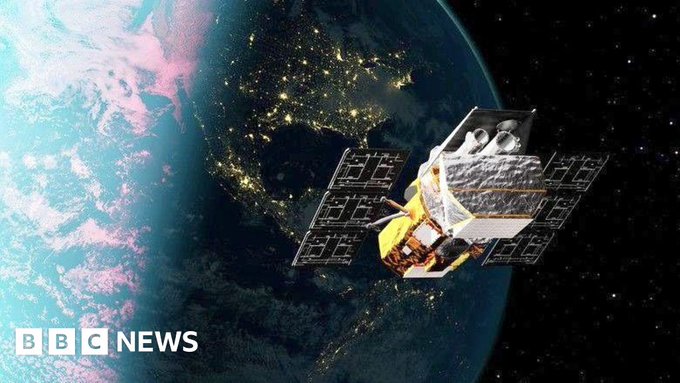
(Engineers from Katalyst Space Technologies built their rescue robot in record time. Photo by New York Post)
A NASA-funded spacecraft has been launched into space on an unprecedented mission to rescue a falling telescope.
The Swift observatory, which detects some of the most powerful explosions in the universe, is at risk of crashing back to Earth in the coming months.
A small rescue craft called LINK will attempt to intercept it, grab hold of it using three robotic arms, and lift it back into a stable orbit.
The mission, launched on Friday, has never been attempted before.
Space scientist Dr Simeon Barber, a senior research fellow at the Open University, described it as high risk, though he noted that NASA clearly considers it worth attempting, and that the scientific community shares that hope given how important the telescope is for studying extreme high-energy phenomena that cannot be observed any other way.
Swift is falling because heightened solar activity has caused Earth’s atmosphere to expand outward to the point where it now touches the observatory, creating drag that gradually lowers its orbit. When first launched, Swift orbited at roughly 373 miles above Earth; it has since dropped to around 220 miles, with most of that decline occurring in just the past two years.
While satellites regularly fall and burn up on re-entry, Swift holds particular scientific value among researchers who use it to study the earliest moments of the cosmos.
Roughly the size of a large car, the observatory was launched in 2004 carrying three telescopes designed to study the universe’s most powerful explosions, which result from the violent deaths of giant stars and the collisions of the remnants they leave behind.
These events release as much energy in a matter of seconds as the Sun will emit over its entire ten-billion-year lifespan, and because such moments are fleeting, the spacecraft was built to respond quickly, giving rise to its name.
Given that nothing else like Swift exists, NASA determined it was worth saving and handed the task to engineers at Katalyst Space Technologies, a young company based in Flagstaff, Arizona.
According to the firm’s Chief Executive, Ghonhee Lee, the team had less than a year to launch the mission before Swift dropped below an altitude of 186 miles, the point past which rescue would no longer be possible.
In a news release issued earlier this month, Lee described what his team accomplished in just eight months as extraordinary, noting that they designed, built, tested and integrated a robotic spacecraft capable of carrying out one of the most ambitious commercial servicing missions ever attempted.
The resulting spacecraft, LINK, is a three-armed robot roughly the size of a refrigerator, equipped with cameras, guidance systems and small thrusters.
Having launched on Friday, it will spend the coming weeks gradually activating its systems, including power, navigation, and its cameras and sensors, while engineers confirm that each component survived launch.
Although the Pegasus XL rocket carried LINK close to Swift’s orbit, the spacecraft still has considerable work ahead to close the gap, since Swift’s altitude continues to shift from week to week, meaning LINK must track down a moving target while moving itself.
Engineers expect the two spacecraft to finally draw close roughly three to four weeks after launch.
Once nearby, LINK will use its cameras and sensors to approach carefully and circle Swift, photographing it from multiple angles.
While engineers have identified likely points to grab hold of, Barber noted that two decades in orbit may have altered the telescope in ways that make the approach more delicate, meaning LINK must move in slowly before attaching itself.
The critical moment will come when LINK extends its three robotic arms to make the catch. If successful, the craft will carry Swift back to a stable orbit where it can resume its scientific work.
Barber explained that LINK will fire its engines to gradually raise the telescope’s orbit to a stable altitude, describing the process as a slow, graceful lift rather than a sudden boost.
Over the following two to three months, LINK will use its small thrusters to gently haul the pair back upward, from around 220 miles toward Swift’s original altitude of roughly 373 miles above Earth.
The mission remains highly ambitious and unprecedented, with much that could still go wrong.
Should it succeed, attention is expected to turn toward whether a similar rescue could one day be attempted for the even more famous Hubble Space Telescope.








Xenophobic attacks: 4th batch of Nigerians fleeing South Africa arrives Lagos

Businesswoman Sophia Momodu responds to allegation of selling her body

Delta Rep loses N150m to FG as court orders final forfeiture

David v Goliath: Cape Verde chases World Cup history against Messi’s Argentina

Government Promises Electricity Boost as Mini Grid Expansion Targets Underserved Communities

Another batch of Nigerians evacuated from South Africa arrive Lagos

Crocodile wedding: A Mexican mayor marries a caiman every year, but the real story is about people and nature

 Society24 hours ago
Iyabo Obasanjo clarifies father’s real age
- World2 days ago
Boy, 3, pulled alive from rubble six days after Venezuela earthquake disaster
- Society2 days ago
Outrage As Video Of Primary Schoolgirls Smoking And Drinking Surfaces Online
- Breaking2 days ago
Nigerian nun in tears as she’s released after being arrested by ICE while walking to Mass in the US (video)
- Investigation3 days ago
âBabcock university, I heard you guys are looking for me but I wonât show up unless you pay N100,000 ticket for me to show upâ â Content creator Carter Efe replies Babcock universityâs lawsuit
- Breaking2 days ago
"I would have contacted HIV or Hepatitis B if I had stayed" – Nigerian woman says as she reflects on her failed marriage
- Investigation3 days ago
âIâm 22 and no man has ever asked me to be his girlfriend, let alone his wifeâ â X user opens up about her dating experience
- Investigation3 days ago
Groomsman âshoots twoâ at wedding in fight over eating meatballs with his hands