World
Spending more time in bright daylight could transform your sleep, according to new study


This Video Is Trending Right Now
Spending more time in bright daylight could help people fall asleep earlier and get deeper sleep at night, according to new research.
A study led by researchers at the University of Manchester found that adults with brighter and more consistent daytime light exposure tended to fall asleep earlier, wake up earlier and experience more deep sleep during the first part of the night.
The findings, published in the journal NPJ Biological Timing and Sleep, were based on more than 500 days of data collected from 89 adults who wore light sensors and sleep trackers while keeping daily sleep diaries.
Participants who spent more time in brighter daylight generally fell asleep and woke up earlier than those with less light exposure. Those with more consistent daytime light exposure also experienced healthier sleep timing and more deep sleep early in the night, according to the study.
Jennifer Martin, Ph.D., a clinical psychologist and professor at Florida International University’s Herbert Wertheim College of Medicine, said the findings align with what sleep experts already know about how light affects the body’s internal clock.
“Light impacts human sleep through a specific pathway, starting with the eye,” Martin, who was not involved in the study, told Fox News Digital.
“When light hits specific cells in the retina, it communicates to the brain that it’s daytime, meaning we should be alert and active.”
Morning light is especially beneficial because it helps keep the body’s sleep-wake cycle consistent, Martin said. She recommends spending time outdoors early in the day when possible.
“Exposure to sunlight early in the day is really good for healthy sleep,” she said. “Regular morning light helps people feel sleepy around the same time each evening and build a strong sleep routine.”
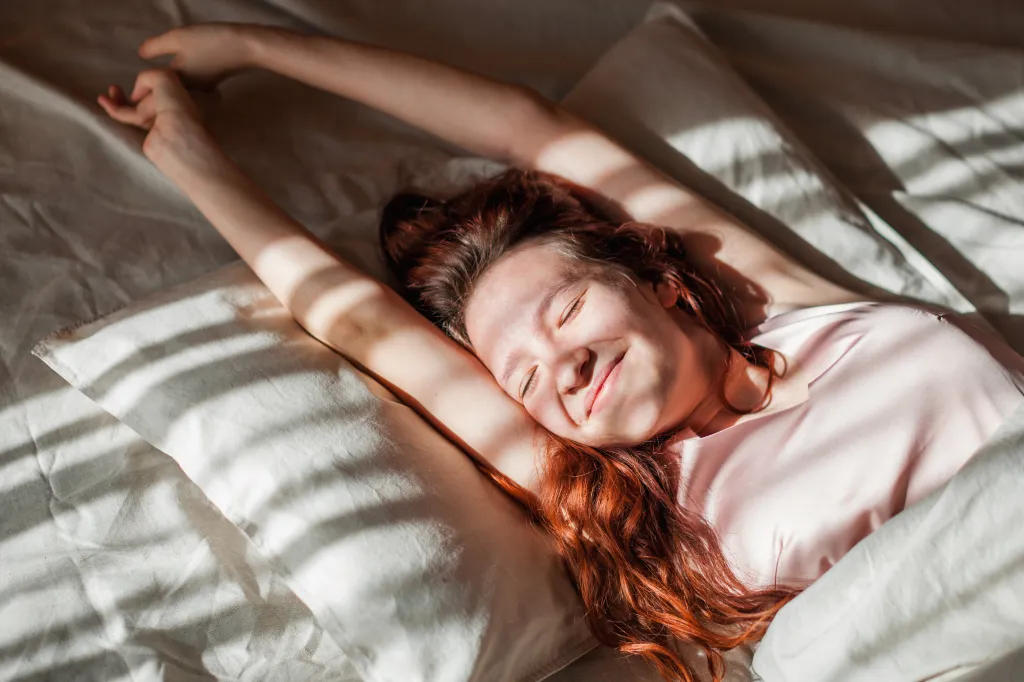
Limiting bright light in the evening can also help improve sleep, Martin said.
She recommends avoiding bright light during the last couple of hours before bedtime and maintaining a consistent wake-up time each morning.
“Varying your wake time by more than about one hour can lead to feelings of ‘jet lag’ and contribute to trouble with regularly sleeping well,” Martin said.

She added that adults should aim for at least seven hours of sleep each night and seek help from a sleep specialist if sleep problems become chronic.
While the findings suggest brighter daytime light may support healthier sleep, the researchers said the study has several limitations.
They noted that the research found an association between daytime light exposure and sleep patterns but did not prove that one directly caused the other.
The researchers also measured light exposure using wrist-worn devices rather than at the eyes, where light directly influences the body’s internal clock, and did not account for factors such as physical activity or meal timing that could affect sleep.
Fox News Digital reached out to the study researchers for comment.


We’ll talk to everybody, including terrorists, to end insecurity — Kwankwaso

Trial Date Set for Former Olympian Accused of Damaging Reflecting Pool

Court Convicts Two Ansaru Commanders, Imposes Life Sentence for Terrorism, Terrorism Financing and Related Offences

High school fights back against city over controversial new ethnic studies curriculum

‘Nothing may be left of APC in Niger after 2027’ — Party chieftain warns

2026 World Cup: FIFA opens investigation into Spain vs Argentina final

Tate Brothers to Stay in Jail as They Fight Extradition on Rape Charges

 Society3 days ago
Heartbroken Girlfriend Storms Studio To Remove Portrait Tattoo Of Cheating Boyfriend From Her Back
- Breaking3 days ago
Ondo police arrest father for burning his 10-year-old daughter’s private part with hot iron over bedwetting
- Society19 hours ago
2026 Ballon d’Or: Top 4 players to win award after World Cup final revealed
- Investigation2 days ago
âI canât date a man who earns less than me. Iâve supported men financially before, and Iâm done with thatâ â Mercy Eke
- Society16 hours ago
Pepper Seller Caught On Camera Applying Pepper On Newborn Baby As Rituals To Usher Her Into The Business
- World1 day ago
Spain earns $51 million for World Cup win and runner-up Argentina gets $34 million as total payout for all 48 teams hits record-high $871 million
- Society3 days ago
Man Finds Beautiful Lady Stripped Totally ‘Nɛkɛd’ In Deep Forest, Says She Doesn’t Know How She Got There
- Investigation2 days ago
US President Trump questions Thomas Tuchelâs tactics in England World Cup loss to Argentina