World
Venezuelans scour collapsed buildings by hand while government machinery stands unused

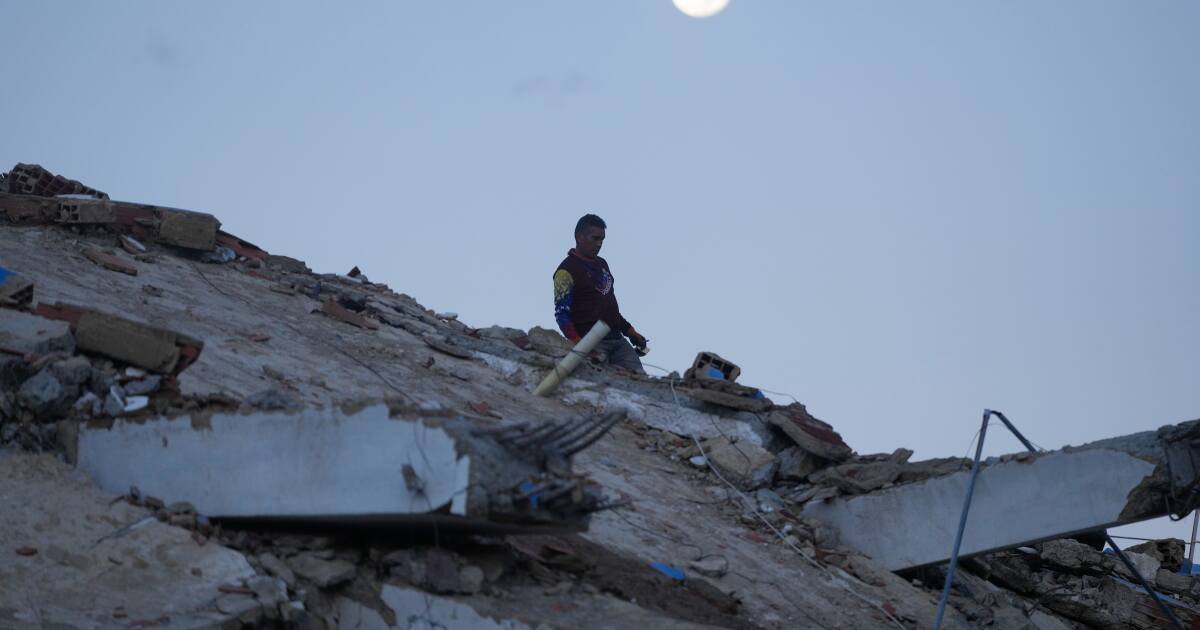
As Venezuelans in La Guaira continued to pick through the rubble of downed buildings yesterday, a government excavator stood immobile next to a pile of concrete and bent rebar.
There is plenty of work to do nearly a week after two massive earthquakes destroyed much of this coastal city. Heavy machinery is a vital tool in the aftermath, yet when CNN asked the excavator’s operator why it was idle, he said there wasn’t any gasoline to put in it.
Venezuela is home to the world’s largest reported oil reserves, yet in the wake of one of its worst earthquakes in over a century, many of its citizens have been forced to dig their friends and family out of the rubble by hand for want of fuel. Their desperation comes as the Venezuelan government faces mounting criticism over its response to the crisis.
“People are outraged,” said political analyst Carmen Beatriz Fernández, director of the consulting firm DataStrategia. “What we are seeing is this tragedy as a reflection of another tragedy, which was dedicating the state’s capabilities solely to repression and propaganda. You dismantled a state’s capacity to provide basic needs.”
RELATED STORY | US leads Venezuela earthquake response with $300 million in humanitarian aid
Adding insult to injury, four officials have been arrested after they were found to be “appropriating valuables found in the rubble.”
In a statement Tuesday, the Scientific, Penal and Criminal Investigations Corps (CICPC) said that the four men were removed from their posts and their cases referred to the judiciary.
“The institution reaffirms to the nation that it will not tolerate, under any circumstances, police misconduct, acts of corruption, or conduct that undermines institutional integrity or adds to the suffering of the victims of this emergency,” added the statement.
Meanwhile, opposition leader María Corina Machado has said that the crisis has motivated her to return to Venezuela from exile in the US, telling Fox News that she and Venezuelans “need to be together.”
The government has defended its response to the earthquakes despite the “initial chaos,” with top lawmaker Jorge Rodríguez touting a new initiative “in which volunteers are distributed according to established priorities.” Interior Minister Diosdado Cabello told Venezuelans early on to trust their government.
“We ask our people that, in the midst of this situation, we be able to organize ourselves in the communes, (that) we be able to organize ourselves in all the structures – we have to know who is missing, where they were, and so that we can do the rescue work more precisely,” Cabello said last Thursday.
The extra resources are sorely needed in La Guaira, one of the hardest-hit parts of the country, where the smell of decay fills the humid air. CNN saw people using pickaxes, shovels and their bare hands to break apart the collapsed high-rise apartment buildings.
“We lost a lot of time trying to figure out new tools to use for a specific activity, like to cut steel,” Hassel Mendoza told CNN. The engineer flew in from Tampa to try and find her mother, sister, brother-in-law and nephew in the ruins of their nine-story apartment building, sleeping on the ground since arriving two nights ago.
Mendoza said that the search had been exceedingly difficult without the right tools. A civil defense team from the neighboring state of Aragua didn’t have any of the equipment needed to quickly break apart the rubble, Mendoza said. No drills, no sensors. Donations of water from the government and elsewhere were helpful, but they weren’t enough.
The official death toll continues to rise, albeit slowly. On Wednesday, National Assembly President Rodríguez – the acting president’s brother – announced that at least 2,295 had died, an increase of about 350 from the day before.
But the casualty figure is believed to be much larger. The US Geological Survey estimates there is a high likelihood that tens of thousands are dead. The United Nations’ Resident and Humanitarian Coordinator in Venezuela Gianluca Rampolla said Monday that the Venezuelan government and the UN are procuring 10,000 body bags in anticipation of more deaths.
When CNN passed by a makeshift morgue at La Guaira’s port, rows of caskets were stacked high on the docks.
Like many of the people camped outside their families’ homes in Venezuela, Mendoza refuses to believe they are gone until the last moment possible. “We have a little hope that my family is alive,” she said. “You never know until you find the bodies.”
Her faith isn’t without precedent. There have been miraculous rescues caught on camera throughout Venezuela, well past the three-day “golden window” for finding survivors. Jack Thorpe, an American volunteer with Resource Rescue International, told CNN that he’s seen trapped people go into “survival mode,” and somehow stay alive while waiting for rescue.
“We’re looking for life and we’re looking for deceased as well,” Thorpe said of his team, which traveled to Venezuela on Monday from North Carolina. “I imagine that they will tell us at some point that it’s a full-on recovery operation. I know that we have still been finding people alive in these buildings, so I’m not ready to give up yet.”
Roughly 2,000 US service members are also assisting with search and rescue and other recovery efforts in Venezuela, Gen. Francis Donovan, the commander of US Southern Command told reporters on Wednesday.
John Barrett, the US Charge d’affaires to Venezuela, said the efforts “remain 100% focused at this stage on the search and rescue mission, and we will continue to do so until a decision within the Venezuelan government suggests that we move from there.”
‘I can’t think about crying’
Deivis Ramos hasn’t cried since his daughters were killed in last Wednesday’s earthquakes. He doesn’t see the use. Crying won’t help him dig through the rubble of his wife’s parents’ apartment building, where he and others have spent days excavating, looking for their bodies.
“I can’t think about crying,” Ramos said. “Right now, even though my soul is breaking inside, I can’t think about crying, because tears won’t move a single stone. What I need is strength and will.”
Ramos’ two daughters –– Darling Antonella, seven, and Dulce María, two –– were staying with their grandparents and great-grandparents, who also died in the earthquakes.
He was working at the city’s large port when the quakes struck. He rushed to the building within 30 minutes of the first earthquake. He’s been digging ever since.
“We’re just asking for the strength to reach where they are and give them rest,” Ramos said. He is astounded by the help that’s come from across the country and from abroad. “From the afternoon of day one, you saw patrols, firefighters, rescue teams – the international aid, people from other states who have come here with their bare hands, their own money.”
The state government brought generators to help them search on the first day, Ramos added. They were initially able to use heavy machinery brought by others to dig, but those machines were moved elsewhere once rescuers determined there was no sign of life in the apartment building.
Ramos and the other volunteers have methodically dug through the rooms of the apartment, finding personal effects – his mother in-law’s phone and sewing table, for instance, and one of his daughter’s beds – but no sign of his children, at least not yet. Ramos suspects that they ran to the other side of the unit, where he hasn’t been able to reach.
“We’ve made our peace with it,” he said. “We just ask for the strength to reach them and give them a proper rest. That’s all we want.”
Isa Soares and Madalena Araujo reported from La Guaira, Venezuela. Gonzalo Zegarra and Haley Britzky contributed reporting.
The-CNN-Wire™ & © 2026 Cable News Network, Inc., a Warner Bros. Discovery Company. All rights reserved.


China’s Renminbi Push Reshapes African Trade Finance Architecture

Church members defy downpour, hold service in their flooded church premises (video)

Gender gap in digital governance threatens inclusive development – CITAD

Nigerian-born engineer pleads guilty to wire fraud in US after steering $1.67m meant for repair of decrepit buildings to himself and family members

God’s original plans was that we all will marry as virgins – Solomon Buchi says

âI came to Nigeria hoping to relocate permanently, but after three months I quietly ran back to Canada. I knew there was f!re on the mountain.â â Canada-based Nigerian woman

Maia Capital Partners Fuels Nesa Power’s Renewable Energy Expansion with R150 Million Mezzanine Facility
- Breaking2 days ago
Forget about body count. Sometimes itâs better to marry a lady who has gone into the world and experienced life than to marry one who hasnât- Nigerian doctor’s advice to men sparks debate online
- World2 days ago
Iran launches strikes targeting Bahrain, Kuwait, threatens "complete halt" to talks

 World18 hours ago
Boy, 3, pulled alive from rubble six days after Venezuela earthquake disaster
- Breaking2 days ago
Community leader and woman k!lled in fresh Plateau attacks
- Investigation3 days ago
âTheyâre coming for usâ: Atiku warns of plot to keep ADC off 2027 polls
- Investigation2 days ago
Ex-NFL star Chris Johnson reveals âshockingâ ALS diagnosis
- Investigation3 days ago
Police bust âone-chanceâ gang, arrest seven for various offences in Ogun
- Investigation2 days ago
Phone snatchers st@b 300-level varsity student to d3ath in Abuja