Investigation
âPsychicâ IT worker sacked for telling female colleague they already met âin his dreamsâ

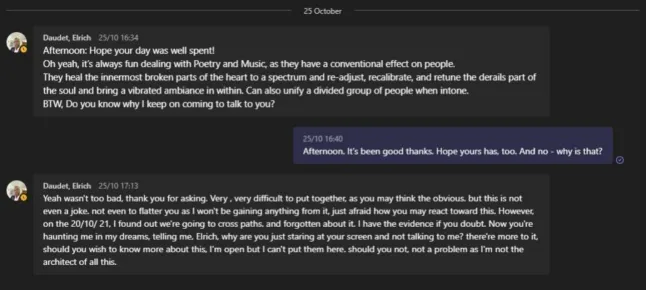

A UK employment tribunal has dismissed the appeal of an IT worker who claimed he was unfairly dismissed after telling a female colleague they had met “in his dreams” and sending her romantic messages.
Elrich Daudet, a former senior computer analyst at Computacenter (UK) Ltd, had sought compensation for unfair dismissal, harassment and race and religious belief discrimination following his dismissal for gross misconduct in 2022.
Daudet argued that he possesses the gift of prophetic dreams, claiming the colleague had appeared to him months before they met as a muse for his poetry and songwriting. The woman later complained to another colleague, saying Daudet was “doing her head in” after he sent her messages and poems, including one comparing her scent to “flowers in the Garden of Eden.”

Following an internal disciplinary investigation, Computacenter dismissed Daudet for gross misconduct in December 2022. An employment tribunal rejected his claims in 2024, ruling that his dismissal was fair and that his belief in prophetic dreams did not qualify as a protected philosophical belief under UK equality law.
Daudet appealed the decision, arguing that his belief extended beyond his personal experiences and was a broader conviction that dreams can predict future events. His lawyer, Chinonso Ijezie, also argued that the tribunal had wrongly concluded that the colleague had been alarmed by the messages.
However, Employment Appeal Tribunal Judge Lord Fairley upheld the earlier ruling, finding no legal error in the tribunal’s decision. He said: “She thought he was coming on to her and that made her feel uncomfortable. It doesn’t matter whether he touches her or if it’s in an email.”
The judge also rejected Daudet’s argument that his communications were an expression of a protected belief. He4 said: “The tribunal’s conclusion that the purported belief wasn’t protected discloses no error of law. On no view were any of the messages sent by the appellant manifestations of any belief held by him.”
Lord Fairley said there was sufficient evidence that the woman had been distressed by the communications. He said: “The messages had effectively involved ‘love poems’, which were ‘amorous in nature’. That’s plainly something that’s objectively s3xual. She thought he was coming on to her and that made her feel uncomfortable.”
The appeal was dismissed, bringing Daudet’s legal challenge against his former employer to an end.


JUST IN: Falana Urges IGP to Take Over Mary Habila Death Probe, Alleges Crime Scene Was Compromised
Unity Bank Is Diverting Electricity Bill Payment In Its Account And Paying N100 Million To Government Official Monthly As Cover Up – ALSTDI

BlockDAG Partners with RedotPay for Unified Super App, While MemeCore & Bittensor Hold Focus

Police intercept truckload of fake pharmaceutical products in Lagos

Tinubuâs government is bent on winning elections by all means – Bishop Onaiyekan
JUST IN: Tempers Flare As DSS, Sowore’s Lawyers Clåsh In Court

Arrest Atiku For Calling You A Forger – Sowore Dares Tinubu

 Investigation3 days ago
âMy ex just logged me out of his Netflix and Prime because I said he is weird and I regret meeting him. That doesnât mean he should remove meâ â Nigerian lady reacts as ex revokes her access
- Investigation2 days ago
Tinubuâs government is bent on winning elections by all means – Bishop Onaiyekan
- News3 days ago
NSCDC hunts vandals, recovers ₦1.8m streetlight cables in Jigawa
- Investigation1 day ago
Fubaraâs political mistake was that he tried to build his own structure – Wike
- Investigation1 day ago
âSopranosâ Actor Vincent Pastore found dead at his home aged 80
- Investigation1 day ago
Donât politicise insecurity – Governor Radda
- Investigation1 day ago
âPeople smugglersâ arrested after Moroccan migrants were caught trying to enter Spain on jet ski
- Investigation3 days ago
Oyo Abduction: I was accused of orchestrating Oriire School Kidnap â Gov Makinde