World
Why Am I Watching Instagram on My TV?

This Video Is Trending Right Now
The videos that Instagram suggests in my never-ending “For You” feed are usually of a constellation of women. They’re strangers, but I call them “my girls.” One of them is remodeling her house; one is always cleaning and “resetting” the van she lives in; one is sampling pasta and sandwiches at various New York establishments. And each has something special that I can’t explain to you—a je ne sais quoi, a curious style of speaking—so I’ve come to look forward to my regular glimpses of their lives, which I get when I scroll in bed before I go to sleep each night.
I regard these strangers as my intimates in a way, even though some of them are not people I think I would like if I actually met them. One morning, I was watching one on my living-room television while sipping my coffee. My husband walked into the room and winced as one of the women changed into a perfect re-creation of an American Girl–doll outfit (very theater kid, not his thing). I felt a flash of defensiveness—she makes everything by hand! She has a real sense of self! Not to mention a seemingly sweet relationship with her father and pet birds. I kept scrolling and was relieved that another one of my girls hadn’t appeared. She often records herself eating a frozen dinner on her couch while watching police body-cam footage on YouTube to unwind. And I mean no disrespect to her, but if she had shown up, I would have lunged for the remote.
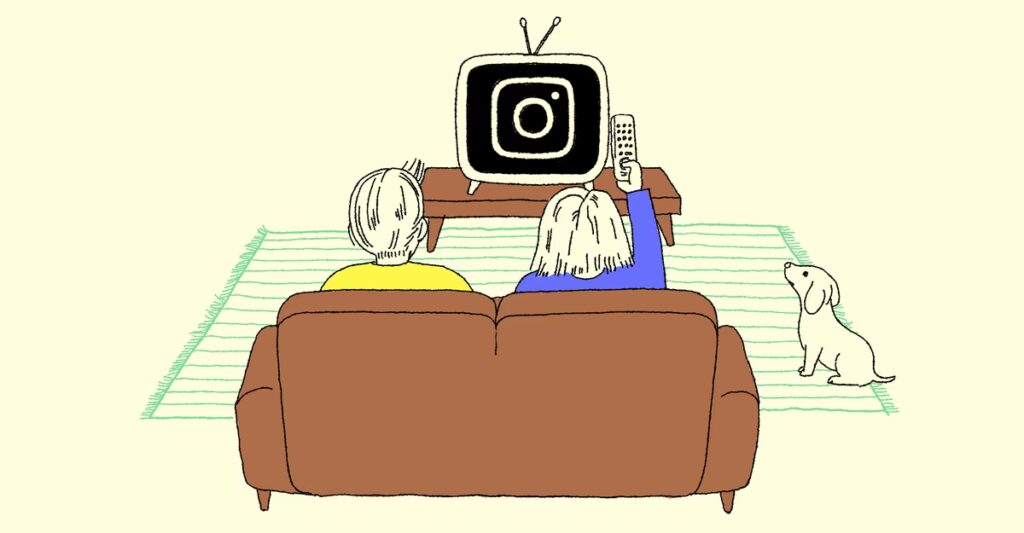
You might be wondering: Why was I watching Instagram on my TV? Instagram’s vice president of product, Tessa Lyons-Laing, has referred to TV as the company’s “next frontier.” As it tries to compete with YouTube and Netflix, Instagram is apparently looking for ways to be … both of them. And so it has launched a stand-alone service for various streaming devices, which it recently expanded with new features to help “friends and family watch together.” This caught my attention: I wanted to try taking the “bad” screen (my phone) and putting it onto the “good” screen (my TV) to see how it would make me (and the people around me) feel.
[Read: The flip-phone cleanse]
Years ago, the “good screen versus bad screen” meme originated as a joke about having an office job. The “bad” screen was a desktop computer at work, whereas the “good” screen was a personal laptop, full of one’s own, delightful, self-chosen digital activities. But in 2022, following the coronavirus-pandemic lockdowns, the writer Kate Lindsay noted a shift. When people referred to the “bad” screen, they now seemed to be talking about their smartphone, which they felt hopelessly dependent on, and when they mentioned the “good” screen, they were referring to the humble television, which now felt wholesome and safe. “We’re so convinced that it’s in our best interest to reverse the effects of social media that even watching a 30-minute TV show uninterrupted seems constructive,” Lindsay observed. But maybe, four years later, the 30-minute-show part is negotiable. Perhaps “good” could come just from giving our thumbs a break, looking up instead of down, and permitting other people to see what we’re doing.
My husband was initially wary of adding his Instagram account to our living-room TV, but he acquiesced, and we had kind of a blast watching his feed together. Most of the videos were of male comedians I didn’t recognize; I sounded like the trope of a Boomer mom as I repeatedly asked, “Do you know him?” whenever a new guy showed up. I didn’t mean “Are you friends?”; I meant “Are they Your Guys?” Sometimes they were, and I was honored to meet them. Sometimes they weren’t; they were just guys. We both laughed to the point of tears at a video that some guy had shared of his dad trying to teach him to bunt a baseball when he was 10 years old. I manually liked it with the remote control and then sent it to myself, from my husband, via direct message. On my TV.
“This intrigues me,” Jonathan Gray, a professor of media and cultural studies at the University of Wisconsin at Madison, told me when I asked him about the app. Scrolling has always had a social element, he said, and people will often show a funny or interesting video to the person next to them. But he was skeptical of whether they would want to share every bit of their feed with their loved ones. “It’s one thing when I turn my phone to my wife and say, ‘Hey, you’ll like this,’ but 90 percent of what I see, she won’t want to watch,” he said. “It seems kind of painful.” Plus, his wife is learning how to whittle at the moment, and he doesn’t want to watch a bunch of whittling videos.
[Read: The extras are tired]
Gray also noted that the recommendation algorithms sometimes take big swings and throw new things at users to learn whether they’ll be interested. One might worry a little about the big swings that could appear on your TV, which to others in the room might appear to be something you’ve already expressed enthusiasm about. When I asked the Instagram spokesperson Christine Pai whether the TV app would filter out any weird stuff, she told me that both apps are using the same recommendation system. (The only specific difference she cited is that the TV app will give an edge to horizontal videos, because they are better suited for the display.)
The app does allow users to play themed “channels” based on their preestablished interests, so you don’t necessarily have to show off your entire, highly variable and sometimes unpredictable feed. The idea with the channels seems to be that making the secret, private shame of scrolling into a collaborative activity will give it a new place in the home. It can be more like watching America’s Funniest Home Videos together after dinner and less like sitting side by side, staring silently at something in your lap. People feel ambivalent about scrolling feeds, Marika Lüders, a professor of media and communication at the University of Oslo, wrote to me on this point. We find it entertaining at times, but we also feel embarrassed and guilty about it. To her, moving Instagram from a phone to a TV seems like “a strategy to increase the status of short-form videos,” by putting them on a screen that people (currently) feel less anxiety about.
That makes sense to me, though I find it just as easy to imagine how this may backfire for the company. Many people who are attempting to cut back on their Instagram use remove the app from their phone and use only the desktop-computer version, which is clunkier and less comfortable to scroll through for hours. Using it is so nonintuitive and unnatural that it calls attention to the absurdity of one’s habit. Moving Instagram to a bigger screen, then, is usually a route not to normalizing it in that new space but instead to severing ties with it altogether. The differences between a phone and a TV are even more dramatic and may be even more off-putting.
Surely the novelty will wear off. Last week, while visiting my sister-in-law and her boyfriend, my husband and I asked them to show us their feeds on their TV. My sister-in-law’s was funny because it was full of wedding-planning content—she’s currently waiting on the requisite engagement ring—and because she kept getting videos of this one baby who’s obsessed with Bad Bunny. Her boyfriend got a hairless cat, a guy pretending to be Wolverine, and a recipe for butter-chicken macaroni and cheese. Those were a little funny, too, but because you don’t know him, you don’t get why and you don’t care. After 20 minutes or so, we got bored of the experiment and left for a baseball game. Later, in the quiet of my hotel room, I went back to my own, private phone.


Two-thirds of parents say their adult Gen Z kids still rely on them financially for support—even though it’s putting them under strain

Gunmen invade Catholic Church in Enugu, abduct seminarian and others

Jamie-Lynn Sigler pays tribute to ‘kind and loving’ ‘Sopranos’ co-star Vincent Pastore after his death

Bandits attack Sokoto community, kill 12, burn father, two sons alive

Man found d3ad in Rivers after he was reportedly kidnapped and drugged by unknown assailants

Israel says it has serious concerns with Hamas disarmament deal

Archaeologists Thought These Cannibalistic Ancient Humans Ate Children. They Were Only Half Right.

 Investigation2 days ago
âSome of us are âpick meâ and we wouldnât know. I used to do things for men I liked when it was supposed to be the other way aroundâ â Lady reveals
- Investigation2 days ago
âMy ex just logged me out of his Netflix and Prime because I said he is weird and I regret meeting him. That doesnât mean he should remove meâ â Nigerian lady reacts as ex revokes her access
- Breaking2 days ago
âWe are going to beat the f**king sh*t out of themâ – Trump issues sharp warning to Iran as diplomacy ends after surprise attack on US base
- Investigation2 days ago
âTinubuâs comment on hunger insensitiveâ- Peter Obi
- Investigation2 days ago
Before you go about snatching someone else’s husband, please check the quality of what your’re snatching first- actress Rita Edochie shades an unnamed âhusband snatcherâ
- Investigation3 days ago
âWeâre committed to increasing finance for Africaâ- CAF urges members to review FIFA’s private investor plan
- Investigation3 days ago
âNigeria is the Republic of docile peopleâ- OAP Dotun slams critics of Tyla concert boycott as he recalls South Africa’s treatment of Burna Boy
- Breaking2 days ago
âNigeria is the Republic of docile peopleâ- OAP Dotun slams critics of Tyla concert boycott as he recalls South Africa’s treatment of Burna Boy