Business
Crude oil prices rise on renewed US-Iran talks


Crude oil prices moved higher on Thursday, with WTI trading near $92 per barrel and Brent rising above $95, as markets rebounded from earlier weakness and tracked fresh developments around the US-Iran conflict. The recovery comes as traders reassess geopolitical risks and weigh whether ongoing ceasefire discussions could stabilise supply routes.
Coin Paper reports indicate that Washington and Tehran are considering extending their current two-week ceasefire to allow more time for negotiations. That possibility has started to shift sentiment.
The White House has signalled optimism about a potential agreement, with officials pointing toward a second round of talks likely to take place in Pakistan. At the same time, Iranian officials are engaging in parallel discussions, including meetings in Tehran aimed at relaying messages between both sides.
Despite the talks, the Strait of Hormuz remains effectively closed under a US naval blockade targeting Iranian ports. This chokepoint handles a significant share of global oil shipments, so any disruption quickly ripples through energy markets.
Shipping data presents a mixed picture.
While US officials say they have halted commercial traffic to and from Iranian ports, some Iran-linked vessels have continued to move through the strait. That contradiction raises a key question: how much supply actually flows right now? The answer remains unclear, and that uncertainty keeps volatility elevated.
Iran has also issued warnings. Officials have indicated that an extended blockade could trigger retaliation, including disruptions across the Persian Gulf, the Sea of Oman, and even the Red Sea. Such threats continue to anchor risk premiums in oil prices.
At the same time, military developments continue to shape expectations. Reports suggest that the US Department of Defence plans to deploy thousands of additional troops to the region in the coming weeks. Meanwhile, Israeli airstrikes in southern Lebanon highlight how the conflict extends beyond a single front.
These overlapping tensions complicate the outlook. Even as diplomacy gains traction, military activity continues to influence trader sentiment. The market now faces two competing forces: optimism around talks and concern over escalation.
Attention now shifts to the expected second round of US-Iran negotiations. These discussions will likely focus on reopening the Strait of Hormuz and addressing Iran’s nuclear programme. Progress on either front could quickly shift market direction.
Investors also track broader regional diplomacy. Planned talks between Israel and Lebanon mark another potential turning point, especially as efforts to reduce cross-border tensions gain momentum.
Oil markets now move in a narrow but volatile range, reacting to every update. Traders watch closely for confirmation of a ceasefire extension and any signals that shipping routes may reopen. Each headline carries weight, and price swings reflect that reality in real time.

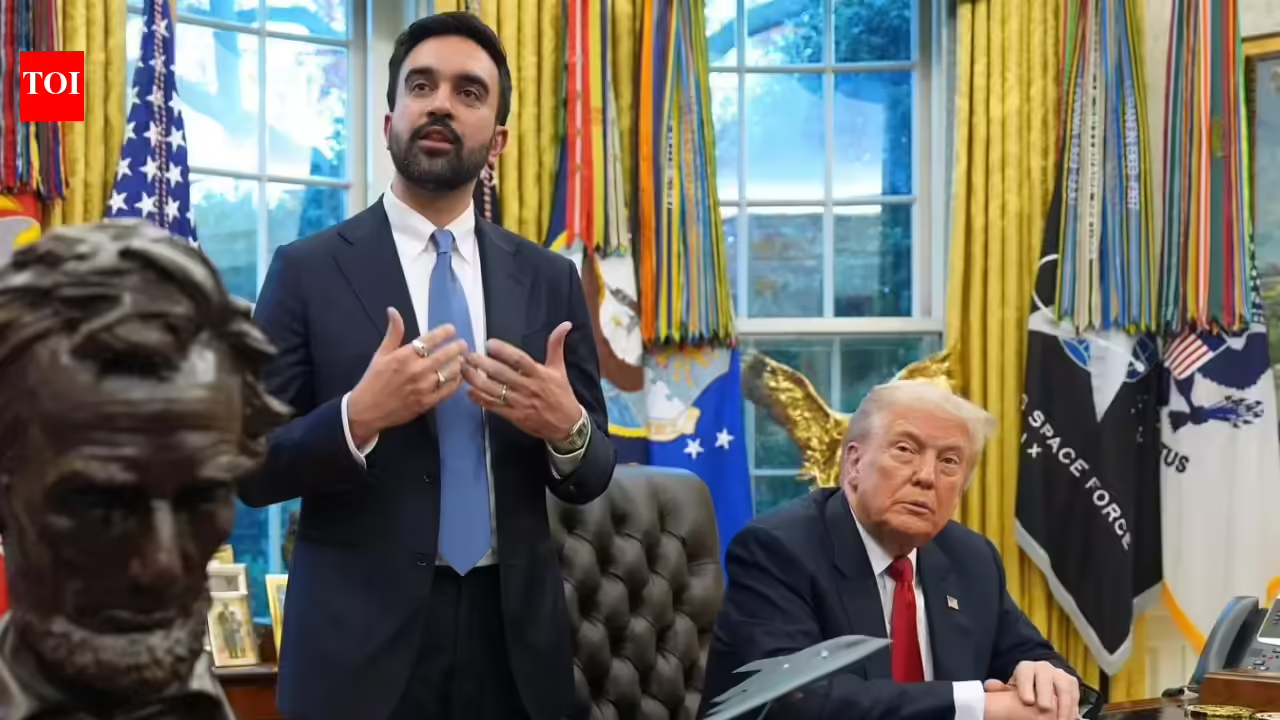
'Destroying New York': Trump slams NYC Mayor Zohran Mamdani’s tax plan

Artemis II astronaut describes "the most unique thing" he saw on the far side of the moon

Two suspected âone chanceâ robbers arrested after pushing 20-year-old student out of moving vehicle in Calabar

Spirit Airlines may halt operations within days, sources say

Storm in Ebonyi ADC as rival camps jostle for control

Trump nominates Dr. Erica Schwartz for new CDC director

Dodgers Smash Spending Record: MLB data shows $514.6m outlay in 2025; gap with low-payroll teams widens

 Breaking2 weeks ago
Outrage as video of secondary school students in Benue state str!ping their classmate surfaces online
 News2 weeks ago
I Joined A Cult, Worked So Hard For Demons – Tonto Dikeh Confesses While Ministering (Video)
- News3 weeks ago
Heartbreaking Story Of 300-Level Ekiti University Student Who Was K!lled After Truck Crashed Into His Building (Video)
- National2 weeks ago
Environmental Sanitation: Lagos meets with LG, LCDA bosses
- News2 weeks ago
WAEC Releases 2026 WASSCE Timetable (Full List)
- Breaking2 weeks ago
Singer Flavour shows off Italian woman and vows to shower her with so much love that she’ll have no choice but fall in love (video)
- Breaking2 weeks ago
Mother Abandons 4 Children with Neighbor and Disappears for Months — Shocking Case Raises Questions
- World1 week ago
Trump LIVE: Iran war bombshell as Trump could be 'removed from Presidency'