News
Enugu community, Lejja, lays claim to cradle of civilisation in West Africa

…Research by University of Nigeria, Nsukka in collaboration with University of Oxford dated these materials to approximately 2000 BCE
By Ikechukwu Odu
TUCKED away in the rolling hills of Lejja, a quiet agrarian community in Nsukka Local Government Area of Enugu State, lies a wonderful discovery that seems to be steadily rewriting the history of human civilisation.
What appears at first glance to be an ordinary village square, dotted with curious mounds of stone and ancient debris, has over time drawn global scholarly attention for a startling reason: it may well be one of the oldest iron-smelting sites in the world.
For the people of Lejja, this is more than archaeology. It is identity, heritage, and a bold claim that their land represents a cradle of civilisation in West Africa.
Otobo Ugwu, where stones speak of a very distant past
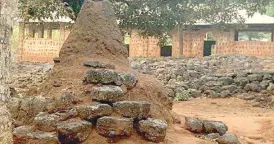
At the heart of this historic narrative is Otobo Ugwu, a sprawling square in Dunoka village, widely regarded as the epicentre of Lejja’s ancient industrial past. Here, hundreds of cylindrical and crescent-shaped slag blocks—remnants of iron smelting – are arranged in striking formations. Some of these blocks weigh as much as 57 kilograms, silent witnesses to a once-thriving metallurgical tradition.
Reason behind the claim
Scientific investigations led by researchers from the University of Nigeria, Nsukka, in collaboration with the University of Oxford, have carbon-dated these materials to approximately 2000 BCE. This places Lejja’s ironworking tradition centuries earlier than the widely accepted origins of the Iron Age in South-West Asia, traditionally dated around 1500 BCE.
The implication is profound: that Africa, and specifically Lejja in Enugu State, may have independently developed iron-smelting technology far earlier than previously believed.
Challenging global historical narratives
For decades, conventional academic thought held that ironworking technology spread into Africa from other regions. But the findings in Lejja conveniently seem to challenge that assumption.
The scale of the site, evidenced by over 800 slag blocks concentrated in specific locations, points to organised, large-scale industrial activity. Archaeologists have also uncovered pipes, furnace remnants, and other materials indicating advanced high-temperature smelting techniques. These discoveries suggest that ancient inhabitants of Lejja were not merely experimenting with iron but had mastered its production in a sophisticated and sustainable way.
In doing so, they challenge long-standing narratives that underplayed Africa’s role in early technological innovation.
Why iron changed everything
The significance of iron in human history cannot be overstated. Its discovery and application marked a turning point in the evolution of societies.
With iron tools, early humans transitioned from subsistence hunting to organised agriculture.
A professor of African Fiction, Damian Opata, an indigene of Lejja community, weighing in on this, explains that dense forests were cleared, soils tilled, and food production increased due to iron smelting in Lejja in olden days.
“Iron also enabled the creation of weapons—spears, knives, and later firearms—that shaped warfare, territorial expansion, and the rise of empires”, he further explained.
In essence, iron laid the foundation for civilisation as it is known today. That Lejja may have been among the earliest centres of this iron revolution elevates its importance beyond regional history to global significance, stakeholders in the community argue.
Lejja, a fusion of industry, culture and governance
Interestingly, according to community members, the Lejja site was not solely industrial. The placement of slag within village squares suggests a fusion of economic activities with social and political life.
For instance, they argued that Otobo Ugwu doubles as a communal arena where villagers historically gathered for deliberations, conflict resolution, and cultural ceremonies. Even today, the square retains its symbolic importance.
Within the same space also stands the revered Okiti Omaba shrine, a towering pillar that embodies the spiritual heritage of the people. Lejja is uniquely known for celebrating both Omaba and Odo cultural traditions—an uncommon duality in the region.
Our stones are more than mere stones; they have spiritual significance —Community
To the locals, the stones are not mere relics; they are sacred. Some are believed to possess spiritual significance, with strict taboos governing their interaction. Oral traditions passed down through generations insist that these stones predate even the oldest known ancestors.
Echoes from the past and present lend credence to claim
Elders in the community recount stories that blur the line between history and myth. According to them, the origins of the slag heaps are unknown, even to their forebears. They speak of a time when Lejja was a formidable settlement, never defeated in war, and renowned for its blacksmithing prowess. Iron tools produced here, hoes, cutlasses, and arrows, were central to both agriculture and warfare.
The traditional ruler of the community, Igwe Boniface Nwaala, also echoed these sentiments, emphasising the pride Lejja brings to African heritage. He notes that while foreign researchers have long been fascinated by the site, much of the excavated material was taken abroad, leaving the community with little physical evidence of its own history.
But recent collaborations with Nigerian scholars have begun to shift this dynamic, offering renewed hope for local ownership and recognition.
We are still neglected in development, community cries out
Despite its global significance on account of the findings, Lejja remains largely underdeveloped. Access roads are poor, infrastructure is minimal, and the site lacks the preservation and promotion it deserves, the community laments.
There are, therefore, growing calls for government intervention to transform the area into a major tourist and research destination. Such development, community leaders argue, would not only boost the local economy but also reposition Africa within the global narrative of technological advancement.
The advent of advanced technology
However, the passage of time poses its own challenges. Traditional practices like blacksmithing are gradually fading, as younger generations pursue modern livelihoods. Cultural tensions have also emerged, particularly between traditional beliefs and newer religious influences, occasionally threatening the preservation of ancient relics.
A legacy waiting to be fully told
Lejja stands today at a crossroads between obscurity and global recognition. Its ancient stones, arranged in quiet dignity across village squares, hold answers to questions that historians are only beginning to ask.
If fully explored and preserved, this community could reshape the understanding of early human innovation, not just in Africa, but across the world.
For now, the people of Lejja continue to guard their heritage with quiet pride, laying claim to a past that may yet redefine civilisation itself.
The post Enugu community, Lejja, lays claim to cradle of civilisation in West Africa appeared first on Vanguard News.







Nigeriaâs Minister of Defence Gen. Christopher Musa exlains why insecurity worsens every Political year

FG slashes import duties as fuel price surge deepens inflation pressure

Probe uncovers syringe reuse at Pakistan hospital as 331 children test HIV-positive

Industrial Court Orders NPA to Pay and Reinstate 19 Wrongfully Disengaged Employees

Foundation expands Lagos disability outreach

Terrorists Attack Benisheikh In Fresh Borno Assault, Target Military Base

Horror as 'overcrowded' migrant ship sinks – 250 refugees missing

 Breaking2 weeks ago
Outrage as video of secondary school students in Benue state str!ping their classmate surfaces online
 News2 weeks ago
I Joined A Cult, Worked So Hard For Demons – Tonto Dikeh Confesses While Ministering (Video)
- News2 weeks ago
Heartbreaking Story Of 300-Level Ekiti University Student Who Was K!lled After Truck Crashed Into His Building (Video)
- News2 weeks ago
WAEC Releases 2026 WASSCE Timetable (Full List)
- National2 weeks ago
Environmental Sanitation: Lagos meets with LG, LCDA bosses
- Breaking2 weeks ago
Singer Flavour shows off Italian woman and vows to shower her with so much love that she’ll have no choice but fall in love (video)
- Breaking1 week ago
Mother Abandons 4 Children with Neighbor and Disappears for Months — Shocking Case Raises Questions
- World7 days ago
Trump LIVE: Iran war bombshell as Trump could be 'removed from Presidency'