World
Supreme Court to weigh Trump's bid to end deportation shield for Haitians, Syrians

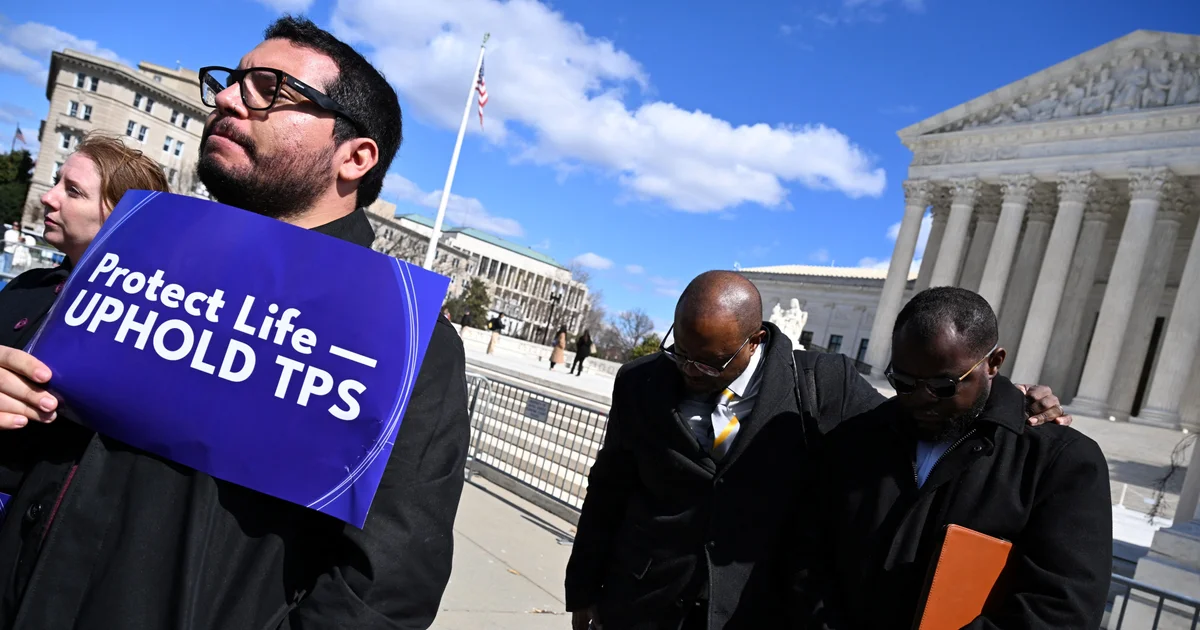
Washington — Dahlia Doe felt as though her world was shaken.
A Syrian national who came to the U.S. more than a decade ago for college, Dahlia, a pseudonym, has received legal protections through Temporary Protected Status, a program that provides relief from deportation to people from certain countries beset by conflict, natural disasters or other extraordinary circumstances.
But in September, the Department of Homeland Security moved to end TPS for more than 6,000 Syrians, giving those authorized to live and work in the United States 60 days to leave the country or risk arrest and deportation.
“I knew that TPS was being targeted. I knew that the Trump administration was going after TPS country after country. But giving us only 60 days was an even further shock and heartbreak for me,” Dahlia told CBS News. “It shows how little our lives matter.”
Dahlia, who is in her 20s, received TPS in 2021. She works as a research director and lives in the Bronx, New York, caring for her father, who has Parkinson’s disease. Her parents are lawful permanent residents and her sister is a U.S. citizen.
A Syrian citizen and passport holder, Dahlia was born in another Middle Eastern country and has never lived in Syria. But if the Trump administration is allowed to move forward with ending TPS for Syrian nationals — an issue that the Supreme Court will weigh Wednesday — Dahlia fears she is at risk of being removed to a country where she has never lived and where she has no immediate family. She and six other Syrian nationals filed a lawsuit last year seeking to stop the Trump administration from stripping away their deportation protections.
“My life would turn into a constant state of fear and uncertainty. Everything I’ve built, my entire adulthood, would vanish right in front of my eyes,” she said. “It’s not just a legal change. It’s not just a policy. It’s disrupting entire lives overnight for people like me who have been here a decade or more.”
Syria is one of 13 countries for which the Trump administration has moved to roll back temporary protections. The Supreme Court is set to consider Wednesday the Department of Homeland Security’s effort to terminate TPS both for Syria and Haiti, in a pair of cases known as Mullin v. Doe and Trump v. Miot.
The Justice Department and those defending the administration have argued that TPS is supposed to provide temporary relief from deportation. They said the decision to scrap the program for Syrians and Haitians was rooted in protecting national security and public safety.
The Supreme Court last year allowed DHS to revoke protections for hundreds of thousands of migrants from Venezuela, putting them at risk of removal. Other nations targeted by the Trump administration include Afghanistan, South Sudan, Yemen and Nicaragua.
Congress enacted the TPS program in 1990. It gives the homeland security secretary the power to provide temporary, country-specific relief to foreign nationals who cannot safely return to their home countries because of war, natural disaster or other “extraordinary and temporary conditions.”
Relief is limited to up to 18 months, but the secretary can provide extensions of TPS designations, and Congress did not limit how many times the protections can be re-upped. Congress also restricted who can receive TPS, deeming ineligible foreign nationals who have been convicted of a felony or more than one misdemeanor; engaged in drug trafficking; belong to a terrorist group; or whose presence in the U.S. would endanger national security or foreign policy.
The Obama administration first designated Syria for TPS in 2012, citing “extraordinary and temporary conditions” stemming from former Syrian President Bashar al-Assad’s crackdown on anti-government protests.
Haiti, meanwhile, was designated for TPS for the first time by the Obama administration in 2010 because of a devastating earthquake, which affected roughly one-third of Haiti’s population of 9 million people. The Biden administration extended TPS for Haiti several times because of economic, health and political crises in the wake of the assassination of its president in 2021.
But soon after Mr. Trump took office, then-Secretary of Homeland Security Kristi Noem moved to end the programs for more than 6,000 Syrian immigrants and 350,000 Haitians. In both cases, Noem found that after consulting with other agencies and reviewing conditions in the two countries, they no longer met the criteria for TPS.
Syria’s designation was set to end last November and Haiti’s in February. Immigrants from both countries had roughly 60 days from Noem’s announcement to when their deportation protections would expire. But the administration’s terminations were challenged by TPS beneficiaries from Syria, led by Dahlia, and Haiti in two separate lawsuits, and judges agreed to postpone the effective dates.
In the case involving Syria, U.S. District Judge Katherine Polk Failla found in part that the termination was motivated by “undue political influence.” She cited statements from Mr. Trump about the legality of the TPS program and an executive order directing DHS to rescind policies that he said contributed to illegal immigration.
Failla said during a November hearing that Noem “endeavored to terminate TPS status whenever presented with an opportunity to do so, resulting in termination decisions that are ground not in law and not in fact, but that are in political considerations simply not relevant under the TPS statute.”
In the case brought by Haitians protected by the program, U.S. District Judge Ana Reyes found there was sufficient evidence that Noem’s decision to terminate TPS for Haiti was motivated in part by “anti-Black and anti-Haitian” animus. Reyes cited derogatory statements about Haiti from Mr. Trump, including his comment calling Haiti a “s**thole country,” and his amplification of a conspiracy theory that Haitian immigrants in Springfield, Ohio, were eating residents’ pets.
The Supreme Court last year allowed DHS to revoke protections for hundreds of thousands of migrants from Venezuela, putting them at risk of removal. Other nations targeted by the Trump administration include Afghanistan, South Sudan, Yemen and Nicaragua.
The Trump administration sought review from the Supreme Court after appeals courts declined to pause the rulings in favor of the Haitian and Syrian immigrants. The high court said in March it would consider the government’s efforts to roll back the protections for Syrians and Haitians, but it left TPS for the two countries in place while it considers the case.
Before weighing whether the secretary of homeland security acted unlawfully, the Supreme Court must first decide whether courts can even review the claim that the secretary violated federal law when she moved to end TPS for Syria and Haiti.
The Trump administration has interpreted the TPS statute broadly to bar judicial review of the ultimate decision to designate, terminate or extend the relief program, as well as the steps and analysis taken by the secretary in the lead-up to a determination.
“Congress forbade federal courts to second-guess TPS determinations, no matter whether courts would cavil with the final outcome, the Secretary’s decisional process, the substantive reasoning, or something else,” Solicitor General D. John Sauer wrote in a Supreme Court brief. “Any contrary approach would reduce Congress’s robust judicial-review bar to a minor speedbump while installing district courts as the ultimate foreign-policy superintendents of temporary status.”
Sauer argued that Congress imposed several procedural checks on the secretary’s TPS decisions, such as by limiting designations to 18 months and requiring them to be reviewed at regular intervals.
He accused the lower courts of “substituting their own views for those of the Executive as to procedures, country conditions, and foreign-policy objectives.”


Shettima Warns Politicians as Power Struggles Heat Up”

Maternal Health Inequality Persists In Nigeria, As FCT Women Face Rising Risks

2027 polls: C’River group endorses 14 aspirants

Trump warns Iran blockade could last months, sending oil prices soaring

Police arrest 16 suspected cultists at Ibadan poly

FG declares May 1 public holiday to mark Workers’ Day

ADC will be on 2027 ballot despite legal challenges — David Mark

 Breaking2 days ago
Man falls asleep after r@ping 89-year-old woman in South Africa
- World3 days ago
Trump humiliated as major NATO leader tears apart US plan in Iran war
- World3 days ago
Adult content creator accused of using 5-year-old girl to attract men for cash
- News2 days ago
UCL: Arsenal receive double injury boost ahead Atletico Madrid semi-final
- Breaking2 days ago
CCTV footage shows final moments of 22-year-old Kenyan student before she fell to her d3ath from sixth floor of apartment
- World3 days ago
Trump dinner shooting suspect charged with attempted assassination of president
- World19 hours ago
Trump and Iran issue fresh warnings as standoff continues
- Breaking3 days ago
I am sorry – OAP Roby Ekpo apologises for crying during tell-all interview about his marriage to ex-wife, Mayowa Lambe