World
Astronomers identify ‘Loktak protocluster’ in the early universe named after Loktak lake in Manipur

This Video Is Trending Right Now
For a long time, astronomers treated the early universe as a place where galaxies were still finding their footing, small systems forming stars rapidly, while the larger cosmic structures familiar today had not yet settled into existence. Galaxy clusters, the sprawling cities of the cosmos, were thought to become influential much later. Yet fresh observations from the distant universe are beginning to complicate that picture. A giant protocluster seen only 1.2 billion years after the Big Bang now suggests that location already mattered at a surprisingly early stage. Even then, galaxies growing inside crowded regions appear to have evolved differently from those living in quieter stretches of space, hinting that the environment began steering cosmic development almost from the start.
Loktak protocluster reveals one of the earliest massive galaxy structures in the universe
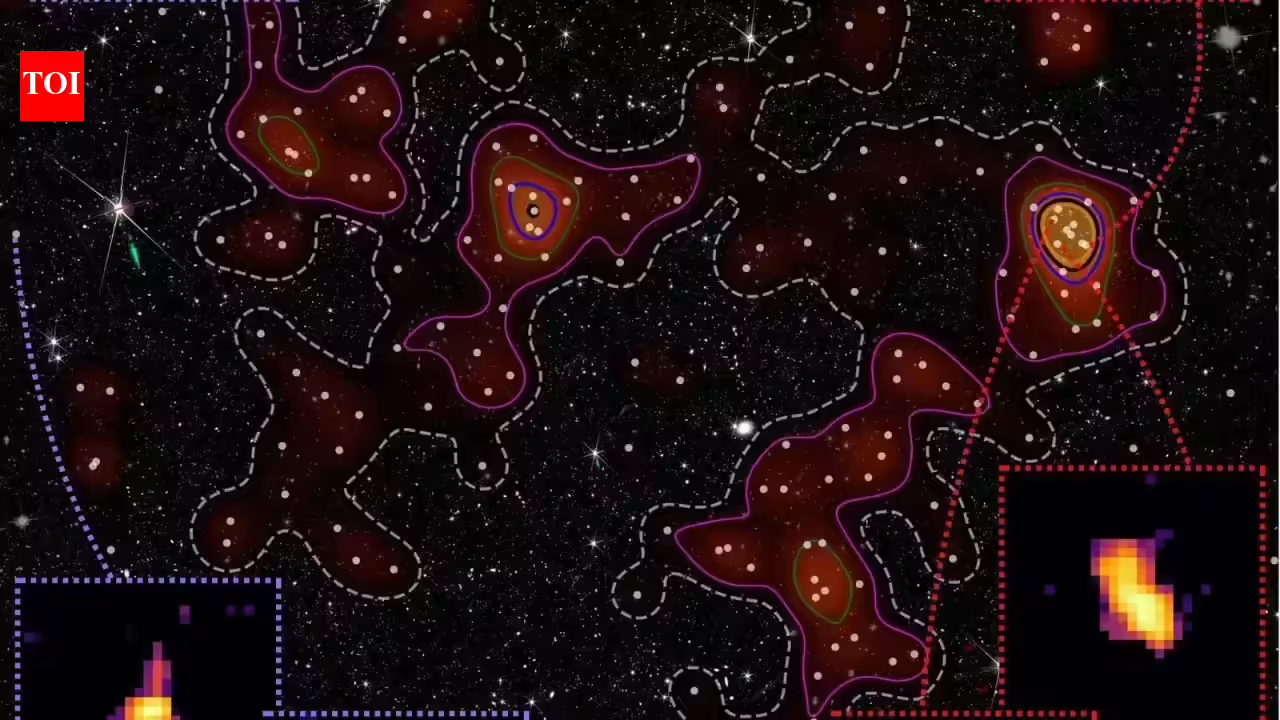
The structure at the centre of the study is known as the Loktak Protocluster, an enormous concentration of galaxies identified in a period when the universe was still in its infancy. It was first picked out using the Subaru Telescope in Hawaii, whose wide-field imaging system allowed astronomers to scan large areas of the distant sky for signs of clustered galaxy growth.As reported by UNI, a team led by Manipuri astrophysicist Ronaldo Laishram has identified a vast structure of young galaxies dating back nearly 12.6 billion years, offering fresh insights into how galaxies formed and evolved in the early Universe.At that time in cosmic history, galaxies were still actively forming stars. Many emitted strong Lyman-alpha radiation, a particular wavelength produced when energetic young stars excite hydrogen gas around them. By isolating this signal, astronomers were able to map where galaxies were gathering together. The resulting picture showed something unusually organised for such an early epoch: several dense regions connected into one larger structure. The team named it after Loktak Lake in Manipur, whose floating landmasses loosely resembled the linked concentrations seen in the survey data.
What protoclusters reveal about the early stages of galaxy transformation
Modern galaxy clusters are among the largest gravitational structures in existence. Some contain thousands of galaxies bound together by dark matter and enormous quantities of hot gas. Their galaxies often appear older and less active than isolated systems elsewhere in the universe. Astronomers have known for decades that galaxies inside these dense environments behave differently. Star formation tends to slow down. Shapes become rounder. Interactions between neighbouring galaxies grow more common.The uncertainty lay in timing. Nobody knew exactly when environmental influence first began leaving marks on galaxy evolution. Protoclusters offered a way to look backwards into that transition period, before mature clusters had fully assembled. The Loktak system sits at a particularly useful distance because its light comes from roughly 12.6 billion years ago. Observing it is effectively observing an era when large-scale cosmic structure was still under construction.
How the James Webb Space Telescope revealed hidden differences in early galaxy growth
After the Subaru discovery, the region was examined with the infrared instruments aboard the James Webb Space Telescope. Webb allowed astronomers to compare galaxies inside the protocluster with galaxies from more average environments existing at the same moment in cosmic time. At first glance, the galaxies did not seem especially different. In ultraviolet observations, which highlight areas where new stars are actively forming, both groups showed fairly similar sizes. Their bright star-forming cores appeared to be growing at comparable rates.The distinction emerged in optical wavelengths tracing older stellar populations. Galaxies embedded in the dense protocluster environment appeared substantially larger overall than their counterparts elsewhere. On average, their structures extended roughly 1.4 times farther.


BREAKING: ADC Announces Winner of Kaduna State Governorship Primary

No one deserves to die, Senate leader warns against electoral violence

Government orders recovery of encroached university land

Arteta adamant English title can inspire Arsenal to Champions League glory

NRC suspends Warri-Itakpe train service
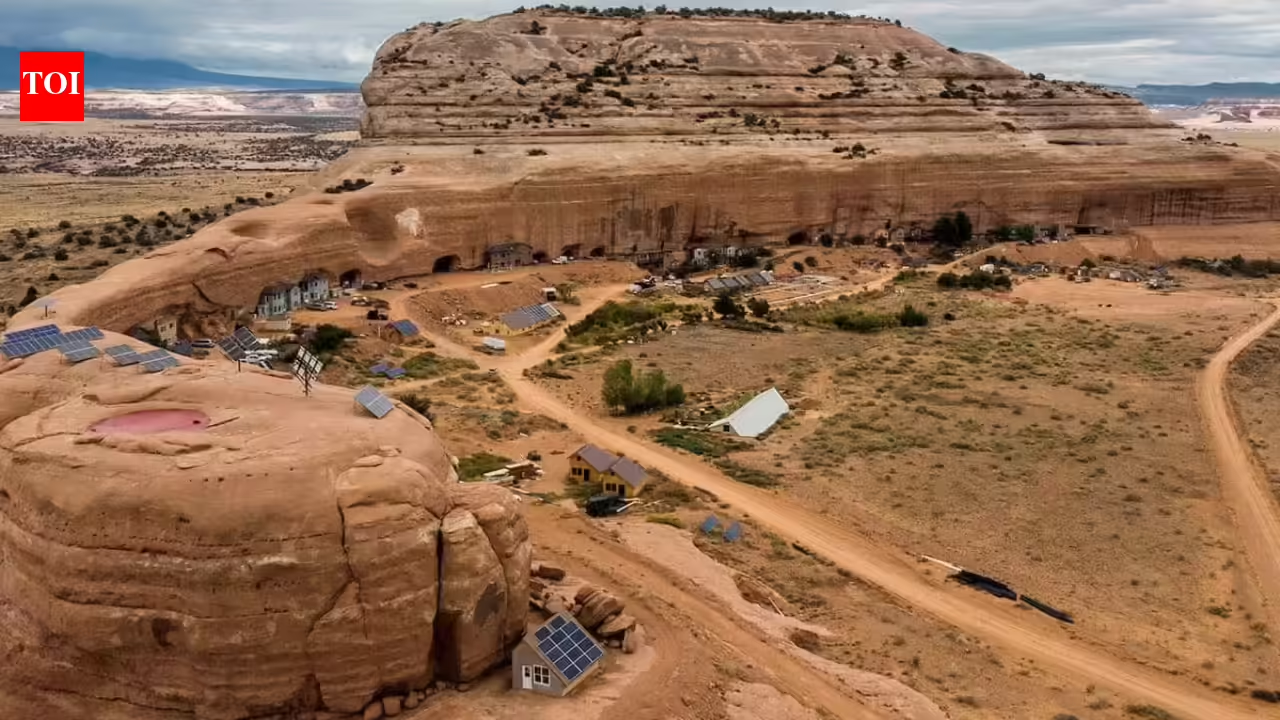
Inside America’s hidden cave city where hundreds of children and families live off-grid inside sandstone cliffs

Eid-el-Kabir: Oyo abductees will be back home, Makinde assures
- Breaking2 days ago
Repentant Boko Haram members are given N3m payoff after rehabilitation and placed on monthly salary of N50,000- man whose father was k!lled by the insurgents alleges (video)
- National2 days ago
Fallen Nation: While Terrorists Kill Nigerian Soldiers, General Bolaji Salami Builds Hotel and Laugh
- News3 days ago
Full list of countries that replaced withdrawn teams in FIFA World Cup
- World1 day ago
Iran 'downs US drone' and 'shoots at American F-35 jet' as WW3 fears explode
- Breaking1 day ago
2027: Jonathan eligible to contest elections — Court rules, awards N21m fine against lawyer
- World3 days ago
Iran's supreme leader is holed up in undisclosed location, U.S. intel says
- National2 days ago
Breaking: Eid-ul-Adha: FG declares two-day public holiday
- World1 day ago
WW3 fears explode as European countries ask for help

