News
Reps panel, N/Delta stakeholders back Tantita, reject decentralisation

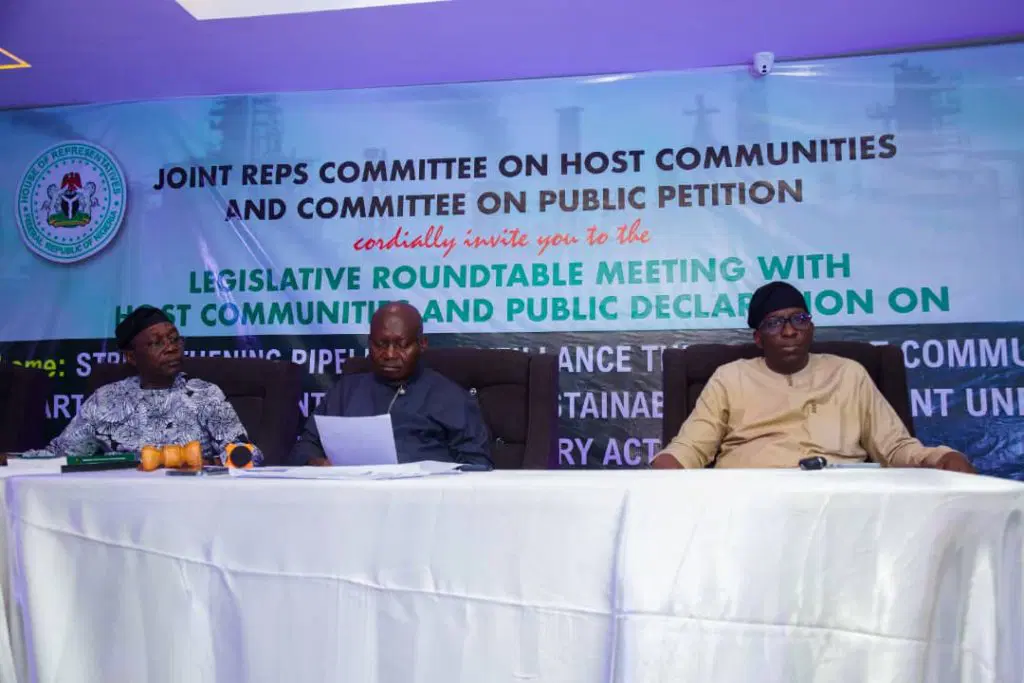
…House committees pass confidence vote on Tompolo’s firm, push for 6% HOSTCOM Fund under PIA
…PIA already decentralised Niger Delta benefits, says Prof. Dike
…insists pipeline contract agitation misplaced, real battle is for 6% HOSTCOM funding
By Joseph Erunke, Abuja
The Joint Committee of the House of Representatives on Host Communities, HOSTCOM, and Public Petitions on Wednesday passed a sweeping vote of confidence on Tantita Security Services Nigeria Limited, dismissing ongoing calls for the “decentralisation” of the company’s pipeline surveillance contract as “baseless” and “anti-Niger Delta.”
The declaration came at the end of a high-level Joint Retreat involving lawmakers and Niger Delta stakeholders in Owerri, Imo State, where participants resolved to shift the region’s focus from controversies surrounding pipeline contracts to a fresh legislative push for an increase in host community funding under the Petroleum Industry Act, PIA, 2021.
The retreat, themed: “Strengthening Pipeline Surveillance Through Host Communities Partnership, Accountability and Sustainable Development Under the Petroleum Industry Act 2021,” ended with far-reaching resolutions endorsing Tantita’s operations and urging the Federal Government and the Nigerian National Petroleum Company Limited, NNPCL, to grant the company a long-term contract extension.
In resolutions signed at the end of deliberations on May 27, 2026, the Joint Committee declared that Chapter 3 of the Petroleum Industry Act had already established a comprehensive framework for decentralised community participation in pipeline surveillance through the Host Communities Development Trust, HCDT, structure and the mandatory three per cent operating expenditure contribution by oil companies.
According to the lawmakers, the existing HOSTCOM provisions under Sections 234–258 of the PIA already guarantee legal and operational decentralisation for oil-producing communities across the Niger Delta.
The retreat therefore rejected fresh demands for further decentralisation of the surveillance contract currently handled by Tantita Security Services Nigeria Limited.
Participants accused promoters of the agitation of pursuing “personal contract interests disguised as community advocacy.”
The resolutions stated: “All calls for further ‘decentralisation’ of the private security contract are hereby dismissed as baseless and anti-Niger Delta.”
The committee maintained that the pipeline surveillance contract remained a private arrangement distinct from the statutory HOSTCOM structure created by the PIA.
In one of the strongest endorsements yet of Tantita’s operations, the lawmakers and stakeholders commended the company for what they described as effective and patriotic service in safeguarding Nigeria’s oil assets.
The retreat specifically cited the recovery of national crude oil production, protection of critical petroleum infrastructure and restoration of peace in oil-bearing communities as key achievements of Tantita under the leadership of High Chief Government Ekpemupolo, popularly known as Tompolo.
“Tantita Security Services Nigeria Limited, in partnership with NNPCL, has rendered demonstrably effective service in the protection of crude oil pipelines and the recovery of national crude oil production,” the resolutions stated.
The Joint Committee subsequently passed a unanimous vote of confidence in the company and called for a long-term renewal of its surveillance contract to consolidate gains already recorded in the fight against crude oil theft and pipeline vandalism.
The retreat also extended its endorsement to President Bola Tinubu, the NNPCL and the Office of the National Security Adviser, applauding what it described as their roles in restoring peace and protecting Nigeria’s economic lifeline.
Participants further hailed Tompolo and his operational team for making “manifest patriotic sacrifices” toward stabilising the nation’s petroleum sector.
Beyond the security debate, however, the retreat signalled a major shift in advocacy priorities for the Niger Delta by adopting a resolution to sponsor an amendment to the Petroleum Industry Act aimed at increasing the HOSTCOM statutory funding from three per cent to six per cent.
The proposed amendment, according to the lawmakers, is intended to strengthen the HOSTCOM framework and provide greater resources for infrastructure, youth empowerment, environmental remediation and sustainable development in host communities.
The resolutions are expected to reshape the political conversation around oil pipeline surveillance in the Niger Delta while intensifying pressure on the National Assembly to revisit the funding structure of host communities under the PIA.
Earlier in his keynote address, a leading energy law expert and President of the Association of Environmental Lawyers of Nigeria, Prof. Samuel Chisa Dike, ignited fresh debate over oil pipeline surveillance and host community rights in the Niger Delta, declaring that agitation against Tantita Security Services Nigeria Limited was legally misplaced and politically distracting.
Speaking at the retreat organised by the House Committees on Host Communities and Public Petitions and facilitated by La Grande Services, Dike insisted that the Petroleum Industry Act had already decentralised benefits to oil-producing communities through the HOSTCOM framework.
He argued that the real struggle for Niger Delta stakeholders should no longer be over the controversial pipeline surveillance contract handled by Tantita, but rather an upward review of the statutory host community allocation from three per cent to six per cent.
In a keynote address titled: “The Truth About Pipeline Surveillance: Why Chapter 3 of the PIA Has Already Decentralised, Why Tantita’s Contract Is Private, and Why the Real Fight Is for 6%,” the professor delivered a sweeping defence of the pipeline surveillance arrangement while urging lawmakers and host communities to redirect their energies toward legislative reforms capable of transforming the region.
The retreat, held at McDons Skye Hotel, Owerri, was attended by the Chairmen of the House Committees on Host Communities and Public Petitions, Rt. Hon. Dekor Dumnamene Robinson and Rt. Hon. Kwamoti Bitrus Laori, respectively, alongside HOSTCOM trustees from across the Niger Delta.
Declaring that “the law must be separated from propaganda,” Dike said much of the controversy surrounding pipeline surveillance contracts stemmed from a deliberate conflation of two entirely different legal arrangements.
According to him, the Host Community Development Trust established under Chapter 3 of the PIA is statutory and belongs collectively to all oil-bearing communities, while the Tantita surveillance contract remains a private commercial agreement between the NNPCL and Tantita Security Services Nigeria Limited.
“The HOSTCOM framework is statutory decentralisation. Every Niger Delta community is already captured by force of law. But the Tantita contract is private, contractual, and governed by the doctrine of privity of contract,” he declared.
He stressed that no host community, pressure group or youth organisation possessed the legal authority to demand the cancellation, redistribution or “decentralisation” of the surveillance contract.
“The Pipeline Surveillance Contract is strictly a private business arrangement between the Federal Government, through NNPCL, and Tantita Security Services Nigeria Limited,” he said.
“It is governed by contract law, and under the doctrine of privity, only parties to the contract can enforce or interfere with it. Host communities are not parties to that contract.”
Citing judicial precedents, including Prince Bourdillon Ekine & Ors v. Shell Petroleum and Chief Ndewari & Ors v. Shell Petroleum, Dike said the courts had already established that while host communities are entitled to development benefits under the PIA, such rights do not extend to controlling private commercial contracts.
He described current calls for “decentralisation” of the Tantita contract as “a category error” and “the pursuit of private contractual benefits dressed in the language of community advocacy.”
In one of the strongest endorsements yet of Tantita’s operations, Dike credited the firm with helping Nigeria recover from crippling crude oil theft and economic sabotage.
According to him, before Tantita’s engagement in 2022, Nigeria’s crude production had collapsed to below 1.2 million barrels per day due to rampant pipeline vandalism and illegal bunkering.
He, however, said the hybrid surveillance model adopted by Tantita, involving ex-agitators, local community networks, private security personnel and collaboration with the Nigerian Navy and the Nigeria Security and Civil Defence Corps, NSCDC, had significantly reversed the crisis.
“Production has climbed to over 1.7 million barrels per day. Thousands of illegal tap points have been dismantled. Hundreds of billions of naira in stolen revenue have been recovered. Thousands of Niger Delta youths have been engaged productively,” he stated.
He noted that,“Peace has returned to communities that had not known peace in decades.”
The professor warned that renewed agitation against the surveillance contract posed serious economic and security dangers to the country.
He therefore called on the Federal Government and the NNPCL to immediately grant Tantita a fresh long-term contract extension of between three and four years to consolidate the gains already achieved.
“The annual agitation cycle around the renewal of Tantita’s contract has become an economic distraction, a security risk and a political weapon. It must stop,” he warned.
Beyond defending Tantita, Dike said the most urgent task before the Niger Delta was securing an amendment to Section 240 of the PIA to increase HOSTCOM funding from 3% to 6% of operating expenditure.
According to him, the existing 3% allocation, though historic when introduced in 2021, has become grossly inadequate to address the region’s mounting developmental and environmental challenges.
“Three per cent is no longer enough. It is insufficient for schools, healthcare, roads, water supply, youth empowerment, women participation, environmental remediation and sustainable peace,” Dike declared.
He argued that doubling the statutory contribution to 6% would significantly reduce tensions in oil-bearing communities and diminish recurring disputes linked to surveillance contracts.
The legal scholar disclosed that the proposed upward review already enjoys the backing of the Joint House Committee on Host Communities and HOSTCOM trustees and would soon be formally sponsored as an amendment bill in the National Assembly.
He described the proposed amendment as “the true battle for the soul of the Niger Delta.”
“This is what our people should march for. This is what should dominate public discourse. Not who gets a share of a private surveillance contract, but how every host community can secure double statutory funding by law,” he said.
Dike further urged lawmakers and host community leaders to “stop the noise, pass the resolutions, draft the amendment and deliver the 6%.”
In an emotional conclusion, he described the Petroleum Industry Act as “the covenant of the Niger Delta,” insisting that Chapter 3 of the law represented the region’s strongest legal shield since oil exploration began in Nigeria.
“The 3% was our beginning. The 6% will be our breakthrough,” he declared.
The remarks are expected to intensify conversations around the future of pipeline surveillance operations, host community funding and the implementation of the PIA across the Niger Delta region.
The post Reps panel, N/Delta stakeholders back Tantita, reject decentralisation appeared first on Vanguard News.






Canada, Bahamas tighten border controls over Ebola outbreak

Pope Leo XIV takes the wheel of Ferrari’s first fully electric supercar
Pope Leo XIV takes the wheel of Ferrari’s first fully electric supercar

2027: Sultan urges Nigerians to pray for credible leaders ahead of elections

2027: Your antecedents will determine your victory not my name – Olubadan tells aspirants

Drunk illegal immigrant driving on wrong side kills 4 people in highway crash in Oklahoma

Boy, 3, plunges to d£ath from block of flats as woman arrested over ‘neglect’
- Breaking2 days ago
Repentant Boko Haram members are given N3m payoff after rehabilitation and placed on monthly salary of N50,000- man whose father was k!lled by the insurgents alleges (video)
- National2 days ago
Fallen Nation: While Terrorists Kill Nigerian Soldiers, General Bolaji Salami Builds Hotel and Laugh
- News3 days ago
Full list of countries that replaced withdrawn teams in FIFA World Cup
- World1 day ago
Iran 'downs US drone' and 'shoots at American F-35 jet' as WW3 fears explode
- Breaking1 day ago
2027: Jonathan eligible to contest elections — Court rules, awards N21m fine against lawyer
- World3 days ago
Iran's supreme leader is holed up in undisclosed location, U.S. intel says
- National2 days ago
Breaking: Eid-ul-Adha: FG declares two-day public holiday
- World1 day ago
WW3 fears explode as European countries ask for help

