Breaking
Atiku faults stringent bail conditions imposed on El-Rufai

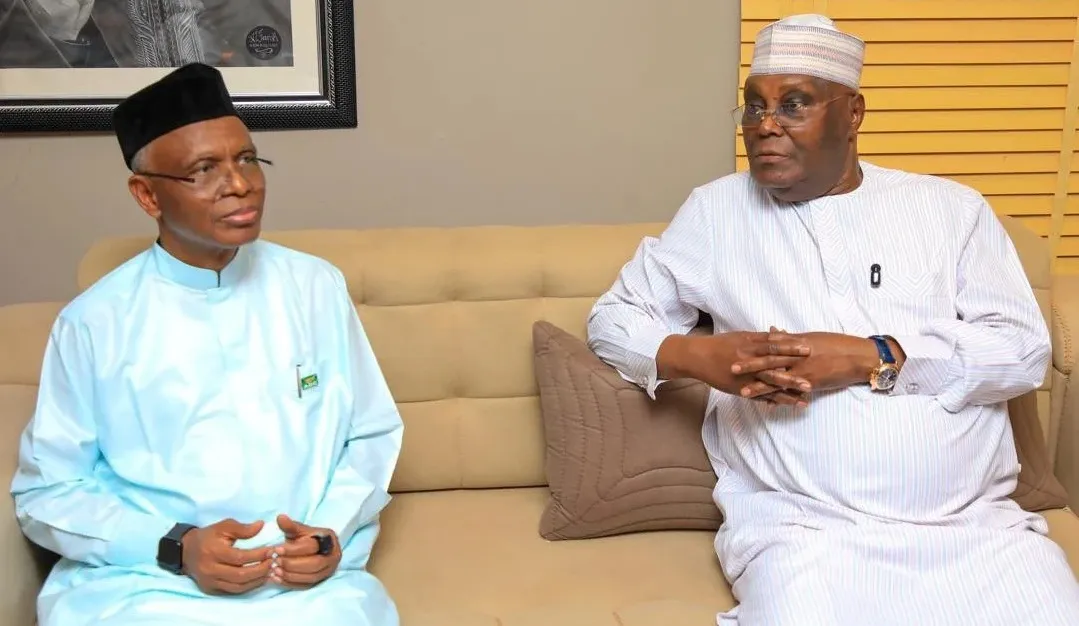
Former Vice President Atiku Abubakar has criticised the bail conditions imposed on former Kaduna State Governor, Nasir El-Rufai, warning that excessively stringent requirements could undermine constitutional safeguards and weaken public confidence in the justice system.
Mr Atiku’s reaction followed the refusal of the Federal High Court to vary the bail conditions granted to El-Rufai, who is facing trial on charges filed against him. The court had ordered the former governor to produce a Grade Level 17 federal civil servant who owns verifiable property in either Maitama or Asokoro, Abuja, as one of his sureties.
The court also required El-Rufai to provide a N200 million bail bond, while the second surety must be a recognised traditional ruler from Kaduna State.
In a statement issued on Wednesday by his Senior Special Assistant on Public Communication, Mr Phrank Shaibu, Atiku described the court’s decision as troubling, arguing that bail conditions that are practically impossible to meet amount to a “constructive denial of bail.”
“The law is settled that an accused person remains innocent until proven guilty. Bail exists to preserve that constitutional protection. It was never designed to become a sophisticated instrument for punishment before conviction,” Mr Atiku stated.
The former vice president questioned the rationale behind imposing conditions that many defendants would find difficult, if not impossible, to satisfy.
“Nigerians are entitled to ask a simple question: is the objective to grant bail or to ensure that bail remains unattainable?” he asked.
According to Atiku, the implications of such judicial decisions extend beyond the case involving El-Rufai and could affect the liberties of ordinary citizens.
“This is not merely about one individual. It is about the principles that underpin a democratic society governed by the rule of law. Today it is El-Rufai. Tomorrow it could be any citizen whose liberty depends not on the law but on whether he can satisfy conditions that few Nigerians can ever meet,” he said.
He stressed that the judiciary remains the last line of defence against abuse of power and should ensure that its decisions promote confidence in the fairness and accessibility of justice.
“At a time when public trust in institutions is under unprecedented strain, the judiciary must be careful not to create the impression that justice is available only in theory but unreachable in practice,” he stated.
Atiku maintained that the primary purpose of bail is to guarantee a defendant’s appearance in court and not to keep an accused person in detention before trial.
“Bail conditions should secure attendance in court, not guarantee continued incarceration,” he added.
The former vice president also expressed concern over what he described as a growing perception that opposition figures and government critics are increasingly becoming entangled in legal and administrative disputes.
“No democracy can thrive where citizens begin to suspect that legal processes are being used not merely to prosecute offences but to punish dissent. The strength of a democracy is measured not by how it treats those in power but by how it treats those who challenge power,” he said.
While clarifying that he was not commenting on the substance of the allegations against El-Rufai, Atiku insisted that constitutional rights must remain paramount throughout the judicial process.
“The question of guilt or innocence is entirely for the courts to determine. What concerns every patriot is whether constitutional safeguards are being faithfully upheld,” he said.
He further argued that the right to liberty, the presumption of innocence and the right to a fair hearing are constitutional guarantees that should not be compromised.
“The right to liberty, the presumption of innocence and the right to a fair hearing are not privileges to be dispensed with at convenience. They are constitutional guarantees,” Atiku stated.
According to him, whenever bail conditions become impossible to fulfil, detention effectively becomes punishment before trial.
“There is a name for a situation where a citizen is told he has been granted bail but is simultaneously subjected to conditions that make his release virtually impossible. It is called a constructive denial of bail,” he said.
Mr Atiku called on all institutions involved in the administration of justice to uphold fairness, proportionality and respect for fundamental rights in order to preserve public confidence in Nigeria’s democratic and judicial systems.


Nigerian Actor Joseph Momodu Completes US Army Training, Becomes Specialist After Emotional Family Tribute

Every FCT district ‘ll feel Tinubu’s impact – Wike

Family announces burial rites for Enugu Commissioner’s mother
King Charles reveals £12.9m tax bill for first time as monarchy's public funding nears £100m

Urgent UK Manhunt for Mother After Baby Girl Found at Waste Site Triggers Major Investigation

2 alleged Epstein victims sue former Victoria’s Secret CEO Les Wexner

NAFDAC urges Nigerians to check food labels before purchase

 Society24 hours ago
Lady Mob-Attacked in Market, Stripped Totally Nak£d Over Accusation of Theft of GH¢40,000
- Society2 days ago
I am proud to be a Virgin and I will remain a virgin till I die because I want to be a good example to my Children-39-Year-Old Woman
- Investigation3 days ago
New photo of 10-year-old boy severely b@ttered by his guardian in Anambra
 Society2 days ago
Boyfriend Walks Away After Allegedly Seeing Girlfriend Flirt With Another Man At Club
- Investigation23 hours ago
Tiktoker Peller hits back at Rapper Ycee after rapper linked âPeller cultureâ to Nigeriaâs âOlodo uprisingâ
- Society1 day ago
Late Mr Ibu’s Wife And Family Appeals For Help From Nigerians Over Unpaid Rent, School Fees And Other Expenses
- Breaking19 hours ago
"You are n@ked" Airline refuses to let woman board plane in ‘revealing clothes’ during heatwave
- Investigation19 hours ago
âMany of our goods are getting bad as a result of foreigner must go protestsâ – Businessman residing in South Africa laments