National
EXCLUSIVE: Court-Martial President Declares ‘Prima Facie Case’ Against 36 Military Personnel Accused Of Plotting To Overthrow Tinubu's Govt Before Trial Begins

Allegations of bias and controversy have emerged at the ongoing General Court-Martial trying 36 Nigerian military personnel over an alleged plot to overthrow the President Bola Tinubu’s government.
The controversy stems from reports that the President of the court-martial declared that a prima facie case had already been established against the defendants, despite the prosecution not having called a single witness or tendered any evidence before the court.
The development has raised serious concerns among defence lawyers, who accused the military tribunal of prejudging the case and demanded that the panel recuse itself from further proceedings.
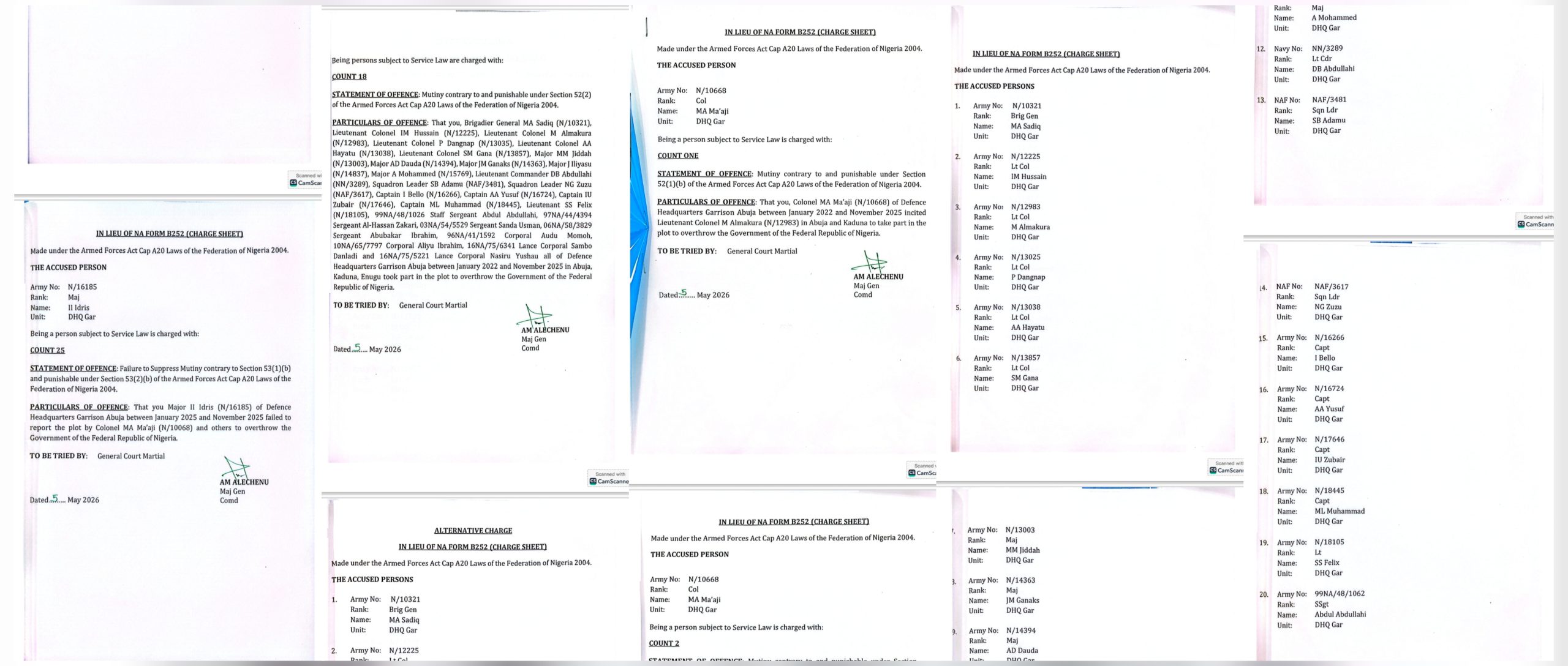
SaharaReporters gathered that the officers and soldiers were arrested, detained and subsequently arraigned before a general court-martial over allegations that they participated in a conspiracy between January 2022 and November 2025 in Abuja, Kaduna and Enugu to overthrow the Government of the Federal Republic of Nigeria.
According to court documents obtained by SaharaReporters, the defendants were slammed with 25 counts bordering on conspiracy, mutiny, failure to suppress mutiny and other offences under the Armed Forces Act.
Sources familiar with the proceedings told SaharaReporters that the defence team had challenged the jurisdiction of the court-martial to hear the matter, arguing that the allegations essentially amounted to treason, an offence which they insisted could only be tried by the Federal High Court.
“The court ruled that the charge is competent and that it has jurisdiction to hear the matter. Our position was that the court lacks jurisdiction because the defendants were charged with mutiny and treason. We argued that only the Federal High Court has jurisdiction to entertain an offence of treason and that the charge, in its entirety, is fundamentally defective,” one of the defence lawyers told SaharaReporters.
“The court, however, ruled against us and held that it has jurisdiction. While delivering the ruling, the President of the court-martial made a statement that raised serious concerns. In the course of reading the ruling, he stated that a prima facie case had been established against the defendants.”
The lawyer stressed that at the time the statement was made, the trial had not commenced in substance.
“At that stage, no witness had testified and no evidence had been led. Yet the court-martial stated in its ruling, while addressing our jurisdictional objection, that a prima facie case had been established against the defendants,” the lawyer said.
“This gave the impression that the court had already formed an opinion on the substance of the case before hearing any evidence.”
According to sources present in court, the remark immediately triggered objections from the defence team.
“Consequently, counsel for the second defendant rose immediately after the ruling and requested that the court-martial recuse itself from further proceedings, arguing that it had already prejudged the matter,” a source said.
The development reportedly led to intense legal arguments inside the courtroom.
According to multiple sources, the Judge Advocate subsequently acknowledged that the statement was made in error and apologised to the court.
“The Judge Advocate acknowledged that the statement was a mistake and apologised. He suggested that the words referring to a prima facie case be removed from the ruling,” one source disclosed.
However, the defence team strongly opposed the proposal.
“We opposed that suggestion, maintaining that such a statement could not simply be deleted after it had already been pronounced in open court,” one of the lawyers said.
Sources said the incident caused tension among the defence team, with some lawyers reportedly considering a walkout from the proceedings.
After extensive arguments, the proposal to alter the ruling was abandoned.
“It was the Judge Advocate who suggested that the statement be expunged from the record. After objections were raised by defence counsel, it was eventually decided that the statement would remain on the record and would not be expunged,” a source familiar with the proceedings told SaharaReporters.
The defence subsequently applied for certified records of the proceedings.
“The lawyer for some of the defendants applied for certified copies of the record of proceedings, particularly the ruling in question. We wanted to verify whether the statement had been accurately reflected in the official record. Despite our oral and formal application, the record has not yet been made available to us,” one of the lawyers said.
“The attempt to alter the record after the ruling was delivered is a matter of significant public interest and should be captured in any report of the proceedings,” he added.
Court-Martial President’s Ruling
The ruling was delivered by the President of the General Court-Martial, Air Vice Marshal H.I. Alhaji (NAF/2211).
While addressing the preliminary objections raised by the defendants, AVM Alhaji stated that the defendants were standing trial for offences including failure to suppress mutiny and conspiracy to commit mutiny under the Armed Forces Act.
He noted that after the charges were read, several defendants raised preliminary objections challenging the competence of the charges, the jurisdiction of the court-martial and the legality of the proceedings.
According to the Court-Martial President, defence counsel filed and adopted their written addresses on May 19, 2026, after which the Judge Advocate advised the tribunal on the applicable law and procedure.
The court identified several issues for determination, including whether the convening order signed by the Commander, Defence Headquarters Garrison, Major General A. Alechenu, was valid; whether the allegations amounted to treason which only the Federal High Court could try; whether the charges were vague and incompetent; whether the proof of evidence disclosed sufficient material linking the accused persons to the alleged offences; whether certain prosecution officers who investigated the matter could participate in the prosecution; and whether the defendants’ appearance in restraints violated their constitutional rights.
On the issue of the power of the Defence Headquarters Garrison Commander to convene the court-martial, AVM Alhaji ruled that the commander possessed the authority under Section 131(2)(b) of the Armed Forces Act.
He stated that the Defence Headquarters Garrison Commander occupied a command position equivalent to those held by General Officers Commanding in the Nigerian Army, Flag Officers Commanding in the Nigerian Navy and Air Officers Commanding in the Nigerian Air Force.
According to him, such commanders possess statutory authority to convene a general court-martial.
“The Commander Defence Headquarters Garrison is eminently qualified to convene a General Court-Martial as provided under Section 131(2)(b) of the Armed Forces Act,” he ruled while dismissing the defence objection.
Addressing the argument that the allegations amounted to treason, AVM Alhaji held that although the Federal High Court possesses jurisdiction over treason offences, the defendants before the court-martial were members of the Armed Forces and were being prosecuted under Sections 52 and 53 of the Armed Forces Act for military offences relating to mutiny and failure to suppress mutiny.
“The defendants are personnel of the Armed Forces of Nigeria and therefore subject to service law,” he stated.
“This general court-martial agrees with the Judge Advocate that the officers are subject to service law and therefore are within the jurisdiction of this court.”
He further declared that the accused persons were not standing trial for treason.
“This court wishes to reiterate that the accused are standing trial on offences relating to mutiny and failure to suppress mutiny, contrary to the position of the defence counsel,” he said.
“In view of this, the court has jurisdiction to proceed with the case.”
On the allegation that the charges were vague and incompetent, the court-martial president held that the charges adequately informed the defendants of the allegations against them.
He noted that the charge sheet identified the accused persons, the periods during which the offences were allegedly committed, the locations where they allegedly occurred and the nature of the offences.
According to him, the requirements of Rule 15(5) of the Rules of Procedure (Army) 1972 had been satisfied.
The court therefore overruled the objection.
The tribunal also considered arguments relating to the proof of evidence tendered before it.
Defence counsel argued that the proof of evidence did not disclose sufficient material linking the accused persons to the alleged offences and urged the court to strike out the charges.
The prosecution, however, argued that at that stage it was not required to establish a prima facie case because the prosecution had not yet opened its case and that issues concerning the sufficiency of evidence would arise only after the close of the prosecution’s case.
It was during this aspect of the ruling that the controversial statement regarding the existence of a prima facie case against the defendants was allegedly made, sparking the ensuing dispute over whether the tribunal had prematurely formed an opinion on the merits of the case.
List Of Accused Personnel
The accused persons are Brigadier General M.A. Sadiq (N/10321); Colonel M.A. Ma’aji (N/10668); Lieutenant Colonel I.M. Hussain (N/12225); Lieutenant Colonel M. Almakura (N/12983); Lieutenant Colonel P. Dangnap (N/13025); Lieutenant Colonel S. Bappah (N/13036); Lieutenant Colonel A.A. Hayatu (N/13038); Lieutenant Colonel S.M. Gana (N/13857); Wing Commander I.U. Yusuf (NAF/3117); Major M.M. Jiddah (N/13003); Major H. Yusuf (N/13877); Major A.D. Dauda (N/14394); Major J.M. Ganaks (N/14363); Major D. Yusuf (N/14753); Major Iliyasu (N/14837); Major M.A. Usman (N/15404); Major A. Mohammed (N/15769); Major I.I. Idris (N/16185); Lieutenant Commander D.B. Abdullahi (NN/3289); Squadron Leader S.B. Adamu (NAF/3481); Squadron Leader N.G. Zuzu (NAF/3617); Captain G. Binuga (N/16722); Captain I. Bello (N/16266); Captain A.A. Yusuf (N/16724); Captain I.U. Zubair (N/17646); Captain M.L. Muhammad (N/18445); Lieutenant S.S. Felix (N/18105); Warrant Officer Nasiru Ibrahim (95NA/39/2281); Staff Sergeant Abdul Abdullahi (99NA/48/126); Sergeant Alhassan Zakari (97NA/44/4394); Sergeant Sanda Usman (03NA/54/5529); Sergeant Abubakar Ibrahim (06NA/58/3829); Corporal Momoh Audu (96NA/41/1592); Corporal Aliyu Ibrahim (10NA/65/7797); Lance Corporal Sambo Danladi (16NA/75/634); and Lance Corporal Nasiru Yushau (16NA/75/5221).
The case has been adjourned for continuation of proceedings, while defence lawyers continue to press for access to certified records of the controversial ruling that has now become the centre of the dispute over the fairness and impartiality of the military tribunal.
Follow the Sahara Reporters channel on WhatsApp: https://whatsapp.com/channel/0029VaFClvtH5JM6SSsP7M2Y

Chernobyl fuel facility hit: Nuclear fears resurface, Kyiv says Russian attack ‘deliberate'

Pakistani minister in Tehran in fresh bid to restart Iran-US talks
Pakistani minister in Tehran in fresh bid to restart Iran-US talks

US downs Iranian drones as Gulf tensions deepen amid stalled peace talks

One dead in several shootings near West Bank

Reps minority leader: Ozodinobi rejects Ugochinyere’s bid
One dead in several shootings near West Bank

 World3 days ago
Donald Trump sparks health panic as he 'falls asleep' in his chair live on TV
- Breaking2 days ago
Woman shares flimsy reason that made her breakup with her boyfriend who was âperfectâ
 Business3 days ago
IFC, Standard Chartered launch $300m finance facility
- Breaking2 days ago
"Are you not ashamed to post this?" Politician called out after sharing project she commissioned in her Constituency
- Breaking14 hours ago
Elon Musk could be the worldâs first trillionaire in weeks
- Breaking3 days ago
Nigerian woman says her fiance ended their relationship after she "over ate" during visit to his family house
- News3 days ago
Police secure final forfeiture of ₦2bn assets linked to alleged fraud scheme
- Breaking3 days ago
"You cannot pray away bad roads or banditsâ â Actress and producer Mary Remmy Njoku urges Africans to match faith with action