Breaking
How NIMC database tracked 7 Boko Haram Commanders returning from Hajj – Tunji-Ojo

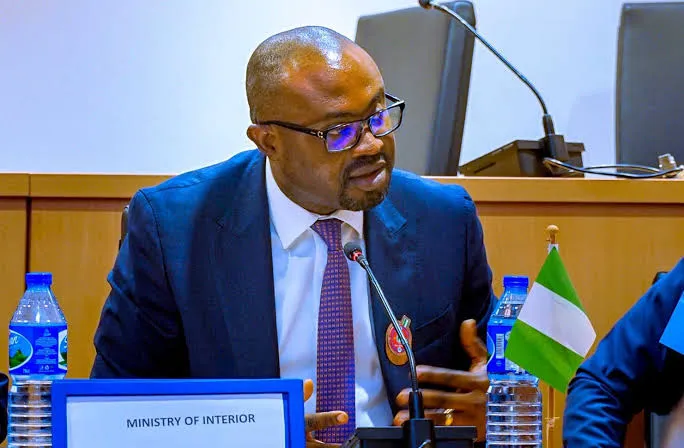
The Minister of Interior, Dr Olubunmi Tunji-Ojo, has revealed that Nigeria’s integrated National Identity Management Commission, NIMC, database recently enabled security agencies to arrest seven suspected Boko Haram and Islamic State West Africa Province, ISWAP, commanders returning from the 2026 Hajj pilgrimage.
The minister made the disclosure on Friday at the Presidential Villa, Abuja, during the signing into law of the National Identity Management Commission, NIMC, Act 2026 by President Bola Ahmed Tinubu.
According to a statement issued by the President’s Special Adviser on Information and Strategy, Bayo Onanuga, the arrests were made possible through the integration of the NIMC database with the Nigeria Immigration Service and international security platforms.
Tunji-Ojo said the seven suspected terrorist commanders were intercepted at Katsina Airport last Thursday as they returned from the Holy Pilgrimage in Saudi Arabia before being handed over to the Department of State Services (DSS).
He said the operation demonstrated the growing effectiveness of the Federal Government’s efforts to harmonise Nigeria’s identity management system under President Tinubu’s administration.
“I know sometime ago the Senate President was alarmed by how some terrorists went on pilgrimage, wondering how they crossed our borders. We inherited a fractured system. But I’m happy to tell you that even last week, Thursday, seven of the known commanders of Boko Haram and ISWAP at the point of coming back from Mecca were arrested in Katsina at the airport and were handed over to the DSS,” the minister said.
According to him, the successful operation was possible because the NIMC identity database now communicates directly with the immigration database and the International Criminal Police Organization (Interpol) network on a 24-hour basis.
“This is only possible because NIMC’s ID is already connected with the immigration database, and it’s already speaking to even the Interpol 24/7, and we have been able to automate this,” he added.
Tunji-Ojo said the Tinubu administration inherited a fragmented identity management system in which key government databases operated independently of one another.
He noted that before the reforms, services such as passport issuance and driver’s licence registration were disconnected from the national identity database, making verification and intelligence sharing more difficult.
“When Mr President came on board, we had a disconnected system within our identity data management system. At that time, getting a passport and getting a driving permit were completely disconnected from our identity database. But today, you can’t get a Nigerian passport without pulling data from NIMC,” he said.
The minister described President Tinubu’s assent to the NIMC Act 2026 as a landmark achievement that would further strengthen Nigeria’s security architecture.
According to him, the new legislation will accelerate the harmonisation of identity databases, enhance the integrity of the National Identification Number (NIN) system, improve collaboration among government agencies and strengthen Nigeria’s capacity to combat terrorism, identity theft, financial crimes and other security threats.
President Tinubu signed the NIMC Act 2026 into law at the State House, Abuja, in the presence of Senate President Godswill Akpabio, Deputy Speaker of the House of Representatives Benjamin Kalu, Attorney-General of the Federation and Minister of Justice Prince Lateef Fagbemi, the Director-General of NIMC, Dr Abisoye Coker-Odusote, and other senior government officials.
The Presidency said the new law provides a modern legal framework for Nigeria’s identity management system and is expected to strengthen national security, improve public service delivery and support the country’s digital economy.


Transfer: Onyedinma pens new contract with Wycombe Wanderers

Alleged diversion of N1.7trn: Shinkafi petitions IGP, DSS, others over viral social media video

US-Israel-Lebanon deal: Hezbollah warns of 'civil war'; rejects 'disarmament'

Obahiagbon named as Tinubu makes fresh appointments

DR Congo Takes Rwanda to International Court Over Alleged Support for Rebels

Adeboye, Oyedepo thank Trump, seek more US action against terrorism in Nigeria

2027: Nigerian Govt vows to prosecute anyone tampering with citizens’ data

 Society2 days ago
Lady Mob-Attacked in Market, Stripped Totally Nak£d Over Accusation of Theft of GH¢40,000
- Society2 days ago
I am proud to be a Virgin and I will remain a virgin till I die because I want to be a good example to my Children-39-Year-Old Woman
- Investigation2 days ago
Tiktoker Peller hits back at Rapper Ycee after rapper linked âPeller cultureâ to Nigeriaâs âOlodo uprisingâ
 Society2 days ago
Boyfriend Walks Away After Allegedly Seeing Girlfriend Flirt With Another Man At Club
- Society2 days ago
Late Mr Ibu’s Wife And Family Appeals For Help From Nigerians Over Unpaid Rent, School Fees And Other Expenses
- Breaking2 days ago
"You are n@ked" Airline refuses to let woman board plane in ‘revealing clothes’ during heatwave
- Investigation23 hours ago
Nud£ painting done by Sigmund Freudâs grandson sells for a mind-blowing $39M at auction
- Investigation2 days ago
âMany of our goods are getting bad as a result of foreigner must go protestsâ – Businessman residing in South Africa laments