Breaking
June 12: CISLAC honours democracy heroes, raises alarm over insecurity, poverty in Nigeria


The Civil Society Legislative Advocacy Centre, CISLAC, has paid tribute to the heroes and heroines of Nigeria’s democratic struggle, declaring that the country’s democracy was not handed to its citizens but won through years of sacrifice, courage and resistance against authoritarian rule.
In a Democracy Day statement issued on Thursday by its Executive Director, Comrade Auwal Musa Rafsanjani, the organisation described June 12 as a symbol of the resilience of Nigerians who fought for justice, human rights, accountability and the sovereignty of the people.
According to CISLAC, the annual commemoration serves as a reminder that the democratic freedoms enjoyed today were secured at great personal cost by patriots who challenged military dictatorship and oppression.
Tribute to Democracy Heroes
The organisation paid tribute to several prominent figures whose contributions shaped Nigeria’s democratic journey, including Chief MKO Abiola, Hajia Kudirat Abiola, General Shehu Musa Yar’Adua, Chief Gani Fawehinmi, Ken Saro-Wiwa, Balarabe Musa, Prof. Eskor Toyo, Prof. Festus Iyayi, Comrade Chima Ubani, Barrister Bamidele Aturu, Emma Ezeazu, Dr. Yima Sen, Prof. Abubakar Momoh, Innocent Chukwuma, Douglas Oronto, Hajiya Bilkisu Yusuf, Dr. Tajudeen Abdulraheem and several others.
CISLAC also honoured the authors of the Minority Report of the 1978 Constitutional Conference and numerous unnamed activists and citizens who contributed to Nigeria’s democratic development.
“Their legacy remains a guiding light for democratic resilience, civic responsibility and the continuous demand for good governance,” the organisation stated.
Democracy Beyond Elections
While acknowledging Nigeria’s achievement of over two decades of uninterrupted democratic governance and peaceful transitions of power, CISLAC stressed that democracy should not be measured solely by the conduct of elections.
The organisation argued that the true test of democracy lies in its ability to guarantee security, justice, welfare and inclusive development for citizens.
“As Nigeria marks over two decades of democratic rule, there is a need to assess whether democratic governance is translating into improved living conditions and opportunities for the people,” it said.
Concern Over Rising Insecurity
CISLAC expressed concern over the worsening security situation across the country, citing terrorism, banditry, kidnapping, communal clashes and farmer-herder conflicts as major threats to national stability.
The organisation noted that continued violence has led to the loss of lives and displacement of communities, warning that democracy cannot flourish in an environment where citizens live in fear.
It called for comprehensive security sector reforms driven by intelligence gathering, accountability and preventive measures.
Economic Hardship and Rising Poverty
The advocacy group also raised alarm over increasing economic hardship, inflation, unemployment and the rising cost of living.
According to CISLAC, recent policy reforms such as the removal of fuel subsidies and foreign exchange adjustments have intensified the burden on ordinary Nigerians despite their long-term economic objectives.
The organisation urged government at all levels to adopt people-centred policies that protect vulnerable groups and reduce widening social inequalities.
Youth Unemployment Threatens Stability
CISLAC warned that persistent youth unemployment and underemployment pose significant risks to national stability.
It said the lack of economic opportunities for young people contributes to irregular migration, insecurity and social discontent.
To address the challenge, the organisation advocated increased investment in education, skills acquisition, entrepreneurship, agriculture and industrialisation.
Corruption Remains Major Challenge
The group identified corruption as one of the biggest obstacles to Nigeria’s democratic and developmental progress.
According to CISLAC, corruption continues to weaken public trust in institutions and diverts resources meant for critical sectors such as healthcare, education and infrastructure.
It called for stronger anti-corruption institutions, transparent public procurement systems, protection for whistleblowers and consistent accountability measures free from political interference.
Electoral Reforms and Internal Party Democracy
Although it acknowledged improvements in electoral administration, CISLAC expressed concern over vote-buying, electoral violence, voter apathy and the growing influence of money in politics.
The organisation also criticised what it described as weak internal democracy within political parties, including the imposition of candidates and manipulation of party primaries.
It urged stakeholders to pursue reforms aimed at strengthening political parties as genuine platforms for democratic representation.
Education, Healthcare and Civic Space
CISLAC further highlighted challenges confronting Nigeria’s education and healthcare sectors, including inadequate infrastructure, staffing shortages, rising costs and the growing number of out-of-school children.
The organisation maintained that democracy cannot be sustained without substantial investment in human capital development and called for increased funding and equitable access to quality services.
It also expressed concern over what it described as shrinking civic space, declining public confidence in institutions and challenges affecting judicial independence.
According to the group, strong democratic governance requires independent institutions capable of operating without political interference and upholding the rule of law.
Call for Democratic Renewal
As Nigeria marks 26 years of uninterrupted democratic rule, CISLAC urged government, political leaders, civil society organisations, the media and citizens to recommit themselves to the principles of transparency, accountability and participation.
The organisation maintained that while sustaining democracy is important, its success should ultimately be measured by improvements in the welfare, security and prosperity of Nigerians.
“Nigeria’s democratic future will be judged not by the survival of elections alone, but by the dignity, safety and prosperity of its people,” the statement added.


Nigeria not qualifiying for World Cup is a big miss â Chelsea legend John Terry says

Insecurity: Security forces, all Nigerians are victims – Defense Minister

June 12: Tinubu never targeted, deployed security agencies against oppositions, protesters – Aide
June 12: Tinubu never targeted, deployed security agencies against oppositions, protesters – Aide

Davies ruled out of Canada’s World Cup opener

Hunter Biden says he will take part in 2028 US election, but only on one condition

June 12: Democracy means little to Nigerians amid insecurity – Okpebholo

 Breaking2 days ago
Nobody can stop me from visiting any part of Nigeria â Sheikh Gumi
- Breaking2 days ago
"Unless you’re d£ad, you must pay" â Young truck driver calls out motorist who allegedly damaged his side mirror and fled
- Breaking2 days ago
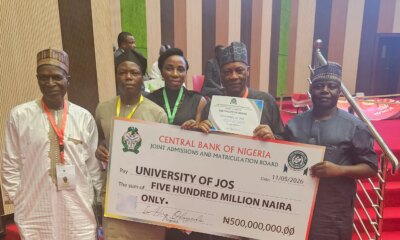
UNIJOS emerges top winner at JAMB Admissions Awards, receives ₦500m grant
- National3 days ago
Abia warns residents against fake N65,000 Otti giveaway
- National2 days ago
Court Adjourns ₦337 Million Fraud Case Involving NASS Officials to September 23, 2026
- Business3 days ago
FG unveils $1bn AfCFTA credit facility to boost Nigerian exports
- Business3 days ago
NIPR Lagos to host forum on public trust
 Breaking3 days ago
Primaries: Protesters storm Lagos APC secretariat, express grievances