National
Nigeria’s power reform faces delivery test as Band A credits and net billing take effect

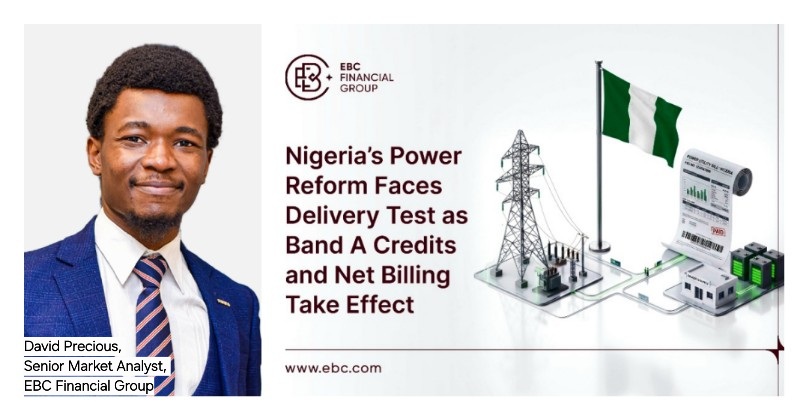
EBC Financial Group (EBC) notes that Nigeria’s electricity reform is entering a phase where higher tariffs, customer credits and new rules on renewable self-generation will be judged by whether businesses actually receive reliable power and can reduce diesel backup costs.
Under the Nigerian Electricity Regulatory Commission (NERC) Service-Based Tariff (SBT) system, a tariff model that links electricity prices to expected supply levels, Band A customers pay premium electricity tariffs in exchange for an expected minimum supply of 20 hours per day.
NERC’s latest compensation order sends a clear signal: if customers are paying a premium rate, they should receive the supply level they are paying for, and if they do not, they should be credited.
Why Power Reliability is Now a Business-Cost Story
Nigeria’s power supply gap remains a direct cost for businesses. NERC’s April 2026 Operational Performance Factsheet showed that grid-connected power plants had a Plant Availability Factor (PAF) of 31 percent, with an average of 4,286 megawatts (MW) available for dispatch out of 13,625MW of installed capacity. When available grid power falls short of business needs, companies often have to keep backup generators running, adding fuel, maintenance and planning costs to production.
The Central Bank of Nigeria (CBN) Business Expectations Survey for March 2026 identified insufficient power supply with an index reading of 74.5 as a leading business constraint, ahead of insecurity, high or multiple taxes, high interest rates and financial problems. The index ranks the severity of reported business constraints, with higher readings indicating a more pressing concern for firms.
Band A Compensation Tests Tariff Credibility
NERC’s compensation directive does more than reimburse customers for missed supply hours. It sets a precedent that premium tariff bands carry enforceable service obligations. NERC issued Directive No. NERC/2026/002 on the Special Compensation of Band A Customers Arising from Grid Generation Constraints, covering eligible Band A customers affected by power shortfalls between February and March 2026.
Under the framework, smaller electricity users, classified as Non-Maximum Demand (Non-MD) customers, are to receive a credit equal to 20 percent of the approved February 2026 energy cap for the affected feeder, meaning the electricity line serving those customers.
Larger commercial and industrial users, classified as Maximum Demand (MD) customers, are to receive 20 percent of the average energy billed per MD customer in February 2026. Prepaid customers are to receive token credits, while postpaid customers are to receive bill adjustments, with February compensation due by 31 May 2026 and March compensation due by 30 June 2026. NERC also directed Distribution Companies (DisCos), the companies that deliver electricity to end-users, not to offset compensation credits against existing customer debts.
The cost of unreliable power does not stay inside the electricity bill. When a factory, supermarket, estate, logistics operator or cold-storage facility pays a premium tariff but still runs diesel backup, those costs move into production, inventory protection, food storage, transport pricing and consumer prices. Customer credits help, but the wider sector still has to manage generation limits, revenue collection and payments across the supply chain.
David Precious, Senior Market Analyst at EBC Financial Group, said, “Nigeria’s power reform is moving into an accountability phase. Higher tariffs can only build confidence if customers and businesses receive the level of supply they are paying for.
NERC’s Band A compensation order and the rollout of net billing point to the same market test: electricity reform must now be measured by delivery, transparent credit mechanisms and whether businesses can reduce diesel backup costs.”
Net Billing Turns Self-Generation into a Business-Cost Question
Beyond customer credits, NERC’s Net Billing Regulations 2026, published on 3 June 2026, open a separate question for businesses already spending heavily on diesel and backup power: whether renewable self-generation can become a more reliable and cost-effective alternative. The regulation creates a framework for eligible customers to generate renewable electricity, use what they need and export any surplus power to distribution networks.
Many Nigerian businesses already invest in generators, diesel storage, solar systems or hybrid power because grid supply is not reliable enough for production, refrigeration, logistics, retail operations and business continuity. Net billing could make that investment more efficient by allowing eligible users to recover some value from excess renewable power rather than leaving it unused.
The framework is not designed as an instant solution for every household. Qualifying solar or renewable systems must have installed capacity between 50 kilowatt peak (kWp) and 1.5 megawatt peak (MWp), making it more immediately relevant to commercial users, estates, shopping centres, manufacturers, institutions and larger facilities with enough electricity demand and capital to invest.
Participants will also need approval from their local distribution company, a technical feasibility review, a Net Billing Agreement and NERC registration. Qualifying systems will require meters that record both electricity consumed and electricity exported.
Whether net billing delivers real savings will come down to implementation. Exported electricity will be credited at an export tariff approved by NERC, which will not necessarily match the price businesses pay for retail electricity purchases.
The specific rate and how payments will be settled are still to be confirmed by NERC and DisCos. That export tariff, together with metering, approval timelines and settlement reliability, will determine whether net billing reduces actual costs or remains a regulation that has not yet translated into commercial value.
New Minister Adds an Implementation Test
The appointment of a new Minister of Power adds a wider delivery test to both reforms. President Bola Ahmed Tinubu swore in Joseph Olasunkanmi Tegbe as Minister of Power on 8 June 2026, after the Senate cleared his appointment on 6 May 2026, according to the State House.
For businesses and investors, the question is not only whether Nigeria has new rules, but whether the sector can implement them consistently. That means Band A credits must be applied on time, net billing approvals must be workable in practice, export tariffs must be transparent and distribution companies must collect enough revenue to keep paying generators and transmission companies.
What Nigeria’s Electricity Market Will Watch Next
The next phase of Nigeria’s electricity reform may be judged by whether existing rules work in practice, not by new announcements. By 30 June 2026, the March Band A compensation deadline will show whether premium-tariff customers receive visible credits when supply falls short. Net billing faces the same practical test: whether approvals, meters, export tariffs and settlement processes can turn renewable self-generation into a real cost-saving option for eligible businesses.
At the same time, both reforms raise the operating bar for DisCos. They must credit customers when service falls short, collect revenue efficiently and keep payments moving to generators and transmission companies. Higher electricity prices may improve sector revenue, but they will not be enough if businesses still have to pay twice: once for premium grid supply and again for diesel backup.
For more information, visit www.ebc.com


Family of Belfast stabbing victim ‘disgusted’ at scenes of rioting

Bauchi NDC governorship candidate responds to bench warrant over alleged defamation
Family of Belfast stabbing victim ‘disgusted’ at scenes of rioting

Davido draws global attention to abducted Oyo schoolchildren at World Cup Concert

Jeffrey Donaldson denies abuse of two alleged victims
Jeffrey Donaldson denies abuse of two alleged victims

Zohran Mamdani wanted to meet Colombian president Gustavo Petro who posted 'Heil Hitler' on X. Trump said 'No'

 World3 days ago
Horror as woman gang raped in field after being knocked unconscious
- World3 days ago
Pope Leo denounces what he calls "scourge" of sexual abuse by Catholic clergy
- Breaking3 days ago
"Before HIV vs living with HIV" – Man writes as he shares his photos before and after HIV diagnosis
- National3 days ago
Wikki Tourists declare six players AWOL, notify NFF
- Breaking1 day ago
UNIJOS emerges top winner at JAMB Admissions Awards, receives ₦500m grant
- Breaking15 hours ago
Nobody can stop me from visiting any part of Nigeria â Sheikh Gumi
 News3 days ago
LAWMA vows action after officers attacked in Lagos
- World3 days ago
Horror as girl, 7, gang raped in toilet after being abducted from her home