Breaking
Terrorists now recruit, raise funds online, Nigerian Army warns

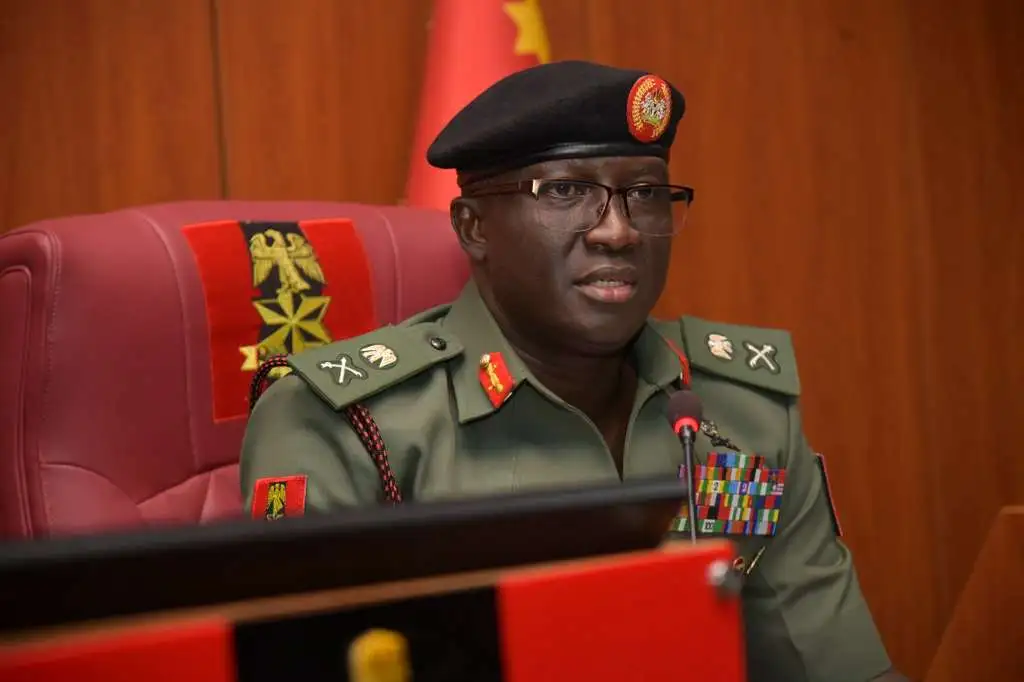
The Nigerian Army has raised the alarm that terrorist and other criminal groups are increasingly exploiting cyberspace to recruit members, raise funds, coordinate attacks and spread propaganda, warning that the trend poses a growing threat to national security.
The Chief of Army Staff, COAS, Lt.-Gen. Waidi Shaibu, made the disclosure on Tuesday at the 2026 Nigerian Army Cyber Warfare School Seminar in Abuja.
Represented by the Deputy Chief of Special Services and Programmes, Maj.-Gen. Jeremiah Manjang, Shaibu said cyberspace had become a strategic battlefield where both state and non-state actors operate with unprecedented speed, making cyber threats more complex and difficult to counter.
According to him, hostile actors no longer require physical presence to disrupt critical infrastructure, compromise sensitive information, manipulate public opinion or undermine national security through anonymous cyber attacks.
He said terrorism, insurgency, banditry, kidnapping, separatist agitations, organised crime, misinformation and disinformation were increasingly being enabled, coordinated and amplified through digital platforms and cyber networks across the country.
“The reality is that terrorist and criminal groups now exploit cyberspace for recruitment, propaganda, fundraising, intelligence gathering, attack coordination and concealment of illicit financial transactions. This demands a proactive and coordinated national response,” he said.
The army chief said the evolving nature of security threats had compelled the Nigerian Army to undertake a major transformation of its cyber capabilities to effectively confront complex, asymmetric and technology-driven threats.
He called for stronger cyber intelligence capabilities powered by artificial intelligence, machine learning and advanced data analytics to enhance early warning systems, threat detection and predictive security analysis.
Shaibu also advocated deeper collaboration among government institutions, the military, law enforcement agencies, academia and the private sector, stressing that cybersecurity could no longer be addressed by a single institution.
He emphasised sustained investment in indigenous cyber capabilities, research, technological innovation and human capacity development to safeguard Nigeria’s digital sovereignty and improve national resilience against emerging threats.
According to him, integrating cyber capabilities into conventional military operations would enhance surveillance, intelligence gathering, geospatial analysis, command-and-control systems, situational awareness and overall operational effectiveness.
Earlier, the Commandant of the Nigerian Army Cyber Warfare School, Brig.-Gen. Jacob Bawa, said the seminar was organised to deepen cybersecurity awareness, strengthen cyber resilience and promote collaboration among security stakeholders.
Bawa noted that Nigeria’s growing dependence on digital technologies had exposed critical infrastructure, including telecommunications, power, financial systems and government databases, to cybercriminals, terrorists and hostile state actors.
He said the school was established as a centre of excellence for cyber warfare training, education and research, adding that participants would examine cyber resilience, threat intelligence, incident response, cyber warfare and emerging technologies to develop practical recommendations for strengthening Nigeria’s cybersecurity architecture.
Also speaking, Global Cybersecurity Resource, Abdulhakeem Ajijola, warned that national security increasingly depended on protecting digital systems, noting that artificial intelligence was reshaping military operations, command structures and the protection of critical infrastructure.
Ajijola urged Nigeria to build sovereign cyber capabilities, cautioning that dependence on foreign-controlled software, platforms and artificial intelligence could undermine national resilience, operational continuity and independent decision-making during crises.
He stressed that while technology should strengthen national sovereignty, accountability for operational decisions must always remain with human commanders.


Kumuyi Says Only God Can Solve Nigeria’s Security Crisis

Woman narrates how her brother was beaten to d3ath after being mistaken for Fulani in Plateau

How Uba Sani modernized abattoirs, transformed meat processing – Butchers

US Supreme Court strikes down Trump’s push to end birthright citizenship

Canada, Paraguay, Morocco, Brazil book World Cup round of 16 spots

Pope Leo Appoints Two Nigerians to Key Vatican Evangelization Roles

Shettima Pushes Economic Reforms, Says Government Must Work Closely With Businesses

 Breaking2 days ago
UNBELIEVEABLE: Video of A Fat Wife Beating And Flogging Her Slim Husband Sparks Debate Online Among Couples and Youths
 Breaking1 day ago
Forget about body count. Sometimes itâs better to marry a lady who has gone into the world and experienced life than to marry one who hasnât- Nigerian doctor’s advice to men sparks debate online
- Investigation2 days ago
âThe Islamic Republic of Iran will no longer exist!â Trump threatens amid fragile ceasefire
- Investigation2 days ago
Emerging facts points to his innocence – Harrison Gwamnishu shares update on man brutally beaten after being accused of N2m theft in Enugu
- Investigation2 days ago
Iran vows to unleash âhellâ on US bases after fresh attacks as Trump warns regime will âno longer existâ if war restarts
- Investigation2 days ago
ISWAP fighterâs wife surrenders to troops with her two-month-old baby in Borno
- Investigation2 days ago
Former MLB star Gorkys Hernandez’s wife d!es in Venezuela earthquake
- World1 day ago
Iran launches strikes targeting Bahrain, Kuwait, threatens "complete halt" to talks