World
US officials reveal details of Iran agreement after days of secrecy

Senior US officials dictated the memorandum of understanding with Iran to journalists on Wednesday after days of secrecy, and Iran suggested that its deal with the United States could be signed by presidents Donald Trump and Masoud Pezeshkian.
Such an signing ceremony would represent a major step for the two countries, which saw diplomatic relations break off in 1980 over the US Embassy hostage crisis in Tehran.
The officials spoke on condition of anonymity to read the the draft, which Iran has not released, ahead of formal signing ceremony set for Friday.
According to the officials, the draft agreement includes a new “minimum” standard for downblending of highly enriched Iranian uranium and has provisions to ensure the “territorial integrity” of Lebanon after Israel’s latest attacks against Hezbollah in Lebanese territory.
In return, the US will move to waive, but not eliminate, some wide-ranging sanctions against Iran once the deal is signed.
The US draft of the agreement also secures toll-free passage of the Strait of Hormuz for only 60 days, and it does not preclude fees in future, the officials said.
Meanwhile in Iran, Foreign Ministry spokesperson Esmail Baghaei was quoted by Iranian state television talking about the potential for the two presidents to sign the pact.
Mr Pezeshkian became president on a promise of seeking better relations with the West.
However, he has been sidelined for months after Iran’s mass killing of protesters in January and in the war as hard-liners have taken over the levers of the country’s theocracy.
The accord is due to be signed Friday in Switzerland. It also envisions Iran receiving at least 300 billion dollars (£223 billion) to rebuild after the war, according to leaked copies of an interim agreement that officials say broadly matches the document.
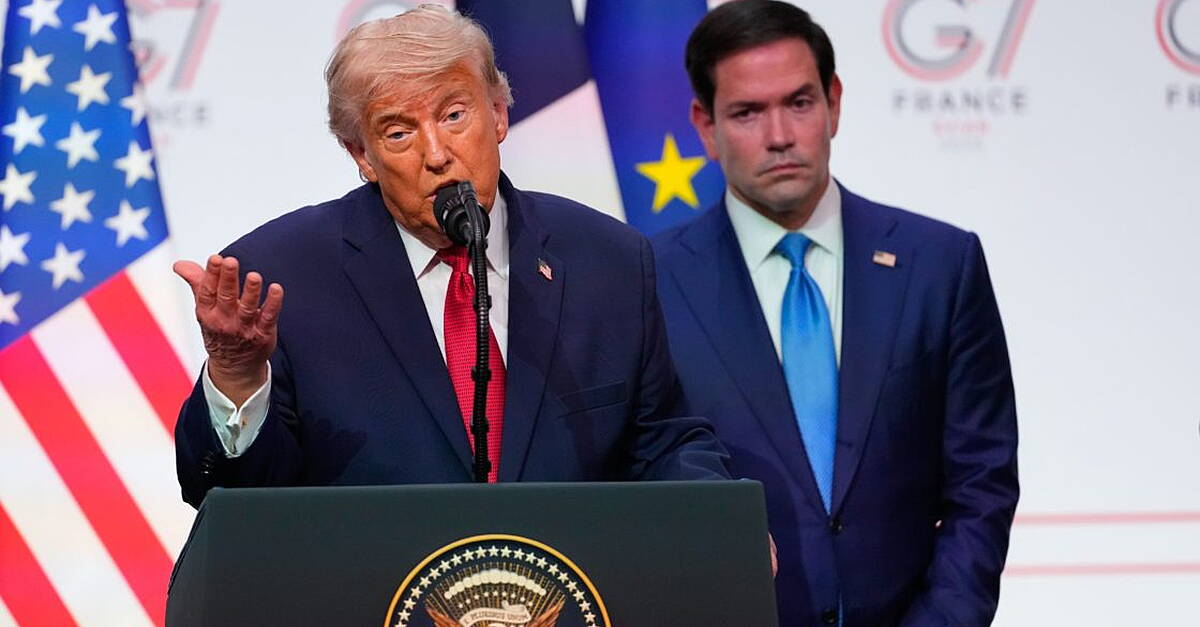
US President Donald Trump cast some uncertainty on whether the signing would happen as planned. Asked how confident he was that the ceremony would take place, Mr Trump remarked on the unpredictability of deals.
“You never know with deals, do you? But you’re going to find out pretty soon,” he said.
The US and Israel went to war on February 28 in part to prevent Iran from ever getting a nuclear weapon, although Mr Trump’s goals in the conflict have repeatedly shifted.
The interim deal stops the war before that aim is secured. Instead, it opens a two-month period for nuclear negotiations and appears to offer Iran several benefits up front while extracting little in return.
The US agreement to immediately allow Iran to sell its oil freely and the offer to eventually lift all sanctions, for instance, represent major concessions that go beyond the terms of Iran’s 2015 nuclear deal with world powers.
Mr Trump withdrew America from that pact in his first term, declaring it the “worst deal ever”.
The accord likely will draw intense opposition in Washington, and it appears to be a major setback for Israeli Prime Minister Benjamin Netanyahu, who has come under criticism at home from the media, his opponents and even some allies as details emerge.
Much of the agreement would restore the status quo before the war, including ending hostilities, restarting negotiations between the US and Iran over Tehran’s nuclear programme, and reopening the strait, which is a crucial passage for the world’s oil and natural gas and whose closure created a historic energy crisis.
The deal includes an end to the fighting in Lebanon between Israel and the Iranian-backed militia Hezbollah.
That is one of the most delicate parts of the agreement because Israel has maintained it will continue to defend itself and to occupy vast swathes of Lebanon.
Iran has said Israel must withdraw under the deal, although the leaked versions make no mention of withdrawal.
Mr Trump has cited various goals for the war, including at times vowing it would end Iran’s nuclear and missile programmes and its support for Hezbollah and other proxy groups in the region.
He also suggested it could lead to toppling the Iranian government.
The interim deal falls short of all of these goals, but Mr Trump hailed it Wednesday.
“Nobody knows what it is, but it’s very strong,” Mr Trump said in France, where he was attending a Group of Seven summit.
But he also opened the door to abandoning it: “It’s a memorandum of understanding, and if I don’t like it, we’ll go back to shooting at them, dropping bombs.”
Some concessions to Iran – including the full lifting of sanctions and the release of frozen assets – would happen gradually and be linked to progress in the nuclear talks, according to officials from Pakistan, a key mediator.
They outlined some of the deal’s major points on condition of anonymity because of the sensitivity of the issue.
But in the meantime, the US will issue waivers to sanctions that allow Iran to sell oil freely.
The Islamic Republic’s oil export revenues in 2024 were more than 46 billion dollars (£34 billion). Its main buyer of oil, China, is believed to have bought at below-market prices because of its willingness to ignore the sanctions.
Granting oil waivers at the start of the 60-day talks strips the US of a major point of leverage. Only at the conclusion of the overall deal in 2015 were sanctions on Iran’s oil lifted.
The interim deal also opens the door to ending all sanctions Iran faces from the US and at the UN – including those over Tehran’s weapons programmes and human rights abuses – though it says the schedule for that will be worked out later.
Still, that far surpasses the 2015 deal, which only lifted some sanctions in exchange for Iran drastically reducing its enrichment and stockpile of uranium.
The accord would also provide Iran with at least 300 billion dollars to rebuild after an intense US and Israeli bombing campaign. The money also appears dependent on the progress of further negotiations.

US Vice President JD Vance has said Gulf Arab nations would invest that amount. But Gulf countries would likely be reluctant to help Iran after Iranian attacks in the war destroyed oil facilities and other sites in their territory.
Mr Trump reiterated Wednesday that the US would not contribute and said it was up to other countries if they wanted to invest.
The deal provides a major win for the global economy – the reopening of the Strait of Hormuz, the narrow mouth of the Persian Gulf through which a fifth of all oil and natural gas traded once passed before the war began.
Since then, Iranian attacks on shipping and the threat to vessels effectively shut the strait.
The deal also says the US will lift a blockade imposed on Iranian ports and that the strait will return to its pre-war traffic levels in 30 days, while acknowledging Iranian mines may need to be destroyed.
The interim deal sets a 60-day window, which can be extended, to negotiate over limiting Iran’s nuclear programme, which has been discussed at multiple rounds of talks during Mr Trump’s second administration without success.
The US promises not to make threats of military action under the current deal after two rounds of talks were interrupted by attacks.
Iran maintains its nuclear programme is peaceful, though it has enough highly enriched uranium to build multiple atomic bombs, should it choose to do so, according to the International Atomic Energy Agency.
In the interim deal, Iran reiterates that it will never build a nuclear weapon – a promise it also made in the 2015 nuclear accord.

'We need help': Pakistani hostages held by Somali pirates issue desperate video plea
Lionel Messi reveals he’s suffering mystery personal heartbreak after equalling World Cup’s goal record

UK Sanctions Pilot Finance for Ties to Russian Network

Ex-Minister Uche Nnaji Still Receiving Millions in Salaries Nine Months After Removal From Office

Who gave you the audacity to judge Baba Ijesha or CEO Luminee – Bobriisky slams actress Nkechi Blessing, BBNaija’s Angel (video)
Zelenskyy says G7 agrees on ensuring 'support' for Ukraine's 'defence and energy resilience'

NDC guber candidate Gwarzo files complaint against Kano governor’s media aide

 Investigation2 days ago
"If bandits kidnap my wife, I won’t pay ransom. I’ll remarry because they would have slept with her" – Nigerian man
- Politics2 days ago
Governor Okpebholo congratulates Edo Queens, reaffirms commitment to sports development in Edo State
- Investigation2 days ago
16-year-old family member of Boko Haram terrorist escapes and surrenders to troops in Borno
- World1 day ago
Horror as woman 'gang-raped by men with handmade weapons' who 'dragged her from home'
- National2 days ago
A’Court Upholds N197m Damages, Awards 20% Interest Against Nigerian Bottling Company Over Obanikoro’s Crash
- World19 hours ago
Trump slams Israel, praises Iran at G7 summit
- Investigation10 hours ago
Dad, are you also leaving us? Congolese man married to South African woman addresses xenophobic individuals after his son’s heartbreaking question
- National3 days ago
Bala Mohammed visits Makinde, condoles over abduction of schoolchildren, teachers