World
A Mother’s Crusade to Rid South Africa of African Immigrants

This Video Is Trending Right Now
On a clear morning last October, Nozie Khoza and her brigade of self-proclaimed patriots stood at the entrance of a public health clinic in Johannesburg on a quest to shape South Africa in their image.
When the gate opened at 7:30, the group demanded to see IDs from everyone seeking to enter, saying that only South Africans would be allowed inside.
“You belong to Nigeria, sweetheart,” Bongi Nomnganga, one of Ms. Khoza’s allies, told a young woman, turning her away because, even though she had a South African ID, her last name was Nigerian.
“It smells like fraud,” another one of Ms. Khoza’s associates said of a young woman’s South African ID, after the woman told them her parents were from Mozambique.
Ms. Khoza, a 39-year-old mother of two, had no authority to determine who could enter the public clinic.
Rather, she is a foot soldier in a highly organized network of activists going to extreme lengths to harass immigrants in South Africa, most of whom come from other African nations in search of opportunity in the continent’s largest economy.
Polls show a growing number of South Africans share hostility toward immigrants and want the government to do more to thwart the heavy flow of migrants entering the country. There have been nationwide protests and violence. Immigrants have been attacked and even killed, chased from their homes and businesses.
Despite a lack of evidence, many South Africans blame immigrants for crime, for stealing jobs and for taking up valuable public resources in a nation with high unemployment and growing inequality. They say they have lost faith in the government and have taken the law into their own hands.
This wave of anti-immigrant furor echoes movements seen in the United States and Europe. But only 5 percent of South Africa’s 65 million people are immigrants, according to government statistics.
Foreigners accounted for just 3 percent of arrests over the past five years, according to police data. They accounted for just 1.2 percent of arrests for violent crimes over the same period.
Still, officials have ramped up workplace inspections, punishing employers who hire undocumented foreigners. More than 53,000 foreign nationals have been deported or repatriated from South Africa since June, the government said last week.
Cyril Ramaphosa, the president, has announced new investments to secure the nation’s border, and he has repeatedly warned South Africans not to engage in vigilante justice.
But the police have not always intervened when citizens harass foreigners.
“It’s only South Africa that is experiencing such an influx of foreigners every day,” Ms. Khoza told those waiting outside the public health clinic in Rosettenville, a neighborhood in southern Johannesburg.
“The schools are full of your kids. Healthcare is full of you. Workplace is full of you. Restaurants full of you.”
“There’s going to be a war,” she said.
‘We Are Sorry’
Ms. Khoza was born and raised in Durban, the epicenter of much of the recent anti-immigrant unrest in South Africa. But it wasn’t until she moved to Johannesburg at 23 to work as a television extra and in production that she developed her grim view of immigrants.
She said she watched as the city deteriorated over time and blamed the urban blight on immigrant street vendors. She blamed foreign landlords for not taking care of dilapidated properties.
A construction company she owns stopped getting business. She claims it was because Zimbabweans were underbidding her for contracts. She also says she had to send her daughter to private school because the public schools nearest her home were at capacity. She blamed this on immigrant children overcrowding the school system.
Ms. Khoza’s frustration led her to become an outspoken member of a national anti-immigrant group called March and March. The group targets all foreigners — not just those in the country illegally — and wants them gone.
On a Saturday in May, Ms. Khoza joined a group of about 50 people who marched down a residential street near her neighborhood. Their goal was to raid a home they said had been overrun by illegal Congolese immigrants.
They stopped at a house in the middle of the block to carry out what the group called an eviction. It did not matter that the Congolese family living inside was there legally.
The mob used bolt cutters to break through the driveway gate. They banged on the doors and jostled the burglar bars on the windows. The house was dark and seemed empty.
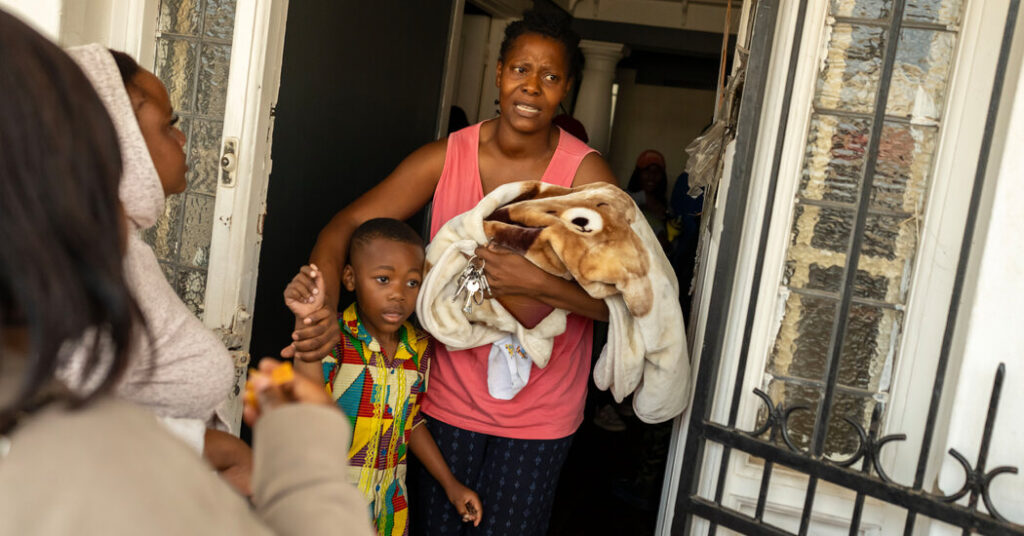
A few minutes later, the mob breached the front door. Teary-eyed children emerged from a dark corridor, hustling out of the house, shivering.
“We are sorry,” some of them squealed.
Their mother, Sandra, an immigrant from the Democratic Republic of Congo, shuffled out in shock as she cradled her youngest child in a blanket, a two-week-old baby. Tall with her hair braided in cornrows, Sandra’s eyes welled with tears as she confronted the angry crowd.
Out of the House
While all the banging was going on outside, Sandra, 38, had been hiding inside with seven of her eight children. She called her husband, Pierre, who was out at the time, and he went straight to a police station to report a break-in. (Both she and her husband asked that their last names be withheld for their safety.)
Having lived nearly half of her life in South Africa, Sandra knew how dangerous situations like this could be. In 2008, the year she arrived after fleeing civil war in Congo, South Africa experienced its first major spasm of xenophobic violence after apartheid, the era when many Black citizens were forced to flee the country’s violent white-led regime.
Vigilantes killed dozens of immigrants and destroyed many foreign-owned shops, leading tens of thousands of foreigners to flee the country. Violence spiked again in 2015 and 2019.
Other African nations have watched these waves of anti-immigrant violence in disbelief, shocked to see so many South Africans turn their backs on people from countries that provided refuge during apartheid. Nigeria has demanded that South Africa compensate its citizens who have been forced to leave their homes and businesses.
Over the years, Sandra, whose house was raided, had learned how to survive as a foreigner in South Africa. She knew not to answer her cellphone in a crowded taxi so no one would recognize her accent. She knew not to play Congolese music too loudly at home or in the hair salon she owned. She knew how to dress like a South African.
She and her husband said they always keep their immigration paperwork up to date and have legal status as asylum seekers. None of that seemed to matter to the angry mob shoving its way into her house.
The group stormed the family’s home and dumped their belongings on the street.
Pierre, 47, was incredulous when he arrived with the police. He had migrated from Congo in 2008 and met Sandra in Johannesburg. He tried to pacify the crowd by speaking Zulu to them and showing photos of a traditional Zulu wedding ceremony he had with a South African woman he called his second wife.
The mob still wanted them out.
ICE Envy
Ms. Khoza has been watching with envy clips of U.S. immigration agents raiding American streets to capture and deport illegal immigrants under the Trump administration.
“The government here should be doing exactly what Trump is doing,” she said, “so that South Africa can have order and South Africans are put first.”
While they wait for the government to act, groups like March and March have asked organizers like Ms. Khoza to be as loud as possible and to make a scene wherever they go.
At Pierre’s house, neighbors flocked to the street to gawk. The block was jammed with police vehicles, a heap of furniture and the mob’s shouting.
Pierre called his landlord, Dermot Connors. When Mr. Connors arrived, he explained that Pierre and his family were lawful tenants and he begged the mob to let the children back inside.
They refused.
Mr. Connors asked the police to intervene, but a police captain told him he was concerned about a potential standoff. “I don’t want to promote violence,” the captain said, adding that the best solution was for the family to find somewhere else to stay for the night.
Sandra stood anguished over her family’s scattered belongings. The keyboard that their eldest child plays at church. The colored pencils that their younger children use for schoolwork. The framed certificate Pierre received from a former employer, praising his “commitment and dedication.”
As the invaders lounged on the family’s furniture, Sandra spotted a familiar face in the crowd. It was Ms. Khoza, whom Sandra said had blocked her several times from getting care at the public health clinic in Rosettenville.
‘I Am a Victim’
Ms. Khoza later said she did not recognize Sandra but felt remorse about what Sandra’s children endured.
“I felt bad a bit,” she said. “I don’t want to lie.”
Ms. Khoza said the defense of her own children went hand-in-hand with her effort to rid South Africa of immigrants. Last year, she explained to her eldest daughter, Owethu, that foreign nationals were taking over their country.
“I am a victim,” Owethu, 17, said in an interview, adding that she sees her mother and others like her as being on a noble pursuit.
“I think they’re brave because they’re fighting against police, they’re fighting against the government,” she said.
That battle continued the day after a recent nationwide anti-immigrant protest on June 30. The organizers had given that date as a deadline for all undocumented migrants to leave the country, and Ms. Khoza hoped to see fewer immigrants on the streets of Johannesburg.
Instead, she saw many immigrant street vendors selling goods just as before.
“It’s no longer allowed to sell here,” Ms. Khoza told a man selling vegetables. “There are people coming here to check the situation. Pack quickly.”
“We told you to leave by yesterday and you are still here,” Ms. Nomnganga, her associate, chimed in.
As the women went from one stall to another, the vendors were rattled and hustled to pack their onions and cellphone cases and socks.
“I have papers,” one of the vendors said, holding up a plastic bag with her passport.
“Mama, we don’t want your permit,” Ms. Khoza said. “The only thing we want is only South Africans in our country.”
The woman packed up her goods and walked away.


AI raises new corruption risks, says EFCC Boss Olukoyede

How the G.O.P. Turned Olive Garden Into a Voter ID Talking Point

Again, court adjourns Lamido, sons’ N1.35bn fraud trial over counsel’s absence

What does ‘infinite scrolling’ on phones do to our brains?

Between actress Ese Eriata and an online fashion police

Burnham's electricity VAT cut could put pressure on Martin amid cost-of-living pressures

Trump-endorsed lawmaker blindsided by DOJ investigation: ‘I know nothing’

 Society2 days ago
2026 Ballon d’Or: Top 4 players to win award after World Cup final revealed
- Society1 day ago
Pepper Seller Caught On Camera Applying Pepper On Newborn Baby As Rituals To Usher Her Into The Business
- World2 days ago
Spain earns $51 million for World Cup win and runner-up Argentina gets $34 million as total payout for all 48 teams hits record-high $871 million
- Investigation8 hours ago
65-year-old married female teacher blindfolded and tied 10-year-old schoolboy to bed before having s3x with him
- Society3 days ago
Prosecution Presents Evidence Against Adu-Boahene in GH¢49.1 Million Trial-Deputy AG Says
- Investigation3 days ago
Iran will teach USA âunforgettable lessonsâ – Iranian Supreme Leader
- Society2 days ago
Nigerian Lady Weeps Uncontrollably On Social Media As Her Bank Account Gets Hacked, Life Savings Wiped Out Except ₦194
- Investigation9 hours ago
"I ‘m fine and healthy" – Video of late Mary Habila debunking her d3ath rumours 3 days before she d!ed at Umahi’s residence