World
Appeals Court Upholds Blocks on Trump Order Restricting Mail Voting

This Video Is Trending Right Now
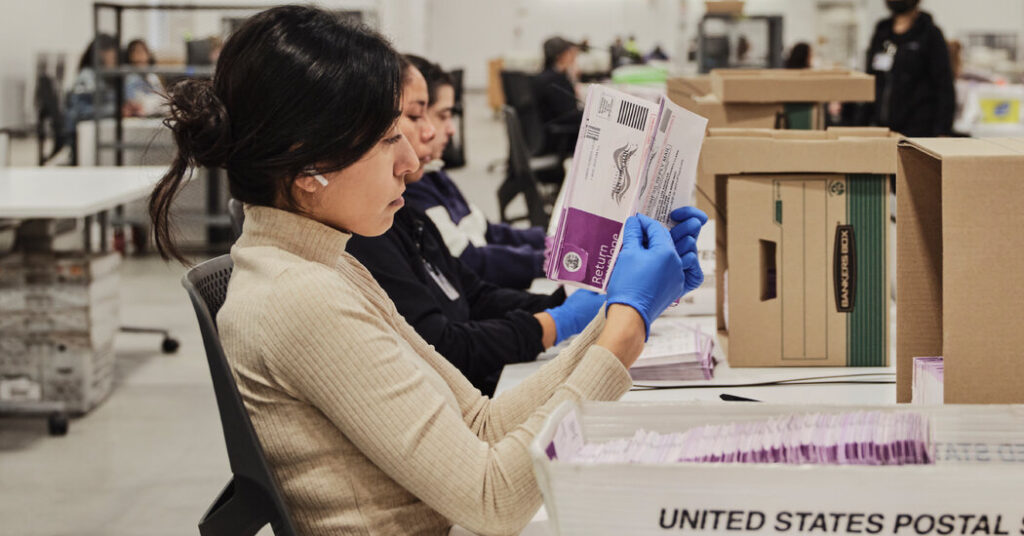
An appeals court on Saturday upheld a lower-court ruling blocking key parts of an executive order from President Trump to restrict voting by mail, the latest setback to his efforts to wrest control over elections as Republicans try to protect slim congressional majorities in an unfriendly political environment.
In a 20-page ruling, the U.S. Court of Appeals for the First Circuit wrote that Mr. Trump’s order “directs unprecedented levels of involvement by federal officials in how states administer elections.” If the order took effect in the midterm elections this November, “it would sow confusion and threaten disenfranchisement of many eligible voters,” the court ruled.
The Constitution grants authority over elections to states and Congress, not to the executive branch. But Mr. Trump has waged a yearslong campaign against voting by mail, signing executive orders, supporting court challenges and promoting legislation to curtail the option, which the president himself uses. Courts have blocked many of these attempts.
Mr. Trump has also repeatedly made unfounded claims that mail voting is rife with fraud, even as he has made clear that restricting the practice would be a boon for his party.
The ruling comes after more than 20 Democratic attorneys general challenged an executive order Mr. Trump signed in March targeting mail voting. The order called on the Department of Homeland Security to compile state-by-state lists of citizens to help determine voter eligibility, and called on the Postal Service to verify voters based on the lists provided by the states.
In June, the Postal Service complied with the order, releasing a proposed rule consistent with many of Mr. Trump’s demands.
The ruling by Judge Gustavo A. Gelpí and Judge Julie Rikelman, both Biden appointees, upheld a federal judge’s order in June striking down key components of Mr. Trump’s directive and calling them “unlawful, null and void.”
Judge Joshua D. Dunlap, a Trump appointee, concurred in part with his colleagues on the three-judge panel. In a separate opinion, Judge Dunlap noted that the rules had not been finalized, often a condition for a lawsuit to be brought. But the judge, who called the case “unusual,” said the executive order threatened “concrete injury” to legal voting. While the appeals court reaffirmed that the Constitution did not grant the executive branch authority over elections, the judges focused their ruling on whether the states could sue before the order goes into effect. The states argued that they had already had to divert resources in reaction to the order. The government countered that their response was premature.
A federal judge in Washington initially declined to halt the executive order in May because it had not been carried out, but a federal judge in Massachusetts later blocked the order as the administration moved to put it into effect.
The appeals court similarly wrote that the government’s acknowledgment that it had moved ahead with Mr. Trump’s directives undermined its arguments that the states claimed legal harm prematurely.
Lawyers representing the government said in recent court filings that they may challenge the appals court’s ruling at the Supreme Court.


Escaped pony leads police on wild chase through streets of major California city: ‘Hold your horses!’

ICE sparks fury for reportedly detaining pastors — then threatening to take their kids

DeepSeek said to tell backers of funding pause after viral posts

‘Top Chef’ star banned from being alone with daughter after abuse finding

Gen Z ‘teen takeovers’ go from hijinks to shootings, theft and vandalism. Blame ‘adolescent brain development’

16 celebs who moved to Florida and why they love it there

Trump’s unprecedented $37B failure exposed as secret meeting details leak: report

 Breaking2 days ago
âFailed nation, failed parenting and lack of home training’- Lawyer, Deji Adeyanju blasts podcast host for saying a poor man has no place in her heart’
 Investigation3 days ago
US didnât detain our President after World Cup Final – Argentine FA says
 News2 days ago
Court Delays Trial Of Alleged Abuja Land Grabbers Over ₦500m Fraud Case
- Society2 days ago
Mid-Year Budget Review: Government Allocates GH¢400 Million For New Buses To Boost Public Transport Fleet
- Investigation2 days ago
Chelseaâs Garnacho joins Aston Villa on loan
- News3 days ago
Businesswoman Loses ₦1m Goods After Exhausting Lagos Trip
- Investigation3 days ago
My past comments about Tinubu now baseless, not lies â Daniel Bwala
- News3 days ago
Femi Otedola Increases First HoldCo Stake With ₦77bn Share Purchase