World
Ethiopia's Danakil Depression looks like another planet and scientists know exactly why

This Video Is Trending Right Now
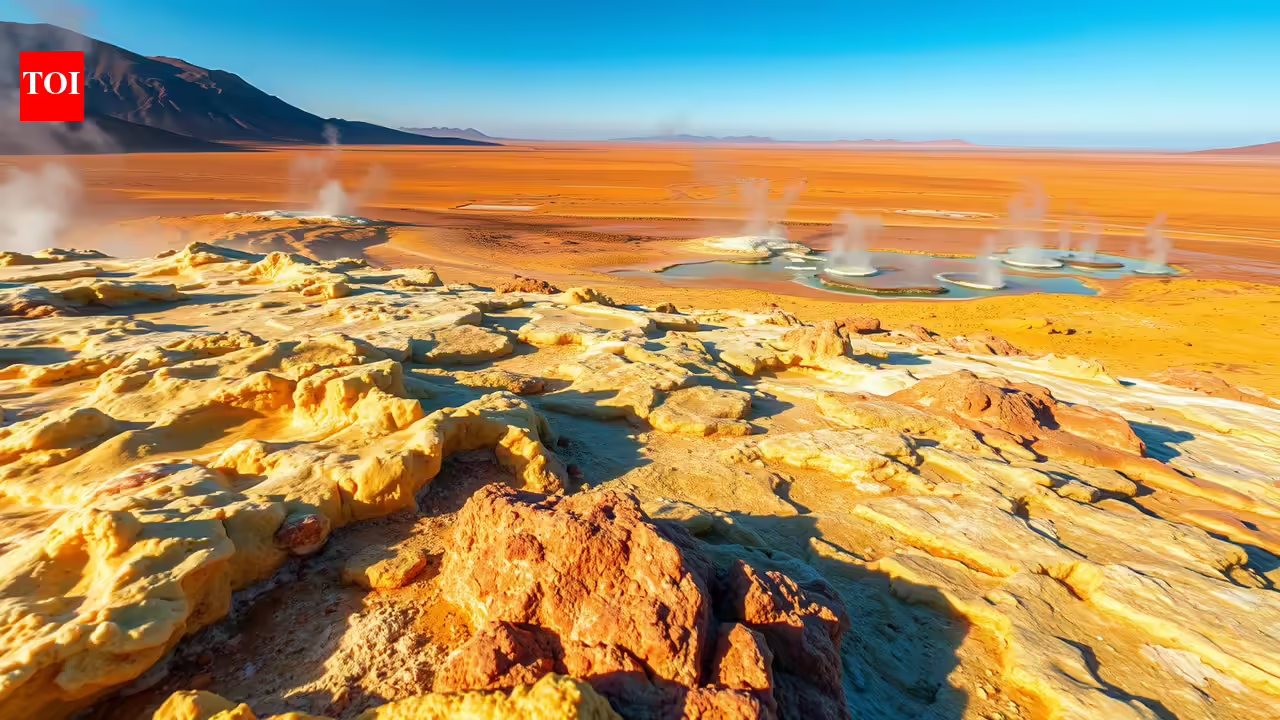
Few places on the planet look less like Earth than the Danakil Depression, a scorched, sunken stretch of northeastern Ethiopia where the ground bubbles with acid, glows in shades of yellow and green, and sits low enough to trap some of the hottest average temperatures ever recorded anywhere on the surface of the planet. Streaks of sulphur, iron oxide and copper salt paint the landscape in colours that look closer to a painted alien movie set than anything found in nature, while nearby volcanoes spit lava into glowing lakes and hydrothermal springs hiss out gases at temperatures well above the boiling point. This is not a coincidence of geology alone; the Danakil Depression sits at one of the most geologically active spots on Earth, a place where the planet’s crust is actively tearing itself apart, and scientists have increasingly turned to it as one of the closest natural analogues we have for the surface of Mars.
Where three tectonic plates are pulling the Earth apart
The Danakil Depression forms part of the wider Afar Triangle, a region where the African, Arabian and Somali tectonic plates all meet and are slowly drifting away from one another. This ongoing rifting process is gradually stretching and thinning the crust beneath the region, and geologists consider the area a rare, active window into how new oceans are born, since scientists believe the Red Sea will eventually flood into this widening rift and create an entirely new body of water millions of years from now. The constant tectonic movement also keeps the region intensely volcanically active, home to several active volcanoes, including Erta Ale, famous for hosting one of the very few permanent lava lakes anywhere on Earth.
The chemistry behind the alien colours
At the heart of the depression lies Dallol, a hydrothermal field widely regarded as one of the most extreme environments on the planet, sitting well over a hundred metres below sea level. According to a study published in Scientific Reports, the area’s hot springs reach temperatures between 90 and 109 degrees Celsius while registering a pH close to zero, making them roughly as acidic as battery acid, and some ponds within the depression have been measured at an even more extreme pH as low as negative 1.5. The vivid colours that give Dallol its otherworldly appearance come directly from this chemistry, as different dissolved minerals crystallise out of the scalding brine, iron oxides create rust red patches, sulphur deposits produce bright yellow crusts, and traces of copper salts tint pools a striking green.
Why life still manages to survive here
Despite conditions that would kill almost any familiar organism within minutes, researchers have found genuine evidence of microbial life clinging on inside Dallol’s superheated, hyperacidic pools. The same study identified extremely small, nano sized archaea, likely belonging to a group called Nanohaloarchaea, physically trapped and preserved within mineral deposits forming around the hydrothermal vents. These organisms are examples of what scientists call polyextremophiles, life forms capable of tolerating not just one extreme condition but several simultaneously, in this case blistering heat, intense acidity and extremely high salt concentrations all at once. Researchers involved in the work noted that finding life surviving under such a demanding combination of stresses carries real significance for understanding just how far the boundaries of habitability can stretch, both here on Earth and potentially on other worlds.
Why scientists keep comparing it to Mars
This connection to the search for extraterrestrial life is precisely why the Danakil Depression has drawn repeated visits from astrobiologists over the past decade. According to NASA’s Astrobiology programme, researchers view the depression as an unusually close terrestrial stand in for the kind of hostile, mineral rich, acidic conditions that may once have existed on early Mars, making it an ideal natural laboratory for testing how scientists might one day detect signs of past or present life on the red planet. Studying how organisms manage to survive, or in some cases fail to survive, Dallol’s most punishing pools helps researchers refine exactly what kind of biological signatures future Mars missions should actually be searching for, since not every corner of this extreme landscape turns out to be equally hospitable even to the toughest known microbes.
A landscape still actively being written
Unlike most dramatic looking landscapes, which tend to form gradually over immense stretches of geological time and then remain largely fixed, the Danakil Depression is still actively changing today. New salt mounds and hydrothermal springs appear on what can genuinely be a daily basis as fluids continue rising from below the volcano, while earlier geological events, including a significant earthquake in 2005, have been directly linked to reactivating dormant springs and creating entirely new features like the hypersaline Gaet’ale pond. This combination of rare active geology, genuinely extreme chemistry, and its usefulness as a scientific proxy for another planet has earned the Danakil Depression a place among the very few sites recognised internationally for their outstanding geological heritage value, a strange, hostile corner of Ethiopia that continues to rewrite its own landscape in real time.


Kogi govt., security forces recover 1,000 rustled livestock in offensive against bandits

Exclusive discounts from CBS Mornings Deals

I did not confer any Chieftaincy title on Baba Ijesa – Ooni Ogunwusi

World Cup 2026: Argentina coach Lionel Scaloni makes honest confession about Cape Verde

Horror WW3 warning as Polish PM says Baltics could be attacked in months

Philadelphia buries time capsule to commemorate America's 250th birthday

Why houses in the Philippines stand on wooden stilts to survive floods, typhoons and extreme heat

 Society2 days ago
Iyabo Obasanjo clarifies father’s real age
- Society3 days ago
Outrage As Video Of Primary Schoolgirls Smoking And Drinking Surfaces Online
- Breaking3 days ago
Nigerian nun in tears as she’s released after being arrested by ICE while walking to Mass in the US (video)
- Investigation2 days ago
Eight de@d and 13 injured after being hit by truck ‘being driven by child’
- Breaking3 days ago
"I would have contacted HIV or Hepatitis B if I had stayed" – Nigerian woman says as she reflects on her failed marriage
 National4 hours ago
Against Nigerian Law, CBN Deputy Governor Emem Usoro Allows Her Eleven Years Old Twin Daughters To Be Company Boss
- Breaking2 days ago
Panelists and guests on a podcast burst into laughter after 54-year-old US woman âmarriedâ to a 36-year-old Nigeria-based man, who she sends money to every month, laments about lack of love from him
- World2 days ago
WW3 fears explode as Cuba warns Donald Trump it's 'preparing for war'