World
Fed Holds Rates Steady but Three Officials Back Increase

This Video Is Trending Right Now
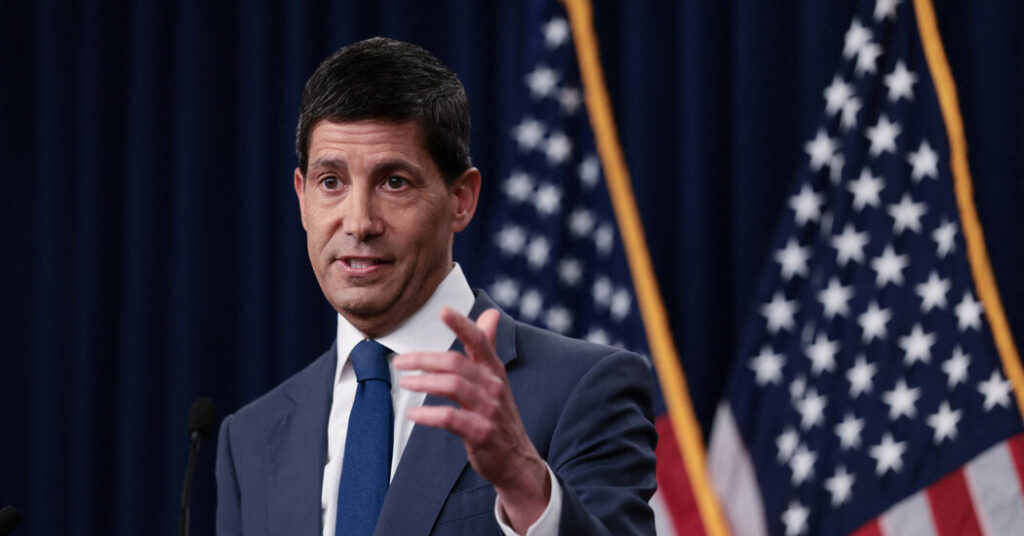
The Federal Reserve on Wednesday kept interest rates unchanged despite growing divisions among policymakers to more directly tackle inflation after five years of overshooting the central bank’s 2 percent target.
The Fed voted 9-3 to maintain rates at 3.5 to 3.75 percent, a level that has been in place since January. Beth M. Hammack of the Federal Reserve Bank of Cleveland, Neel Kashkari of the Minneapolis Fed and Lorie K. Logan of the Dallas Fed dissented, voting instead for a quarter-point increase.
The divisions underscore the tough spot the Fed and its chairman, Kevin M. Warsh find themselves in as they grapple with new sources of price pressures that are threatening to compound an already complicated and longstanding inflation problem.
Oil prices have whipped around in recent days with the Iran war in a delicate limbo. A deal to end the conflict and reopen the Strait of Hormuz, a crucial shipping path for global energy markets, remains distant. President Trump, speaking to reporters on the heels of the Fed’s decision, signaled that the fighting was far from over. He said the United States would mount another round of attacks against Iran. “It’s our turn,” he said, promising to “hit them very hard.”
The war is not the only supply shock the Fed is navigating. Mr. Trump is actively adding new tariffs, and the labor market is still digesting sweeping immigration restrictions he has put in place. Officials are also dealing with booming demand for products tied to the sharp rise in artificial intelligence investment. Supply has yet to catch up, leading to higher prices on items such as semiconductors, computer chips and servers, along with high demand for electricians and carpenters.
The debate at the Fed centers on how quickly inflation will ease from here as some of these temporary factors fade, and whether rate increases will ultimately be necessary to get inflation to return to target.
Mr. Warsh, who presided over his second meeting as chairman of the central bank, owns the outcome.
Since taking the reins in May from Jerome H. Powell, who is now a Fed governor, Mr. Warsh has staked his reputation on vanquishing inflation. He has been explicit that officials have “no tolerance” for elevated inflation, and that evidence of cooling conditions in the latest Consumer Price Index report from June does not amount to “mission accomplished.” That report showed that overall consumer prices were 3.5 percent higher in June than a year earlier, down from a 4.2 percent annual rate in May.
Mr. Warsh, speaking at a news conference on Wednesday, was on the defensive as he was pressed to explain how keeping rates steady was compatible with his “price stability” pledge. He opened the news conference by saying that “where necessary and appropriate, we will not hesitate to act.” He pushed back on the idea that the Fed was on “pause” at this meeting and he repeatedly stressed that there was “nothing inertial” about the Fed’s discussion, its policy or its strategy.
Up until this point, however, Mr. Warsh has not specified how exactly he will make good on his inflation pledge. When asked at congressional hearings earlier this month how the Fed would tame inflation, he stipulated that the central bank would assert its commitment to getting it down, take responsibility for any failure in doing so and study the policy tools at its disposal.
When asked specifically about the effectiveness of the Fed’s tools and whether higher rates were the best remedy to tackle inflation, Mr. Warsh on Wednesday said that this was one tool that “could well be part of that solution, but I wouldn’t say it’s in isolation.”
Updated
Mr. Warsh instead homed in on recent gyrations in financial markets, most notably the rise in yields on inflation-adjusted government bonds. The recent tightening of financial conditions, which capture the availability of credit across the economy, provided the Fed “some comfort that we’ve got the ability and capability to deliver,” he said.
As Mr. Warsh spoke, longer dated Treasury yields rose sharply, with the 30-year bond closing in on its May peak of 5.2 percent. That was the highest level since 2007. The rise in the 30-year Treasury yield suggests some worry about Mr. Warsh’s ability to tackle inflation in the long run.
The case for leaving rates unchanged hinges on an assumption that the Fed can afford to be patient before making a move. Many policymakers see scope for inflation to decelerate in the second half of the year. By the next meeting in September, the Fed will have two more months of data in hand. Moreover, the public has not yet lost confidence in the Fed’s ability to eventually reach its goal, as evidenced by a range of metrics tracking inflation expectations. Mr. Warsh on Wednesday clarified that price stability means returning inflation, as measured by the Personal Consumption Expenditures price index, to 2 percent.
“There is no soft implicit target, not on this committee’s watch,” he said. “There’s only a target, and it’s 2 percent.”
But the longer inflation stays above that level, the more likely that this confidence is rattled. As such, officials have made clear that if inflation does not soon retreat, they would stand ready to raise rates.
What has made the trajectory for rates especially hard to discern, however, is Mr. Warsh’s preference to keep quiet about how he views the outlook. That obscurity, which he said was important so that the Fed could get an “unfiltered” view of what markets think, had fueled speculation ahead of Wednesday’s meeting that Mr. Warsh might deliver a surprise rate increase.
“Surprises are not the objective, but at the same time, I would say we didn’t come into this meeting feeling constrained by the full range of alternatives we had in front of us,” he said.
Traders are now pricing in a rate increase for December and have dialed back expectations for a September move.
A rate rise later this year will no doubt anger Mr. Trump, who tapped Mr. Warsh for the job. The president has long wanted the central bank to lower rates. Following Wednesday’s decision, Mr. Trump laid the blame on Mr. Warsh’s colleagues, who vote alongside the chairman on policy decisions.
“I know he’d love to see lower interest rates, but he’s got a board, and it’s a political board, and they want to keep rates up,” the president said.


Employees flee fire inside TikTok headquarters in Culver City

Beehive Block Party and beyond: SoLa and Live Nation train entertainment’s next generation

Salman Rushdie’s Attacker Found Guilty of Aiding a Foreign Terror Group

Cross River LG workers protest 11 months of unpaid salaries

Microsoft Increases Spending on A.I. as Profit Jumps 31%

John Thune slams Trump’s ‘different form of math’ as election battle heats up

HEDA urges ICPC to probe ex-minister’s alleged salary fraud, payroll

 Society3 days ago
“Nkwasiafoɔ, Who Will Play The Instruments?” — Nana Agradaa Sacks Instrumentalists After Mass Altar Call For Travel Prayers
- News2 days ago
Ìṣẹ-Ekiti Celebrates 25 Years of Purposeful Leadership as Arinjale Marks Coronation Anniversary
- Investigation2 days ago
Bandits abduct 13 passengers on JosâKano highway, police rescue 9
- Investigation2 days ago
Fugitive drug kingpin, ex-intâl footballer bag 24 years jail term for cocaine importation
- Investigation2 days ago
ââDo not shake hands”- UNILAG shares anti-r@pe advisories to female students
- Investigation2 days ago
âOne of my colleagues took the HIV prevention injection, Lenacapavir, and started experiencing this reaction shortly afterâ â Nigerian nurse
- Society2 days ago
“We Have Done Everything Possible for Peace, But Adwoa Safo Wants GH¢3.7 Million Before Releasing Our Father’s Body” — Nana Kwadwo Safo Akofena
- Investigation3 days ago
Spain star Dani Olmo calls out Argentina coach for âlyingâ after World Cup final brawl