World
Government Borrowing Cost Hits Two-Decade High After Fed Rate Decision

This Video Is Trending Right Now
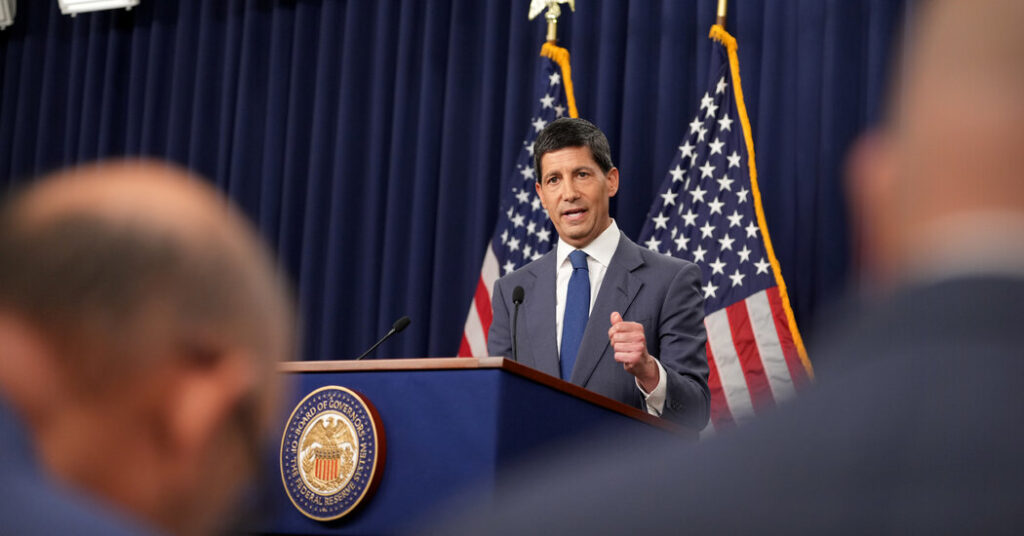
Long-term government borrowing costs shot higher on Wednesday, in a sign that investors doubt whether Kevin Warsh, the new chairman of the Federal Reserve, will keep inflation contained.
The 30-year Treasury yield, an indicator of what it would cost the federal government to borrow money for three decades, rose 0.11 percentage points to 5.22 percent on Wednesday, its largest one-day increase in more than a year, and its highest level since 2007.
The move higher has ramifications for companies, consumers and the government, with Treasury yields underpinning borrowing costs across the globe. The 10-year Treasury yield, arguably the most important interest rate in the world, also rose, up 0.07 percentage points to 4.67 percent, close to its highest level of the year.
The rise in longer-term yields came after the Fed announced Wednesday it would keep short-term interest rates unchanged, despite some investors having bet on a rate increase — the typical tool the Fed uses for slowing inflation.
“The market is concerned that the Fed not hiking is going to result in persistently higher inflation,” said Subadra Rajappa, an interest rate strategist at Société Générale.
Investors have become concerned about resurgent inflation, with the Iran war pushing up oil prices, and rampant spending on artificial intelligence infrastructure driving up prices in the broader economy.
For months, those inflation worries had remained fairly short-term, pushing up yields on short-dated Treasuries. The moves in the 30-year yield on Wednesday suggested investors are now becoming concerned about inflation remaining higher for longer, even decades, to come.
The 30-year “breakeven rate,” a measure of the market’s inflation expectations over 30 years, rose on Wednesday by the most in one day since Nov. 6, 2024, the day after Donald Trump was re-elected president.
Mr. Warsh, in response to questions from reporters on Wednesday, reiterated his commitment to slowing inflation. But Ms. Rajappa noted that Mr. Warsh avoided giving details about how the central bank would act on that commitment, worrying some investors, especially after the central bank had just voted against raising interest rates at this week’s meeting.
Longer-dated Treasury yields have been rising for some time, but not because of inflation, said analysts.
Rising government spending across the globe has helped push up government borrowing costs in recent months, as investors demand more in return for the risk that comes with more indebted countries. Rising growth expectations tied to the A.I. revolution have also helped push up yields.
Wednesday’s sharp move higher, driven in part by rising inflation expectations, “speaks to the sensitivity of long-end yields to Fed credibility,” said Jonathan Hill, an inflation analyst at Barclays.


I hope Peller and Jarvis signed a prenup before getting married – Delta state govâs aide, Ossai Ovie Success

3 No-Skip Punk Albums Turning 20 This Year

Oprah Winfrey Reshapes Her South Africa Education Project After Nearly Two Decades
Man killed over witchcraft allegation, another stabbed to death in Bauchi
Police arrest Osun SSG, others over alleged vote buying

Oil Sector Faces New Funding Levy Debate as South-South Commission Bill Sparks Investment Concerns

Defence Minister inaugurates DICON Institute of Technology in Kaduna

 News2 days ago
Ìṣẹ-Ekiti Celebrates 25 Years of Purposeful Leadership as Arinjale Marks Coronation Anniversary
- Society2 days ago
“We Have Done Everything Possible for Peace, But Adwoa Safo Wants GH¢3.7 Million Before Releasing Our Father’s Body” — Nana Kwadwo Safo Akofena
- World3 days ago
Trump likes daily strikes on Iran, Sen. Kennedy says: ‘You have to kill a few chickens to scare the monkeys’
- Investigation2 days ago
Fugitive drug kingpin, ex-intâl footballer bag 24 years jail term for cocaine importation
- Investigation2 days ago
Bandits abduct 13 passengers on JosâKano highway, police rescue 9
- Investigation2 days ago
Tinubu will run for third term if Good keeps him alive â Babachir Lawal claims
- Society3 days ago
Ogun 2027: Egba people must reject imposition, uphold democracy – Akinfiwatolu of Egbaland
- News3 days ago
PidomNigeria, Dangote, others named top impact companies