World
How Do Monarchs Do It?

This Video Is Trending Right Now
Photographs and Videos by Ana Hop
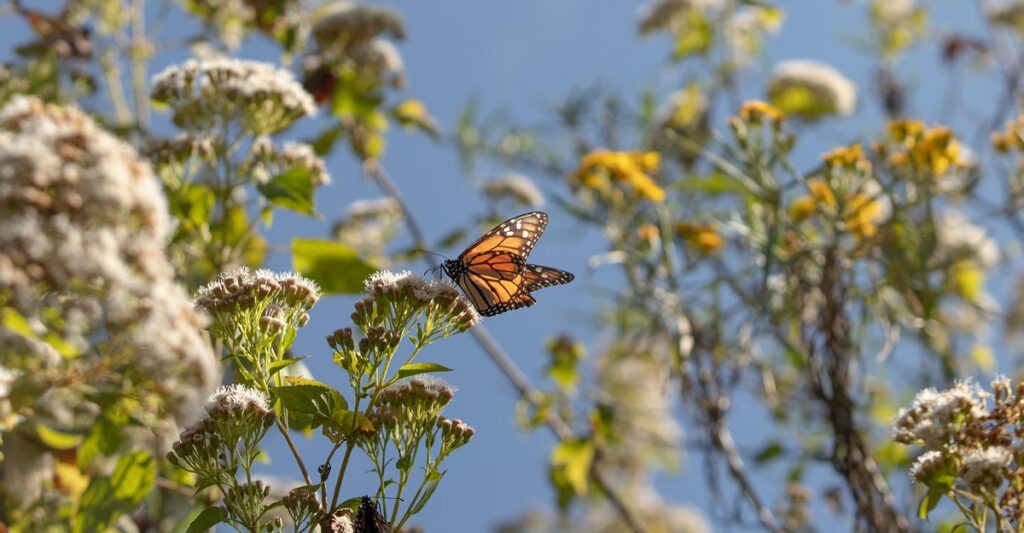
“¡Mire! ” My guide, Silvestre, pointed upward, as if I wasn’t already walking with my neck craned as far back as it could go. The sky was alive with millions of fluttering shapes, congregating into clouds at random, occasionally turning into ribbons that wound through the trees. So many butterfly wings beat the air that their vibrations were audible, like a waterfall rushing in the distance. I understood for the first time the immensity of the event I’d come to see.
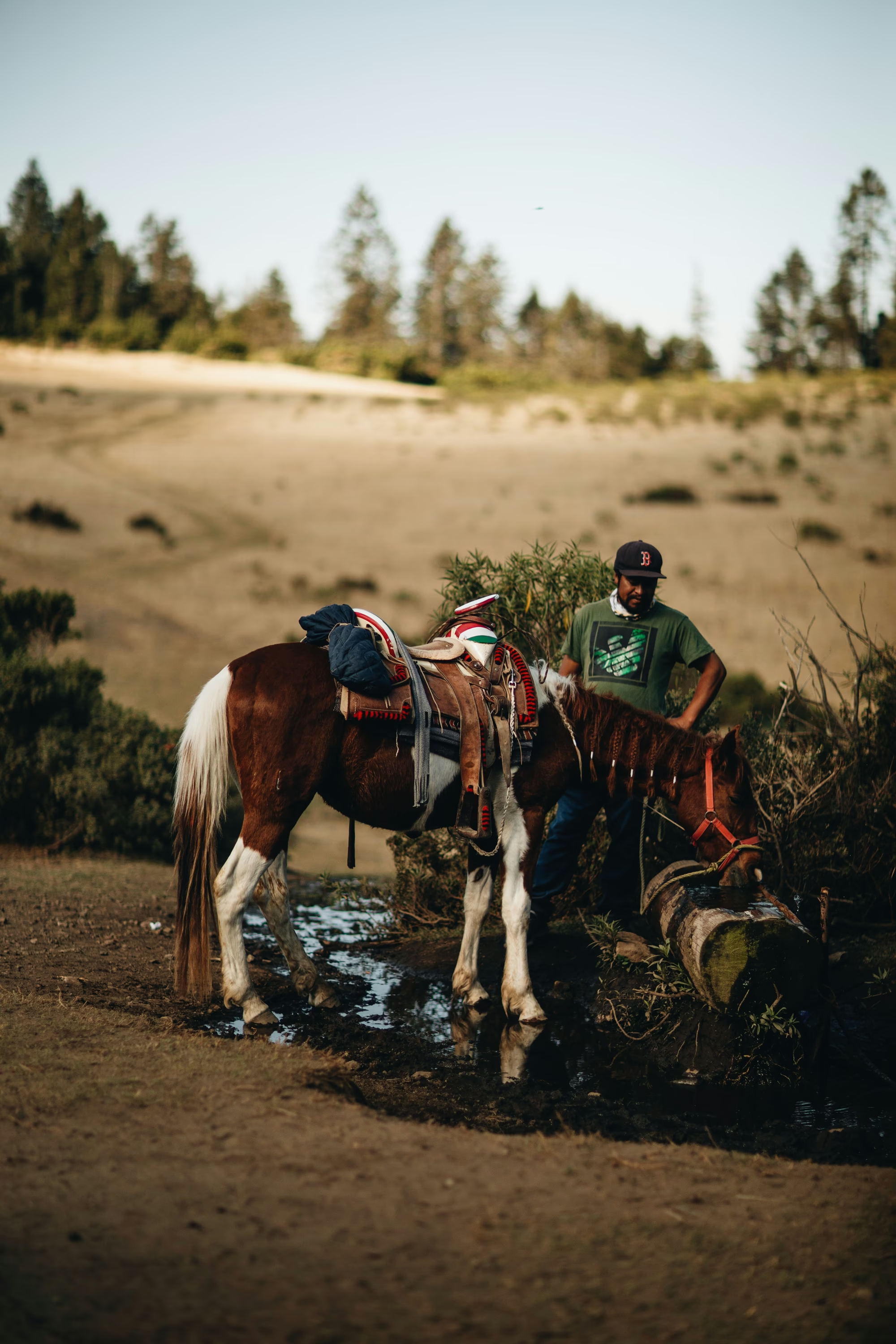
I was in the center of El Rosario butterfly sanctuary, part of Mexico’s Monarch Butterfly Biosphere Reserve. Unaccustomed to the thin air at nearly 11,000 feet above sea level, I’d ridden Pelucha, a rust-colored mare, to the heights of the reserve. About halfway up, the orange-and-black butterflies had begun appearing in groups, alighting on flowers or gathering to sip water from puddles. Coupled pairs mated everywhere, and their constant entanglements on the path made it difficult to avoid stepping on them; Pelucha happily crunched more than a few underfoot. I dismounted at the top of the trail and followed Silvestre as he ducked under a rope that kept tourists from accessing the most sensitive areas of the reserve.
It was February, and the monarchs—northerners that had wintered in Mexico—were preparing for their final journey, which doubled as the first leg of a multigenerational relay race north. Their delicateness belies a life cycle that more resembles long-haul trucking than anything you might read in a children’s book. Each of the butterflies above me had already braved many grueling trials. In the following week or so, the majority would be on their way.
Monarch migration is a wonder of the natural world, one of the longest annual cycles of movement undertaken by any creature on Earth, spanning thousands of miles. Over the past half century, the lands that the monarchs traverse have become more hostile to them, a result of development and herbicides, global warming and organized crime, all of which have put the future of that migration in doubt. And yet, the story I’d come to write—my reason for interloping in this and other sanctuaries—was not just a narrative of beauty being diminished by human trampling and greed. Recently, there’s been good news: Population estimates, after a long march downward, have been increasing for the past two years. This stabilization appears to be connected at least in part to efforts to save butterfly habitats in Mexico, the United States, and Canada. Those developments are reason to hope that there may still be a pathway left for saving the monarchs and their migration.
The monarch persists partly because of the dogged work from its human partners; because of people who have given their life—in every sense of the phrase—to preserve nature. But mostly, the monarch persists because life’s job is to live; because within those thimble-size bodies hides a dynamo of survival that puts our most incredible machines to shame. The more we learn about the butterflies, the more we understand how extraordinary it is that they have so far beaten the odds we have stacked against them, and how forbidding those odds remain.
We’ve known just how epic the monarch’s migration is for only about half a century. In the 1970s, using paper tags placed on butterflies’ wings, the Canadian butterfly researchers Fred and Norah Urquhart completed a lifelong mission to uncover the mystery of where all the monarchs born in Ontario went in the fall. To their surprise, the sojourners they followed made it all the way down the length of the U.S., and on to the mountain forests of Michoacán, Mexico. There they roosted, packed tightly into just a handful of colonies that collectively cover no more than a few city blocks, yet hold nearly all of the continent’s monarchs in winter. The Urquharts first visited these colonies in 1976, and National Geographic published a cover story on their breakthrough.
For centuries, Indigenous people in Mexico’s highlands have witnessed the monarchs’ annual return during harvest season, though for most of that time they didn’t know where they came from. The butterflies have been making this migration for as long as 20 millennia, once finding paths to and from the fields gouged out by glaciers retreating with the spring during the last Ice Age. Now their roosting grounds sit within a handful of sanctuaries that I visited. At Sierra Chincua, a few miles north of El Rosario, I stood on a cliff overlooking the slender trunks of oyamel fir trees. I watched living streams of monarchs flying in different directions, sometimes winding about one another like a gigantic knot forever being tied, and looked in vain for three monarchs that I knew were in the fray.
Each had been given a designation in a spreadsheet—CHI016, CHI013, and CHI001—but those were all very boring names for butterflies, so I’d asked my 6-year-old daughter to give them better ones. She’d come up with Cinderella, Eric, and Carle. (She knows The Very Hungry Caterpillar by heart.)
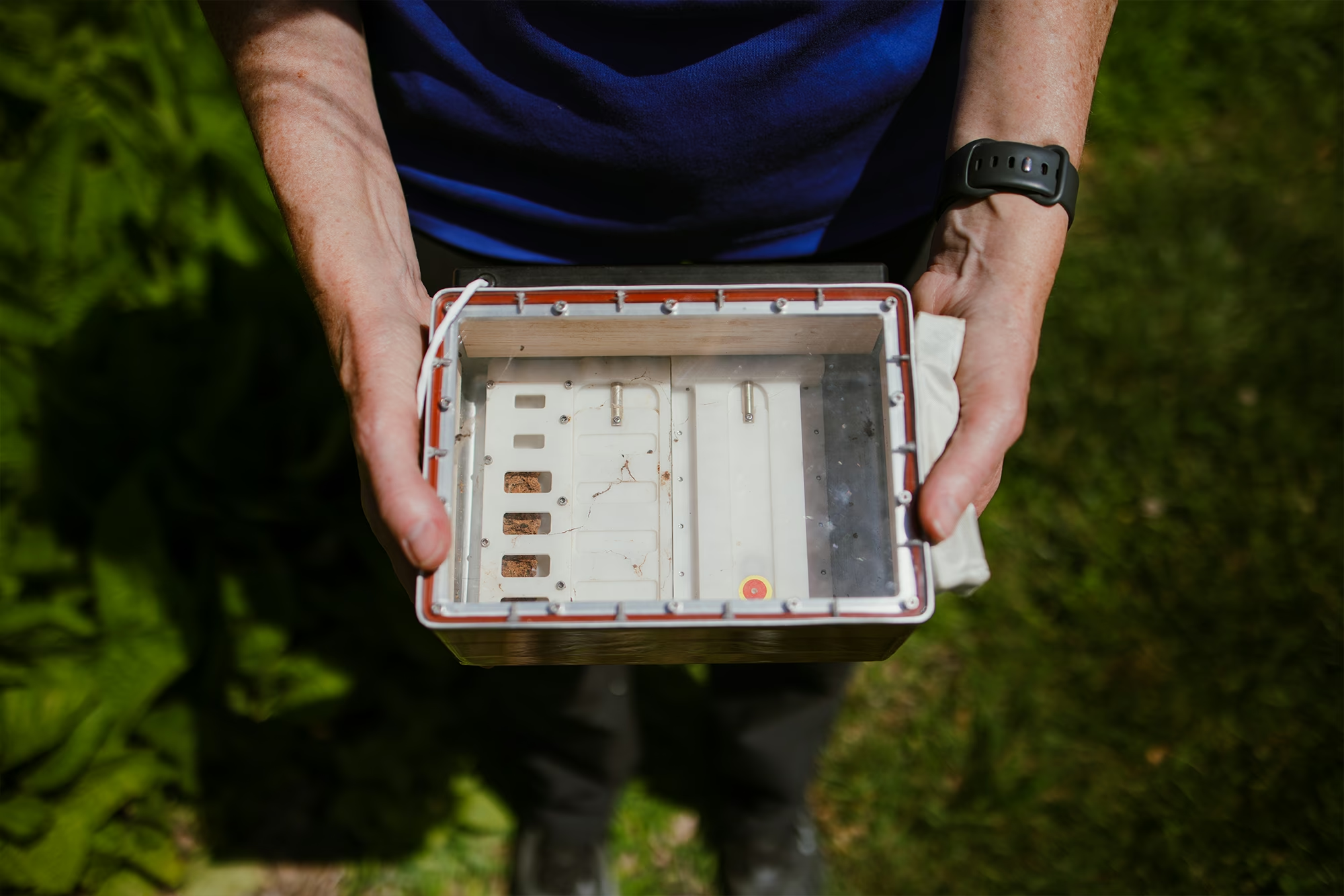
Nothing about the trio was unusual, save for the gear they wore. Affixed to each butterfly’s thorax, like a tiny backpack, was a transmitter the size of a grain of rice. These transmitters, called BlūMorpho tags, had been developed by a company called Cellular Tracking Technologies, and Cinderella, Eric, and Carle were part of the first generation of monarchs to wear them.
Before my visit to the sanctuaries, I’d spoken with David La Puma, an executive at CTT and one of the brains behind the BlūMorpho. The company had initially focused on developing tech for tracking eagles, but La Puma had previously worked in monarch conservation, and carried his interest in the butterflies with him. Tracking a monarch is different from tracking an eagle, as monarchs each weigh less than a dollar bill. Any transmitter attached to one could weigh no more than a few grains of sand.
No battery could be made that small and still provide power over months of flying, and the solar panels that CTT used for eagle trackers were much too heavy. But the team figured out a solution: taking the ultrathin solar squares that line the wings of satellites and carefully chopping them up into tiny bespoke cells. An early version of the tracker, applied to butterflies with dabs of eyelash glue, was linked with a cellphone app via Bluetooth, allowing enthusiasts to follow nearby butterflies—a sort of “Pokémon Go for monarchs,” La Puma said—and record their locations in somewhat haphazard fashion. The newest iteration works more like Google Maps, providing far more complete data on the butterflies’ locations to anyone, almost in real time.
Knowing more about butterflies’ individual habits may enable us to help them thrive collectively (more on that later). The data also just help us get to know the monarchs better. As it turns out, some seem to be worse with directions than others, and can find themselves traveling west or south from Mexico. In the prototyping stage, some monarchs were detected near oil platforms in the Gulf of Mexico, nowhere near land, and some butterflies appeared to enjoy Caribbean vacations. Yet the majority seem to follow well-established paths along invisible corridors in the air.
Cinderella, Eric, and Carle had all been tagged in Sierra Chincua, which meant that I could deduce certain facts about their lives. They were already bona fide world-class wanderers, having flown there all the way from Canada in the fall, a three-month trip. Along the way, they’d dodged birds and windmills and cars, eventually reaching the same patch of forest—perhaps even the same trees—that their great-grandparents had roosted in. For much of the winter, they had not eaten and had barely moved, jamming themselves so tightly against their fellow travelers that from a distance they looked like scales armoring the sides of the trees. Now they’d awakened, stretching their wings and warming up.
Though I couldn’t spot them in the sky, I could see from my phone that Cinderella, Eric, and Carle were near. Over the next several weeks, I would keep tabs on them, following their movements with a level of detail that would have been impossible only a year ago.
Individual butterflies can travel as far as 100 miles in a single day and can congregate in groups so thick that they show up as clouds on weather radar. Glider pilots have seen them flying at altitudes above 10,000 feet. Year after year, new generations tend to gather around the same landmarks, despite having never seen them before. They seem, for example, to love the Barnegat Lighthouse on Long Beach Island, in New Jersey.
The monarchs’ feats of navigation are enabled by their internal technology, a set of instinctual tools that in some ways surpasses our understanding. The butterflies’ eyes can sense the angle and intensity of different forms of light. In each antenna, a complex series of molecules maintains their circadian clock, which, when combined with sunlight cues, gives them their sense of direction.
When the sun is unreliable, monarchs have a secondary method of pathfinding— a biological compass that allows them to sense Earth’s magnetic field. Internal thermostats help govern the timing of their northward movements.
The butterflies’ migration evolved to fit North America’s geography. Monarch caterpillars eat only milkweed, which grows best in cooler climates, but the butterflies can’t tolerate freezing temperatures. The length of the continent’s interior, unbroken by mountains or oceans, allows the monarchs to find the right weather and plants throughout the year—a Goldilocks ecology, neither too hot nor too cold. They are a marvel of nature’s engineering, of the kind of elegance that evolution can achieve over deep time.
“Winter is hard for insects that have to survive it, and monarchs basically avoid it by leaving,” says Karen Oberhauser, a researcher at the University of Wisconsin at Madison and a co-founder of the Monarch Butterfly Fund. Unlike many other butterfly species, which are adapted to very specific microbiomes, monarchs have options if a local environment changes.
Indeed, they seem strikingly well adapted for living alongside the world’s most disruptive change agent: humanity. Milkweed tends to thrive in transitional areas, such as fallow fields, unkempt lawns, and the edges of highways. “When I first started studying monarchs, it really did seem like they kind of had an advantage over a lot of other species,” Oberhauser told me. “That’s a disturbance-adapted species.” She said, affectionately, that monarchs are like rats or pigeons, all part of the strange but sturdy menagerie of modern life.
But there are limits to any creature’s adaptability, and human activity has steadily eroded the monarch’s margin for error. In the 1930s, Mexico’s land-reform program created ejidos, areas designated for communal use by peasants. They began clearing the ancient oyamel forests to plant corn, beans, and squash, and sold the felled timber. Commercial interests also stepped in, accelerating logging in the butterfly’s winter habitats.
North of the Rio Grande, there have been disturbances to the disturbances. Although milkweed can flourish along roads, the advent of the interstate system also introduced one of the most efficient killers of butterflies: speeding traffic. And although farmland in the Midwest was once a reliable (if accidental) incubator for milkweed, the development of Roundup Ready crops in the ’90s allowed more promiscuous use of herbicides. Almost overnight, milkweed disappeared from large-scale farms.
According to a recent report from the World Wildlife Fund, the total area covered by monarch colonies in winter decreased from 45 acres in 1996 to a low of fewer than two acres in 2013. The five-year average of colony size has dropped by 80 percent since the mid-’90s, a plunge of some 170 million butterflies.
As Oberhauser told me, the changes wrought by humans have caught up to the monarchs. In fact, the complexity of the migration might now be a liability, as multiple stops on the journey face upheaval at once. “What makes them so strong also makes them vulnerable,” she said.
My trio of butterflies had been strong from their beginnings. As caterpillars, they’d gorged on milkweed, a plant that is toxic to most animals, and incorporated its poison into their bodies. Their distinct coloring is both a warning for predators and a badge of initiation.
They are already one-percenters—only one in 100 of the eggs laid in Ontario last year had produced butterflies that made it this far. Their generation, called a “super-generation,” is bigger and more robust than their parents’ was or their children’s will be: They are centurions built to make the journey all the way south and partway back. (Two successive generations will eventually complete the round trip to Canada.) Now, after a winter of fasting, huddled close against the cold, they are regaining their strength, sipping nectar from flowers near their roosting trees. On my phone, I can see a map with each location that the butterflies ping as they meander from place to place, ever returning to their central roosts.
My phone shows only their movements, not their more private matters, but I know that before they leave these forests behind, they will each find a mate. For Cinderella and Eric—which, as I told my daughter, is a female butterfly—their mates’ package of sperm will also contain a deposit of nutrients that will help them handle the rigors of the trip. Carle will weaken himself, giving his mate a gift that she must use to ensure the survival of their offspring.
For the past several decades, a diverse group of grassroots activists, scientists, and enthusiasts has worked to forestall the monarchs’ decline. I’d come to Sierra Chincua as the guest of one of them. José Luis Álvarez Alcalá, a local activist and farmer, showed me around. He pointed to the visitors’ center, restaurants, and gift shops near the sanctuary’s entrance. “None of this was here 30 years ago,” he told me. Then he pointed to a copse of young trees creeping up the hills. “A lot of that wasn’t either.” Álvarez Alcalá would know: He helped create much of it.
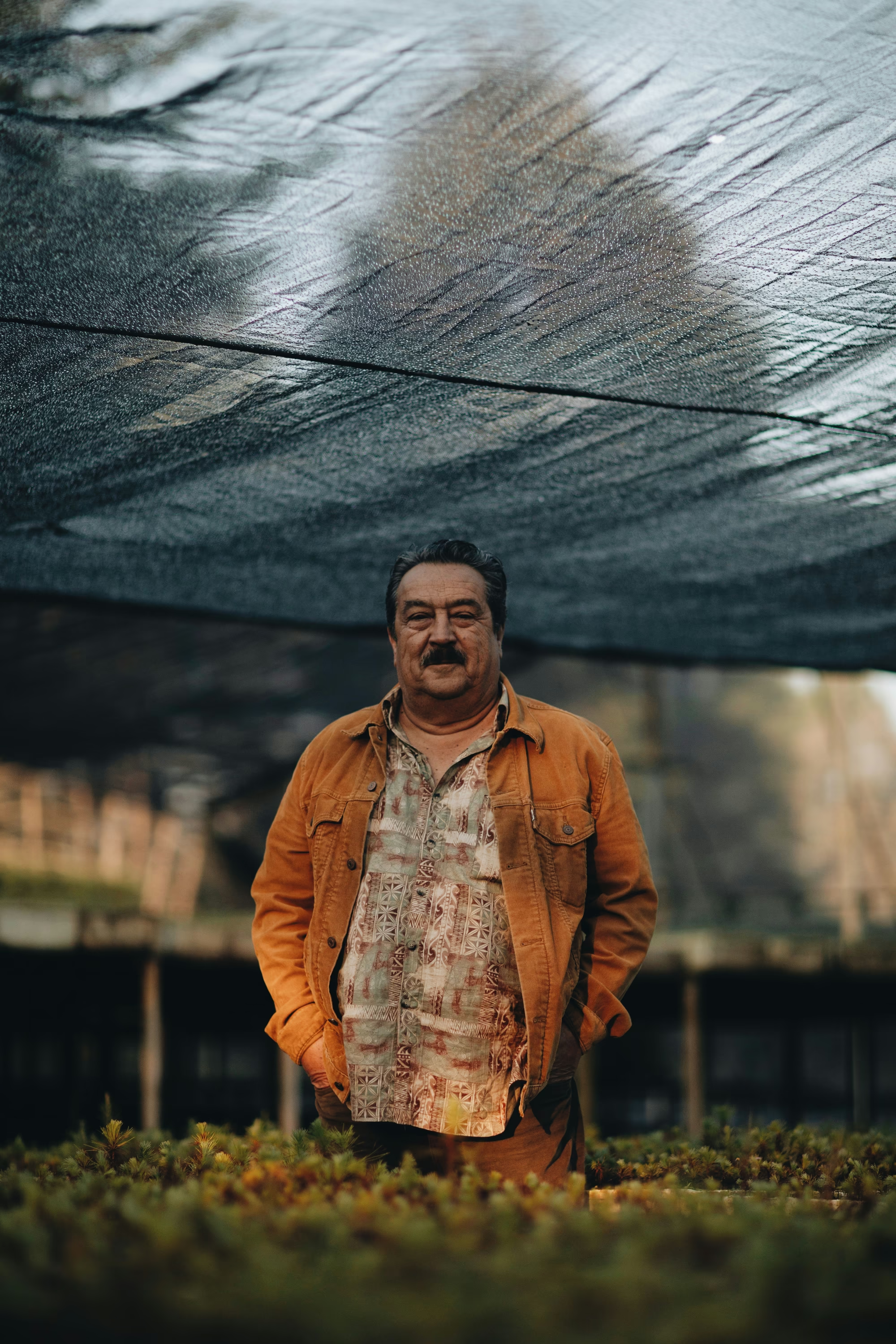
Years of chain-smoking can be heard in the thickness of Álvarez Alcalá’s voice, and when we met, he sported a limp from a recent fall while working. He wasn’t originally a butterfly guy, he said, but was interested in revitalizing the region that encompassed the sanctuaries, and he ran a tree nursery on Hacienda la Cruz, a 17th-century Spanish colonial estate that he’d restored. By the 1980s, just a few years after the National Geographic story came out, the monarchs were already drawing streams of intrepid sightseers from abroad, despite almost no tourism infrastructure. Álvarez Alcalá realized that there might be a way to align the survival of the species with the local economy.
In 1986, President Miguel de la Madrid gave national protections to the main colony sites, creating the Monarch Butterfly Biosphere Reserve. But those protections did not halt or even slow logging. Encouraged by the butterfly scientist Lincoln P. Brower, Álvarez Alcalá and his associates came up with a more proactive plan. They would give the members of the ejidos oyamel fir and pine saplings to grow, instead of their usual crops. The growers would still be free to profit from their land by selling timber for Christmas trees, lumber, or charcoal, but would be encouraged to harvest the wood sustainably. If done right, on a wide-enough scale, the model could help provide both income for the ejidatarios and the basis for butterfly tourism.
Álvarez Alcalá says that, since launching in 1997, his La Cruz Habitat Protection Project has planted about 20 million oyamel fir and pine trees. Other groups have also reforested hundreds of hectares. The oldest of the trees planted as part of this experiment are now maturing and providing winter homes for exhausted monarchs.
Over the span of just a few years, reforesting and ecotourism have transformed much of Michoacán, the state in which the sanctuaries reside. In the municipality of Angangueo, a brilliant mural depicts the social history of the monarchs, the “hijas del sol,” including a painting of the now-famous 1976 National Geographic cover. In El Rosario, the trinkets and souvenirs, the tour-bus parking lots, and even the stable of horses for rent all speak to a symbiosis that has only recently come to be.
The monarch’s star turn has changed the places along the more northerly parts of its route as well. In the U.S., seven states list the monarch as their official insect or butterfly, and in many places, monarchs appear on license plates that urge fellow drivers to protect the environment. More than 50,000 yards, parks, and schools now feature Monarch Waystations, special gardens stocked with milkweed and flowers.
According to the World Wildlife Fund, the overwintering areas covered by monarchs this year increased by 64 percent. Cinderella, Eric, and Carle’s generation was the largest to leave Mexico in seven years. The measured takeaway from the WWF is that “despite challenges, conservation efforts are making a difference.”
Yet there are new challenges, new crises in front of the monarchs. And these may eclipse the ones they’ve seen so far.
“Fucking avocados.” Álvarez Alcalá’s son Luca was driving me around the outskirts of Hacienda la Cruz, where La Cruz Habitat Protection Project is based. He pointed to the offending field in the distance, its neat rows of hunter-green bushes a dead giveaway. The fruits represented one of the emerging threats to the reforesting mission, and to the monarch’s survival.
I’d arrived in Mexico just after the annual high-water mark for avocado consumption: the Super Bowl. Michoacán is the largest avocado-growing region in the world, producing nearly all avocados eaten in the United States. Its volcanic soil is ideal for the fruit, and intense American demand for guacamole and fancy toast has, in these parts, given avocados the moniker oro verde—“green gold.”
Unfortunately for monarchs, their forests sit right in the middle of some of the most promising areas for growing avocados. And the green-gold rush is so lucrative that it has drawn the attention of the area’s cartels, which now extort local growers, smuggle many of their avocados across the border, and even operate plantations directly. There’s a good chance that if you bought chips and guac to eat while you watched Bad Bunny during the big game, a cartel profited.
Recently, cartels have been a major force behind illicit logging in the forests that Álvarez Alcalá and his son have tried to revive and protect, and much of the land has been converted for avocado farming. In 2020, Homero Gómez González, a prominent conservationist at the Biosphere Reserve, was found dead in Ocampo, the closest municipality to the sanctuary. Gómez González had been known as a vociferous antagonist of loggers. His killing has not been solved, but many outlets have placed the blame on the cartels.
Those same cartels instigated the crisis that gripped Mexico during my travels. Just three days before I got to Hacienda la Cruz, Mexican authorities killed Nemesio Rubén Oseguera Cervantes, the leader of the Jalisco New Generation Cartel. The death of “El Mencho” sparked violence across the states of Jalisco and Michoacán: Cartel members erected barricades on major roads and ambushed National Guard members, killing at least 25 and also attacking several journalists.
When I asked the elder Álvarez if touring the region would be safe, he gave perhaps the least-encouraging encouragement I’d ever heard: “I think there will be no problems,” he said. “But nothing in life is for sure.” During my trips to El Rosario and Sierra Chincua, both sanctuaries were mostly empty of tourists; cartels had been burning cars near the base of Sierra Chincua. It was all a stark reminder of how precarious monarch tourism is, and how much money there is to be made in destruction.
When I spoke with Megan Fulton, the executive director of Álvarez Alcalá’s project, she was keen to point me to a recent report from the WWF showing that, the avocado boom notwithstanding, rates of forest degradation and illegal logging in the sanctuaries have slowed in the past year. She attributed the positive development to the local communities being galvanized by global warming and weather changes. “They are the communities that are already seeing the effects of climate change,” she said. “So they want to restore their land and protect it for future generations.”
But the very fact that the communities are experiencing tangible effects—unprecedented heat waves that have killed hundreds, record droughts and wildfires that have ruined crops—means that the problem is bigger than organized crime, and perhaps beyond the ability of individual people or local groups to solve. Climate change is an accelerant for troubles that are already afoot. High mountain elevations that were once cool and less hospitable for avocado growing are getting hotter—and thus more tempting for felling. Warmer temperatures will also narrow the already tiny bands of habitability for oyamel firs, disrupting forest ecologies even in places that logging hasn’t yet touched.
[From the December 2025 issue: Vann R. Newkirk II on what climate change will do to America by mid-century]
The most ominous signs were visible from Hacienda la Cruz. In the forests just outside the property, like scars on the green mountainside, three ugly patches of brown, bare tree skeletons stood out. Luca explained that these patches had been infested by pine bark beetles, notorious evergreen-killers that feed on stressed or weakened conifers. The beetles are a normal part of forest ecosystems, and their numbers are usually controlled by cold winters. But the season has grown warmer. More trees now suffer from heat stress and dehydration, making them targets. Oyamels are particularly vulnerable. Authorities have already been forced to cut down whole sectors of the reserve to keep beetle infestations from spreading.
On my phone, I can see that by mid-February, Cinderella is restless, regularly streaming to the southwest and back, even visiting Ocampo once or twice, veering toward Loncheria Los 4 Elementos, a little snack bar in town that sells tortas, burgers, and micheladas. Eric is a bit more adventurous, making her way almost as far west as Ciudad Hidalgo, where the great father of the nation once owned a hacienda. Carle is more of a homebody, sticking closer to Sierra Chincua and often staying in its forests.
Eric is the first of the trio to leave for good, but her eagerness might be her undoing—the weather might not yet be warm enough for a successful transit. She flies north through Querétaro, but then her tracker stops transmitting. Cinderella and Carle choose to leave with the bulk of their cohort a week later, around the second week of March. There’s not much road ahead for Carle; he stops transmitting soon after.
But Cinderella keeps going, winding her way through Querétaro, swerving toward the old colonial city of San Miguel de Allende, then bending northeast. On March 15, she crosses the Rio Grande in the vicinity of Rio Grande City, Texas.
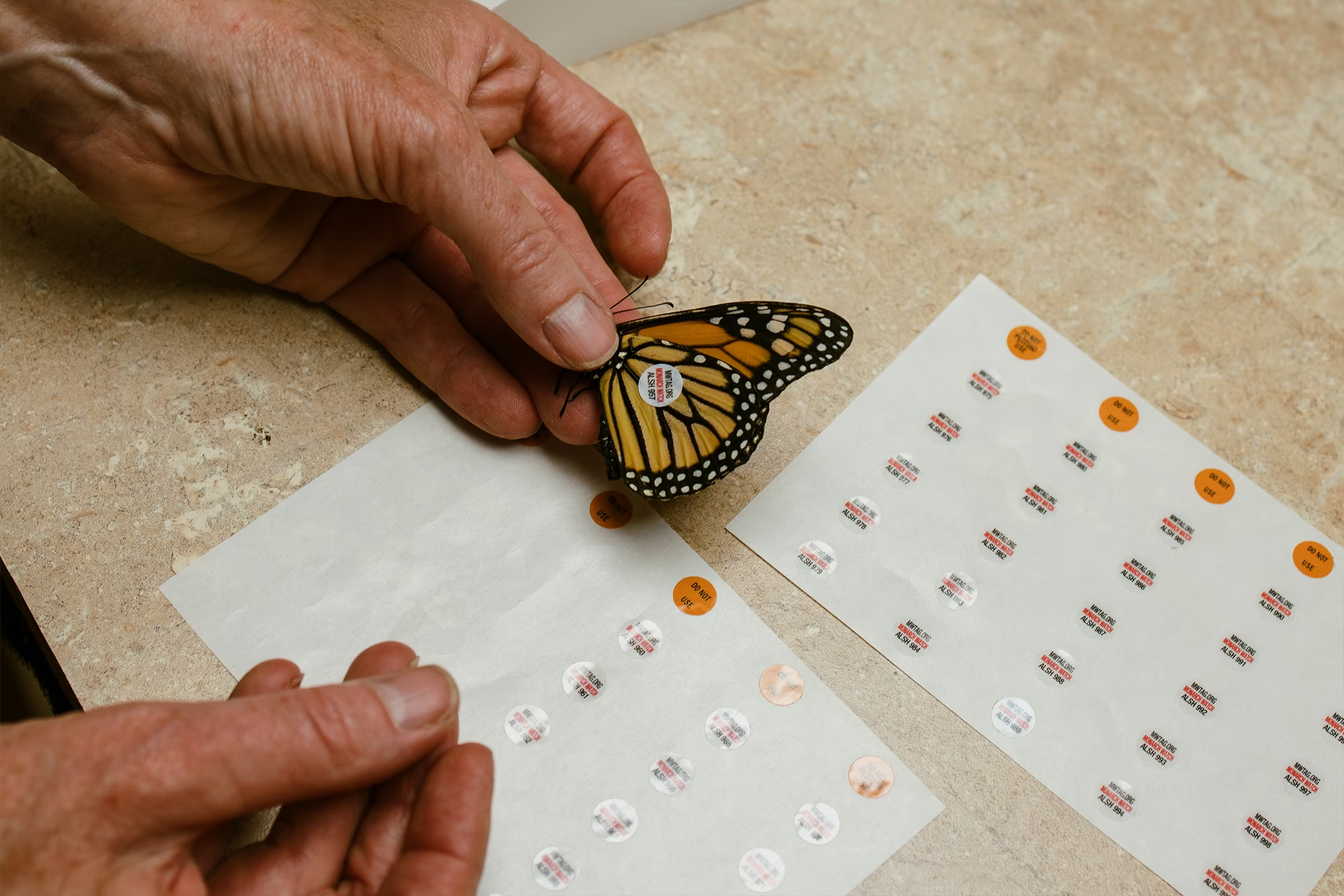
The same week that Cinderella and her fellow survivors began fanning out into the United States, I visited Monarch Watch, an organization based at the University of Kansas that has long served as a hub of monarch research and conservation. I met Kristen Baum, its current director, and Chip Taylor, its founder and director emeritus. Baum runs a blog for Monarch Watch that tracks the radio-tagged butterflies’ movements. These data points could help conservationists model the migration more accurately, anticipate changes in population size, and better decide how and where to allocate resources to restore habitats. The day before my visit, Baum noted that CHI016, Cinderella’s government name, was likely the farthest north among all the tags.
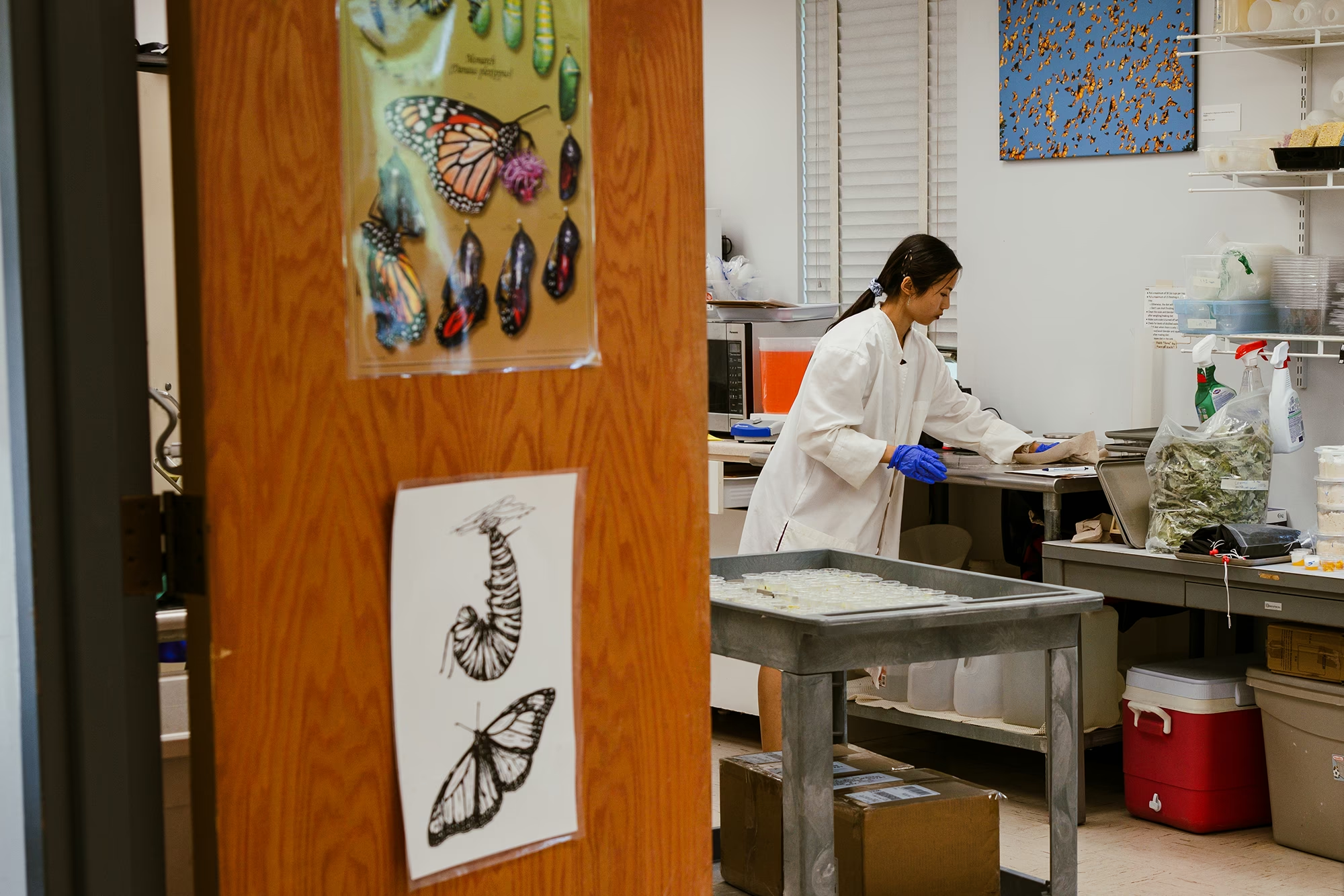
The tiny building that Monarch Watch occupies is jam-packed with records, research, and the butterflies themselves. In one room, I watched as a female split open her green chrysalis and emerged to spread her wings. Across the hall were refrigerators full of milkweed seeds—the group has donated more than 1 million milkweed plants for restoration projects since 2015.
Taylor himself developed an artificial diet that could be used to raise caterpillars in lieu of live milkweed. In 2009, Monarch Watch sent caterpillars provisioned with this food (which looks something like old guacamole) on the Space Shuttle Atlantis to the International Space Station, where they successfully metamorphosed into butterflies.
The word emeritus doesn’t capture the full role that Taylor, 88, still plays; he is a constant presence around the building. Before he secured more generous funding, he’d bankrolled many of Monarch Watch’s activities himself, using the proceeds from investments that he and his wife had made in Apple. He helped pay 100-peso rewards for finding paper butterfly tags—still the standard, low-tech method of tracking the creatures—in Mexico, which became a problem one year when people recovered more than 3,000 tagged butterflies. “That cost me $12,000,” he told me. “I wasn’t too anxious to do that over and over again.”
It was hard, there in the middle of all of the butterfly posters and joyful pictures, to ask him the question I’d really come to ask. But Taylor eventually sighed and launched into an answer on his own. “What we’re doing ecologically to save the monarch butterfly, the scale of it is just nothing compared to what’s going on,” he said. “The population is going to creep lower and lower in time because we’re incapable, I think, at this point, of really mastering enough of the restoration.”
In the United States and Canada, the math leads to a similar place as it does in Mexico. For all the bootstrapped recent successes in forestalling the butterfly’s decline, we’ve merely been playing catch-up. Now climate change is the primary threat to monarch numbers, and it is implacable. Higher temperatures make monarchs more susceptible to infection by a protozoan called Ophryocystis elektroscirrha, a parasite that drains the butterfly’s strength and makes it less likely to complete its journeys. And climate shifts are yet another threat to milkweed’s viability in particular locales, throwing off the distances and timing that are so crucial to each butterfly’s travels.
“Maybe we can do something about the climate, but the opportunities for doing that are really, really diminishing very rapidly,” Taylor said. Even accounting for this year’s surprising bounce-back in numbers, he puts the timeline at 20 years or so before the migrating monarch’s numbers become too low to recover. The U.S. Fish and Wildlife Service estimates upwards of a 50 percent chance that the eastern migratory monarchs will be extinct by 2080.
When I was growing up, the flowers outside my bedroom window always brought visitors. I’d often wake up in the morning to the buzzing of a hummingbird’s wings. But the visitors I greeted most joyfully were the monarchs. On late-summer days, kaleidoscopes of butterflies would land together, covering the flowers like an orange blanket. Even then, I understood that there was something special about their fleeting delicateness. And fleeting it was: The world will probably never again see as many monarchs as existed then.
But I would not bet entirely against the monarch. The fight to protect the species continues. In its persistence and its cooperative nature, that fight shares qualities with the monarch itself. The project is proof, in a fractured time, that people can join together and decide to help defend the things they see as valuable.
Even as Taylor despaired of the monarch’s future, he mused, briefly, about the possibility of restocking wild-butterfly populations using a scaled-up version of Monarch Watch’s colony program. With that, his exertions in perfecting his homegrown colony process—the green smoothie for caterpillars, testing procedures for parasites—came into clearer view for me. They could be understood, I realized, as the beginnings of an attempt to bottle a fragment of the monarch’s magic for the future world. Maybe migration will continue, in that future, with an assist from something like a butterfly doomsday vault. Or maybe the next generation of the monarch’s friends will find further innovations to defeat problems that now seem insurmountable.
The things we have learned recently about individual butterflies will be helpful for vanquishing those scientific problems, but the most important contribution of all this new information might be wonder itself. I am not a scientist, but after watching and tracking the butterflies for months, it seems to me that monarchs have something of a personality, a level of individuality that might endear them even more to the public. Some appear impulsive, or impressively rangy, leaving earlier and traveling more, whereas others fail to leave altogether. In El Rosario, when I asked Silvestre, my guide, about why groups of butterflies chose specific times to find water, he was enigmatic: “They decide.”
And whether or not we call it personality, there’s science behind the idea of the butterflies’ individuality. In humans, traits such as neuroticism and recklessness appear to have some evolutionary basis—emerging perhaps to provide our species with sentries who alerted us to threats, and with explorers who led the way to new food sources. Research suggests that the goofball butterflies that might seem to lack a sense of direction are actually pioneers, scouts finding new habitats to exploit or new places to hunker down should worse come to worst.
No matter what happens along the Mexico route, the monarch is likely to live on, albeit in smaller numbers, elsewhere. Across the planet, most populations of monarch butterflies—in Spain, in Hawaii—are likely descended from vagrants that veered off the Mexico migration path. Monarchs introduced to Australia in the 1870s have now established an annual migration along the east and southwest coasts—they have earned the fitting local epithet of “wanderers.” And in little pockets of the United States, Central America, and the Caribbean, in places where milkweed grows year-round, small monarch populations have settled in, no longer migrating and now sporting shorter wingspans than their more transient cousins.
For all their seeming fragility, monarchs will be an extraordinarily capable partner in efforts to save them. They may yet surprise us. We may yet surprise ourselves.
Cinderella is a marathoner. She flies through San Antonio and then skirts Austin, avoiding the congestion of the city proper during the South by Southwest festival, and then cuts through the Piney Woods toward Texarkana. At the time of her last detection, Cinderella is in Arkansas, having likely traveled from the Great Lakes to the Mexican highlands, and then halfway back. The diaspora she belongs to has spread out across a wide expanse of the country, ending up in Florida, Georgia, Mississippi, Louisiana, Oklahoma, and every place in between. They’ve spent themselves, but they have fulfilled their biological missions.
During her roughly eight-month life, Cinderella traveled farther than scientists might have imagined possible, more than 3,000 miles as the butterfly flies. Along the way, she likely glued hundreds of tiny eggs onto milkweed plants. Perhaps some of the hatchlings will live, and continue her line. Perhaps they, too, will have her preternatural strength and tenacity. I hope, for the sake of my own daughter, and her ability to live in a world of beauty, that they will.
This article appears in the September 2026 print edition with the headline “How Do Monarchs Do It?”


9 Things Experts Wish You’d Do in Midlife to Increase Longevity

Court Orders NICON Insurance to Refund Unlawful Salary Deductions and Remit Pension Contributions

Don’t marry an ugly person, pastor says as he shows off his ‘beautiful’ wife

Sports and Summer Season Drive Streaming to Record 48.6% of TV Viewership in May

Retired AIG, Senior Police Officer Die Days Apart

Appeal court nullifies order seeking ADC deregistration

âNothing we can doâ- INEC rules out extension of voter registration

 Investigation3 days ago
No restriction on movement during sanitation exercise â Lagos commissioner
- Investigation3 days ago
IG did not issue âshoot-on-sightâ order in Benue- Police
- Breaking2 days ago
âIf my son ever gets a girl pregnant, he’s leaving my house immediatelyâ â Cardi B shares parenting stance
- Society3 days ago
Transfer: Chelsea announce deal for Merrick
- Breaking2 days ago
âI used to think love was about finding the right person, but at 30, I don’t believe that anymoreâ â BBN star, Sheggz.
- Investigation2 days ago
âThe Olodo uprising term was not coined by meâ â Nigerian musician Ycee
- News3 days ago
Davido sets London premiere date for ‘Oriade’ album
- Investigation3 days ago
Arsenal want to sign Real Madrid superstar Vinicius Jr with move approved âat all levelsâ