News
JUST IN: Court orders final forfeiture of 48 properties linked to Malami

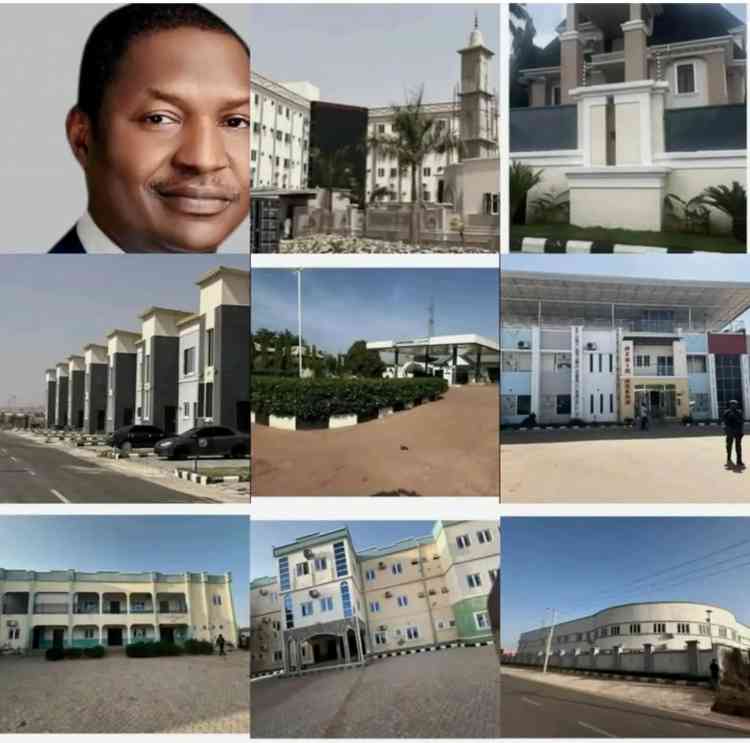
A federal high court sitting in Abuja on Wednesday ordered the final forfeiture of about 48 properties linked to former attorney general of the federation and minister of justice, Abubakar Malami.
Justice Joyce Abdulmalik granted the application filed by the Economic and Financial Crimes Commission (EFCC), ruling that Malami and other claimants failed to demonstrate that the assets were lawfully acquired.
Before delivering the judgment, the court dismissed multiple applications, motions, and objections filed by Malami, his family members, and companies associated with the properties, describing them as lacking merit.
The judge held that the central issue before the court was not ownership but the legality of the funds used to acquire the properties.
She stated that the question before the court was not “who owns the property, but how legitimate are the funds used to acquire the properties.”
According to the court, the respondents had “not dislodged the reasonable suspicion that the property was acquired by unlawful activities.”
Justice Abdulmalik relied primarily on Section 17 of the Advance Fee Fraud and Other Fraud Related Offences Act in granting the final forfeiture order.
However, the court vacated the interim forfeiture order on some of the properties, noting that the EFCC had initially sought forfeiture of 57 properties linked to Malami.
The court clarified that the forfeiture order does not amount to a criminal conviction, although Malami, his wife, and his son are currently facing charges related to alleged illicit acquisition of funds.
The EFCC had initiated civil forfeiture proceedings in January, seeking the permanent forfeiture of 57 properties valued at ₦212.8 billion, which it alleged were proceeds of unlawful activities linked to Malami.
On January 16, during the court’s annual vacation, Justice Emeka Nwite granted an interim forfeiture order and directed the EFCC to publish it in a national newspaper, inviting interested parties to show cause why the assets should not be permanently forfeited to the Federal Government.
The properties are located across Abuja, Kano, Kebbi, and Kaduna states.
Following the publication, Malami, his wife Nana Hadiza Malami, his son Abdulaziz Abubakar Malami, and several companies filed objections, arguing that the assets were lawfully acquired and that the EFCC failed to establish any link to unlawful activities.
They also contended that the commission relied on speculation rather than credible evidence and did not identify any specific criminal offence connected to the properties.
After the court resumed from its annual vacation, the case was reassigned to Justice Abdulmalik.
During proceedings, the EFCC maintained that its investigations showed the properties were acquired with proceeds of unlawful activities and held through proxies acting on behalf of Malami.
The commission argued that under the law, it only needed to establish “reasonable suspicion” rather than prove the case “beyond reasonable doubt.”
Both parties adopted their final written addresses in late May, after which the court reserved judgment.
Although judgment was initially scheduled for July 6, it was postponed twice before being delivered on Wednesday.
Malami, his wife, and his son are currently facing trial over alleged ₦8.7 billion money laundering charges.






Toddler, 2, shot de@d by 4-year-old cousin while on vacation to celebrate 3rd birthday

Surebusinesslist Unveil its Nigeria Business Directory

2027: We need to forgive ourselves, Kwankwaso urges north, south-east political alliance + Video

2027: Tinubu has no opposition – Umahi

2027: Tinubu has no opposition – Umahi

Court Grants Ex CCT Chairman Danladi Umar N100m Bail

2027: APC unveils mobilisation drive in UK, urges support for Tinubu

 Investigation2 days ago
Each and every one of you is guilty РDanish aid worker Anja Ringgren Lov̩n slams Nigerians filming malnourished child accused of being a witch in viral video
- National2 days ago
Gbajabiamila: I borrowed N400 million to buy appointment in Tinubu’s government, says Adeyemi
- Investigation1 day ago
Veterans demand â¦250,000 Minimum Wage for soldiers
- Investigation3 days ago
Parents to pay â¦50,000 to register each child for WAEC or NECO SSCE as govt approves 82% increase
- Investigation3 days ago
âI disagree with youâ – Isaac Fayose knocks Remi Tinubu over calls for singers Davido, Burna Boy, Asake to help poor Nigerians
- Investigation2 days ago
Twelve people arrested after âextreme right-wing terror threatâ against Islamic event in UK
- Investigation1 day ago
Court remands man for impregnating own daughter in Adamawa
- Investigation2 days ago
Female teacher admits to having s£x with boy, 16, as she splits from husband who first exposed her misconduct.