World
Schools are adding pepper-spraying drones to help combat active shooters

This Video Is Trending Right Now
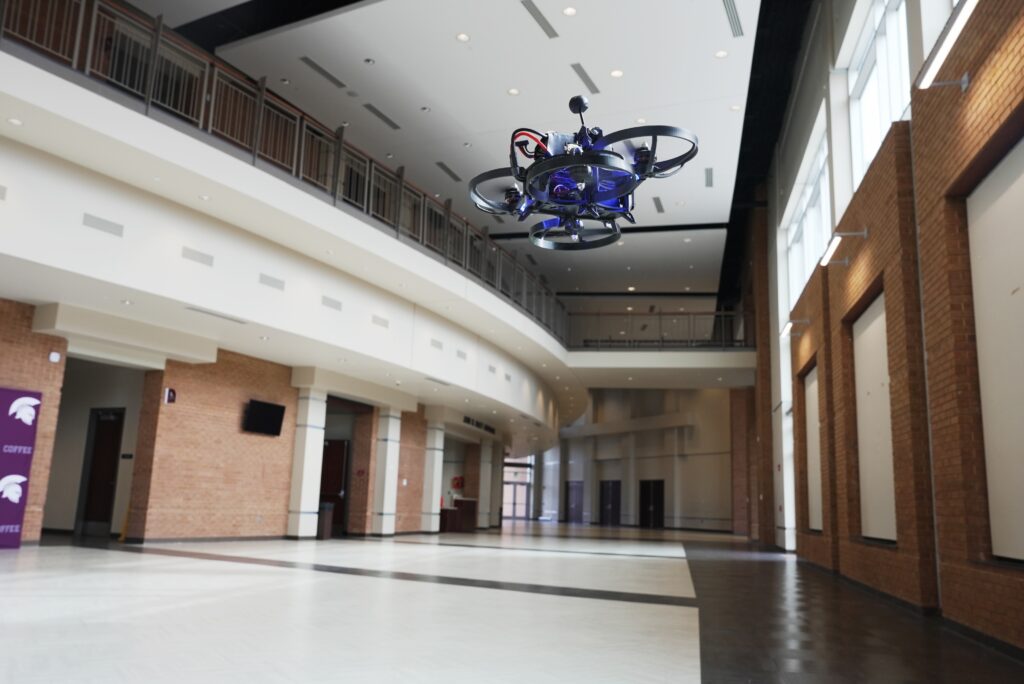
Schools in at least three states will be equipped with drones this year that can zoom through halls, smash windows and pepper-spray active shooters if teachers report a threat.
At least nine schools — three in Florida, five in Georgia and one in Colorado — will have storage boxes that house the plastic, nonlethal aircraft made by Austin-based Mithril Defense. The drones, which can be activated by teachers, are capable of reaching a shooter within 15 seconds.
The aircraft are designed to distract their targets by flashing strobes, blaring sirens, spraying them with pepper gel, or ramming into them at 60 mph.
“Once I get the drones on you, you just can’t escape them,” said Bill King, a retired Navy SEAL and Mithril Defense co-founder.
The programs continue a wave of spending on high-tech security on campuses — a multibillion dollar industry fueled by threat of school shootings. Nearly 400,000 students have experienced gun violence at school since the 1999 attack at Columbine High School in Colorado, according to a Washington Post tracker, which has recorded 435 shootings over that period.
Deltona High School, a public school just north of Orlando, with about 1,700 students, became the first campus to install the system at the end of last school year. Two more Florida schools — Boyd H. Anderson High School near Fort Lauderdale and Godby High School in Tallahassee — were also tapped by the state to complete the $557,000 pilot spearheaded by state legislators.
Five schools in Georgia will also test the drone systems after state legislators there approved a roughly $500,000 pilot program with Mithril Defense. The state has not finalized the schools that will participate, but Mithril said the systems will come online during upcoming school year.
Georgia state Rep. Matt Dubnik (R), chairman of the House appropriations education subcommittee, said the technology could protect schools that don’t have resource officers on campus. The pilot will be tested in schools with and without the officers, he said.
“I’m a believer in the technology,” Dubnik said, adding that hundreds of other state legislators agreed when they voted to pass the budget, which included the funding for the program.
And in Colorado, John Adams Academy — a public charter school in Sterling Ranch for students in kindergarten through grade 12 — will self-fund a drone program for its inaugural year.
Teachers will have an app or classroom panic buttons to summon the drones. Mithril Defense’s professional drone pilots can then fly them remotely.
The drones have been tested in simulations but never by a shooting.
Justin Marston, Mithril’s founder and CEO, said the massacre at an elementary school in Uvalde, Texas, where 19 students and two teachers were killed in 2022 as law enforcement waited over an hour to enter the classroom, inspired the project.
When he learned of the Russian and Ukrainian military forces using cheap drones to attack each other, Marston said he figured a nonlethal version might’ve saved lives in Uvalde.
“The first 120 seconds are incredibly critical, because that’s when most of the shooting happens,” Marston said.
While the drones could be activated any time, they’re meant specifically for potentially lethal situations. The drones wouldn’t break up a schoolyard fight, Marston said. But if one of the students pulled a knife, they could.
Schools across the country have embraced a range of defense technologies from artificial intelligence-powered cameras to weapons detectors amid the threat of campus shootings. But some say military-grade equipment, like Mithril’s drones, don’t belong on campuses packed with children.
School security consultants have, for years, cast doubt on high-tech solutions to school shootings, arguing that low-tech measures, like simply locking external doors, are just as effective.
Curtis Lavarello, who leads the School Safety Advocacy Council, a security consultancy firm, said he worried that Mithril’s drones might accidentally target a fleeing student instead of a shooter. Or that remote pilots, in a split-second decision, might mistake a law enforcement officer for a shooter, especially if teachers initiate a false alarm.
“It’s almost like where gaming and school safety collide,” Lavarello said. “I have some really serious reservations about the deployment of drones in schools.”
Mithril isn’t the first company to attempt to place anti-shooter drones in school. In 2022, Axon Enterprise halted development of taser-equipped drones, after a mass resignation of its ethics board, which worried that the devices would stun innocent students or be abused by hackers.
Jaclyn Corin, who survived the 2018 Marjory Stoneman Douglas High School shooting in Parkland, Florida, that killed 17, said she’d prefer to see officials prioritize policies that help prevent gun violence instead of responding to it.
“School districts have finite budgets and limited attention,” said Corin, executive director and co-founder of March for Our Lives, a youth-led organization advocating for strict gun control. “If we spend significant resources on technologies designed to respond after shooting begins, we have to ask what we’re not investing in instead.”
Nicole Lawrence said she found out from a local TV news story that her child’s Atlanta-area high school was solicited by Georgia to host Mithril’s drones this year (district officials said they do not yet have specific plans for installing the devices). Lawrence said she’s unsure whether the drones will be effective but is willing to give them a chance.
“I’ve put $100,000 toward worse things,” Lawrence said.
Florida plans to review the number of violent incidents at the schools and measure response times to threats. The state will also survey parents, students and staff whether they feel safer under the pepper-spraying, window-smashing devices.
As the drones sat in Deltona High School this summer awaiting their first action, the state approved another $564,000 for the following school year.


2023 campaign funds in your possession not fully accounted for, Onanuga slams Obi

APC hails Yilwatda’s first year as chairman, eyes 2027 electoral victory

Gunmen kidnap 10-year-old boy after invading home in Yobe

Adeyanju Urges Tinubu to Declare Emergency Over Nigeria Housing Crisis

The path forward for the clean energy transition

Cholera Outbreak Claims 14 Lives as Plateau Records 441 Suspected Cases

Lagos Task Force Arrests 33 Suspected Criminals in Major Raid

 Investigation3 days ago
Iâm running for a fourth term as President of the United Statesâ – President Trump
- Breaking2 days ago
âIf my son ever gets a girl pregnant, he’s leaving my house immediatelyâ â Cardi B shares parenting stance
- Investigation3 days ago
No restriction on movement during sanitation exercise â Lagos commissioner
- Investigation3 days ago
IG did not issue âshoot-on-sightâ order in Benue- Police
- Investigation2 days ago
âThe Olodo uprising term was not coined by meâ â Nigerian musician Ycee
- News3 days ago
Davido sets London premiere date for ‘Oriade’ album
- Investigation3 days ago
Arsenal want to sign Real Madrid superstar Vinicius Jr with move approved âat all levelsâ
- Society3 days ago
Transfer: Chelsea announce deal for Merrick