World
Scientists studied 30 Sierra Nevada ponds that can swing 20°C in a day. Shrinking snowpack may make them smaller, warmer and more nutrient-rich

This Video Is Trending Right Now
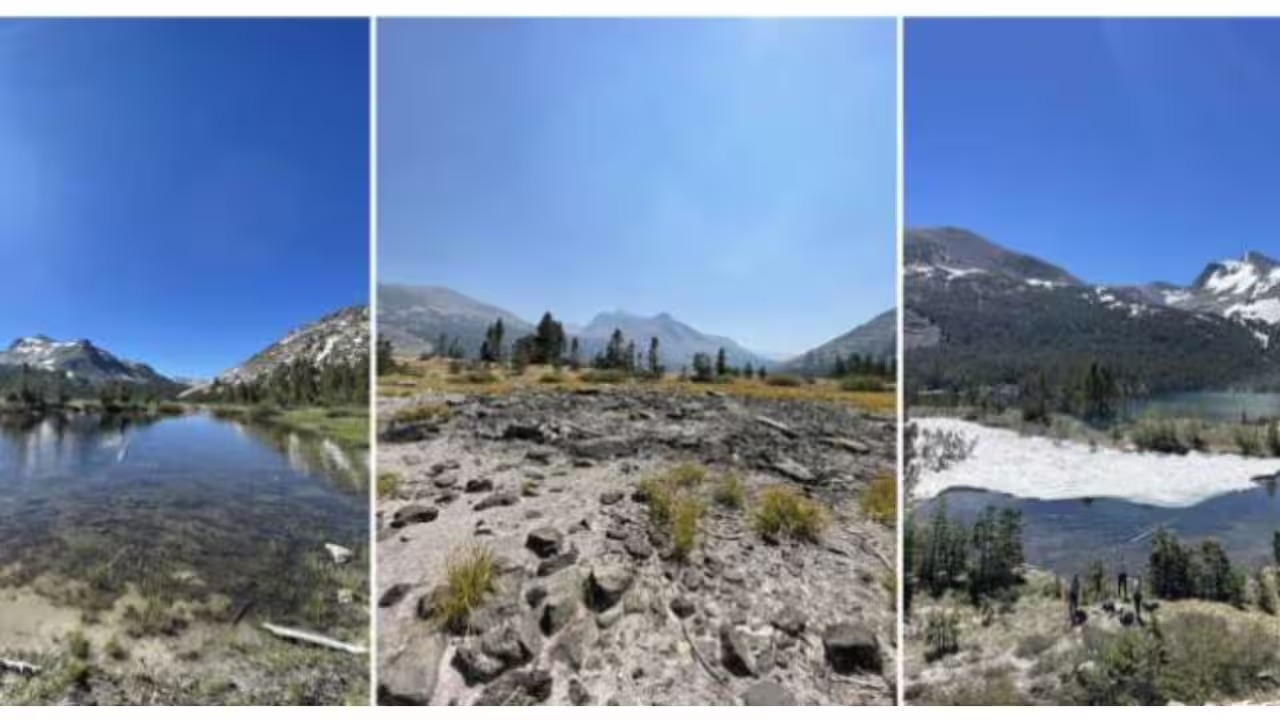
High in California’s Sierra Nevada mountains, small ponds may look peaceful and unchanged. Surrounded by rocky peaks and open skies, they appear calm during summer. But beneath the surface, these shallow water bodies are constantly changing.A new study has found that these mountain ponds are among the most thermally variable freshwater ecosystems on Earth. Their water temperature can change by more than 36 degreen F or 20 degrees C within a single day. Researchers say one major factor behind these dramatic changes is not summer weather, but the amount of snow that fell months earlier during winter.The study, published in the journal Ecosphere, reported by Science X, found that winter snowpack plays a key role in deciding how these ponds behave during summer. It affects their size, water temperature, nutrient levels and even the tiny animals living in them. The findings also suggest that as climate change reduces snowfall, these ponds could become warmer, smaller and richer in nutrients.
30 ponds, four summers
The research began when two graduate students working on high-elevation ponds realised their studies were connected. Christine Bonadonna, then a PhD student at the University of California, Irvine, and Mary Jade Farruggia, then a PhD student at the University of California, Davis, joined forces to better understand these often-overlooked ecosystems.Together, they studied 30 mountain ponds across the Sierra Nevada over four summers. Their research covered both drought years and one of the highest snowfall years ever recorded.The ponds were located at elevations ranging from about 2,300 metres to more than 3,400 metres. This allowed the researchers to compare how different snow conditions influenced ponds across the mountain range.
Snowfall shapes ponds
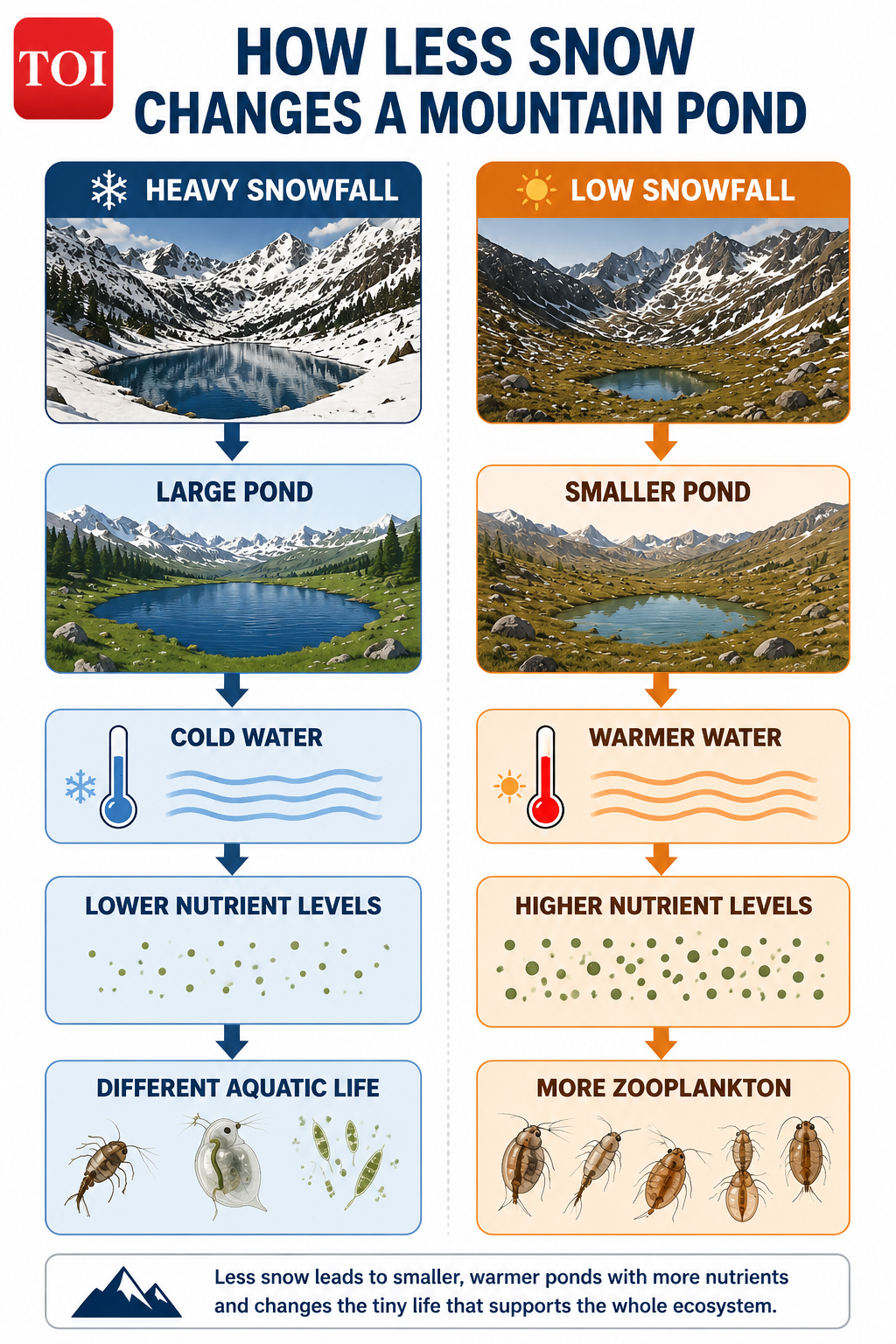
The researchers found that winter snowfall acts as a ‘master driver’ of pond conditions during summer.In years with heavy snowfall, melting snow kept ponds larger, colder and more diluted. As a result, nutrient concentrations remained lower.But, during years with less snowfall the ponds became smaller and warmer. Nutrients became more concentrated because there was less water available.These changes also affected the animals living in the ponds. Warmer, low-snow years supported larger numbers of zooplankton. These microscopic animals are an important food source for many larger aquatic species.
.
Surprising daily cycle
The study also revealed another unusual feature of these mountain ponds. Researchers found that the pond water mixes almost every night during summer.As temperatures drop after sunset in the high mountains, the surface water cools and sinks. This makes the entire pond circulate which leads to the mixing of water from top to bottom.This daily mixing contributes to the large temperature swings seen in the ponds. It is different from many ponds at lower elevations, where warmer water usually stays near the surface while colder water remains below in separate layers.The scientists say this constant mixing is one reason why these small ponds experience such extreme changes over a single day.
Climate change impact
The findings come as scientists expect major reductions in snowpack across the Sierra Nevada because of climate change.According to climate projections mentioned in the study, the region could lose up to 70% of its snowpack by the end of this century.If that happens, many mountain ponds that continue to exist are likely to become warmer, experience greater temperature fluctuations and contain higher levels of nutrients.Such changes could reshape the communities of plants and animals that depend on these freshwater habitats.
Small ponds, bigger role
Although these ponds are small and often receive little scientific attention, researchers say they are important parts of mountain ecosystems.Farruggia, now a postdoctoral scholar at the University of Colorado Boulder’s Institute of Arctic and Alpine Research, said the study highlights their ecological importance.“This work highlights that even though these ecosystems are tiny and are not often formally studied, they are important components of our mountain ecosystems,” Farruggia said, Science X quoted.“Ponds are ubiquitous across the landscape and are processing nutrients, cycling carbon and contributing to biodiversity at levels that cannot be ignored.”She added that more research is needed to understand how these ponds will respond as climate conditions continue to change.


UDUAGHAN AND HIS N47 BILLION CAR PARK CALLED ASABA AIRPORT: MY FIRST HAND EXPERIENCE AND PROTEST CALL TO GET HIM JAILED
IYC National Secretary-Elect Igbeta Resigns Bayelsa Appointment, Declares Unwavering Loyalty to Gov. Diri

Franceâs parliament adopts assisted dying law

Orire abduction: IGP Disu mourns slain Police officer, commends rescue team

'Don't use China as an issue': Beijing hits back after Trump alleges election 'meddling'

PCN Shuts 505 Illegal Drug Outlets in Cross River Crackdown

RMD named Male Feminist ambassador, seeks end gender-based violence

 Society2 days ago
35-Year-Old Man Breaks Down In Tears Like A Baby At Roadside After Wife Reportedly Goes Missing At Kasoa Market
- News2 days ago
Retiree’s Pension Jumps From N18,000 To N206,000 After Government Reform
- Investigation2 days ago
Suspected ISWAP logistics supplier arrested with food items bound for terrorists in Borno
- National2 days ago
JUST IN: Senate to give N10million each to families of security operatives, teachers killed in Oriire rescue
- Investigation2 days ago
R Kelly officially asks President Trump to end his 30-year prison sentence for s 3x crimes
- National1 day ago
2026 Ballon d’Or: Top 4 players to win award ahead of World Cup final
- Investigation2 days ago
âThereâs nothing more absurd than the âEmi Lokanâ sloganâ â Falz knocks slogan of current administration
- Investigation3 days ago
âHow do you tell a 13-year-old girl you like her?â â Lady confronts man over alleged advances towards her younger sister